Show me tell me questions: the complete 2026 guide
Show me tell me questions: the complete 2026 guide
The show me tell me questions are two official vehicle safety questions asked during every UK practical driving test. One comes before you drive, one arrives while you are already moving. Get them right and you sail past. Get them wrong and you pick up a minor fault each. Here is exactly what to expect:
- Two questions total per test: one 'tell me' (verbal, before driving) and one 'show me' (demonstrated while driving)
- The full DVSA pool: 14 'tell me' questions and 7 'show me' questions, making 21 in total
- Random selection: the examiner picks one of each type on the day
- Fault consequences: each incorrect answer counts as one minor fault; an unsafe 'show me' demonstration can escalate to a serious fault and cause immediate failure
- Passing criteria: you can still pass with up to 15 minor faults overall, so one or two wrong answers here will not end your test on their own
What are the 'tell me' questions and how do you answer them?
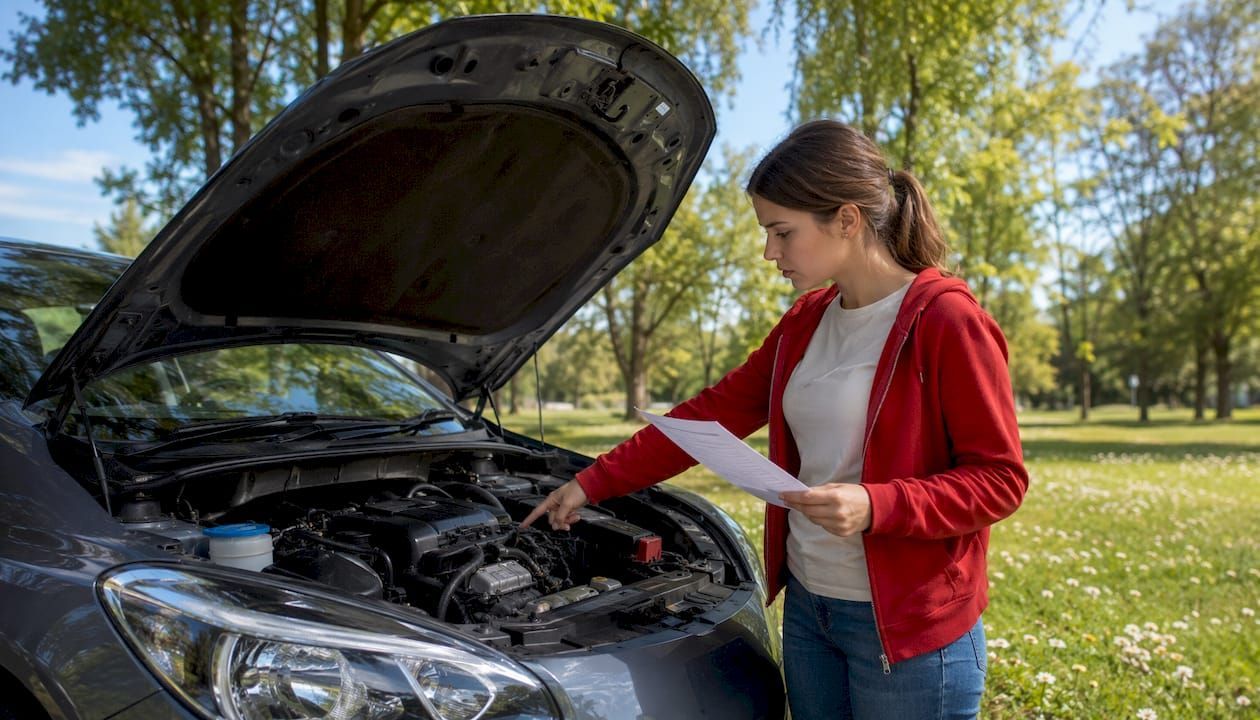
'Tell me' questions are asked while you are stationary, before the engine starts. The examiner wants a verbal explanation, not a physical demonstration, though three questions do require you to open the bonnet. There are 14 official questions in the DVSA pool, and the examiner selects one at random.
The key to a strong answer is structure: say what you would look at, describe what a safe reading looks like, and explain what you would do if something were wrong. Vague answers such as "I would check the brakes" without explaining how are a common reason for picking up a minor fault.
Here are all 14 official 'tell me' questions with guidance on what a good answer covers:
- T1. How would you check the brakes are working before starting a journey?
- Brakes should not feel spongy or slack. As you set off, the car should not pull to one side.
- T2. Where would you find the recommended tyre pressures, and how would you check them?
- Check the manufacturer's guide or inside the fuel cap or door sill. Use a reliable pressure gauge when the tyres are cold, and refit the valve caps afterwards.
- T3. How do you make sure your head restraint is correctly adjusted?
- The rigid part of the restraint should sit at least as high as the top of your ears or eye level, and as close to the back of your head as is comfortable.
- T4. How would you check the tyres have sufficient tread depth and safe general condition?
- Look for no cuts or bulges. Tread depth must be at least 1.6mm across the central three-quarters of the tyre and around the entire outer circumference.
- T5. How would you check the headlights and tail lights are working? (No need to exit the vehicle.)
- Operate the switch with the ignition on, then walk around the vehicle to check all lights are lit.
- T6. How would you know if there was a problem with your anti-lock braking system (ABS)?
- The ABS warning light on the dashboard will illuminate if there is a fault.
- T7. How would you check the direction indicators are working? (No need to exit the vehicle.)
- Operate the indicator switch with the ignition on, then walk around the vehicle to confirm all indicators are flashing.
- T8. How would you check the brake lights are working?
- Press the brake pedal and use reflections in windows or doors, or ask someone to stand behind the car and confirm the lights are on.
- T9. How would you check the power-assisted steering is working before starting a journey?
- Apply gentle pressure to the steering wheel as you start the engine. You should feel a slight but noticeable movement as the system activates. Alternatively, turning the wheel just after moving off will confirm the assistance is working.
- T10. How would you switch on the rear fog lights and when would you use them? (No need to exit the vehicle.)
- Operate the fog light switch with dipped headlights and ignition on, then check the warning light is active. Use rear fog lights when visibility drops below 100 metres.
- T11. How do you switch from dipped to main beam, and how would you know main beam is on?
- Operate the lighting stalk, then confirm by checking the blue main beam warning light on the dashboard.
- T12. Open the bonnet and tell me how you would check the engine has sufficient oil.
- Locate the dipstick, remove it, wipe it clean, reinsert it fully, then withdraw it again and check the oil level sits between the minimum and maximum markers.
- T13. Open the bonnet and tell me how you would check the engine has sufficient coolant.
- Identify the header tank and check the coolant level sits between the high and low markings. Top up with the correct coolant mix if needed.
- T14. Open the bonnet and tell me how you would check the hydraulic brake fluid level.
- Locate the brake fluid reservoir and check the level against the high and low markings on the side of the reservoir.
One thing many learners overlook: for questions T12, T13, and T14, the examiner will specifically instruct you to open the bonnet. Knowing exactly where your bonnet release is before test day avoids an awkward pause that can rattle your confidence for the rest of the test.
What are the 'show me' questions and how do you demonstrate them safely?
'Show me' questions are asked while you are driving, at a moment the examiner judges to be safe. You physically operate the relevant control rather than describing it. There are 7 official 'show me' questions in the DVSA pool, and one is selected at random.
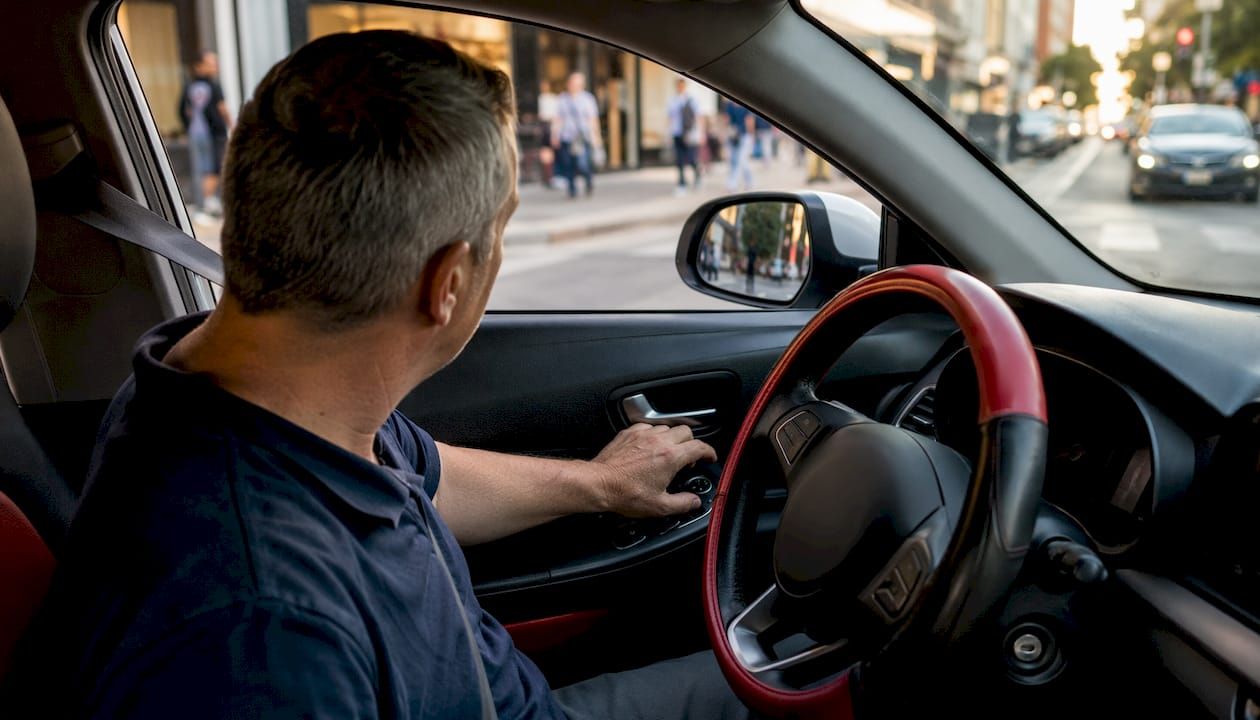
The golden rule is control first, demonstration second. A brief, confident glance to find the switch is fine. Staring down at the dashboard for several seconds, or reaching across with both hands off the wheel, is what turns a minor fault into a serious one. If the moment is not safe, say so.
Here are all 7 official 'show me' questions with guidance on what the examiner expects:
- S1. Show me how you would wash and clean the rear windscreen.
- Locate the rear wash/wipe control, usually on the wiper stalk or a dedicated button, and activate it to spray fluid and run the rear wiper. Keep both hands near the wheel throughout.
- S2. Show me how you would wash and clean the front windscreen.
- Pull or push the wiper stalk to activate the front washers and wipers. A brief, single action is all that is needed.
- S3. Show me how you would switch on your dipped headlights.
- Rotate or push the lighting stalk to the dipped headlight position and confirm the dashboard indicator shows they are on.
- S4. Show me how you would set the rear demister.
- Press the rear demister button, usually marked with a symbol of a rear screen with horizontal lines and arrows. Check the warning light confirms it is active.
- S5. Show me how you would operate the horn.
- Press the centre of the steering wheel briefly. Maintain your grip and steering control throughout.
- S6. Show me how you would demist the front windscreen.
- Direct the heater controls to blow warm air at the windscreen using the windscreen symbol on the air direction dial. Increase the fan speed and switch on the air conditioning if available, as this removes moisture faster.
- S7. Show me how you would open and close the side window.
- Locate the electric window switch on the door panel and operate it to open the window, then close it again. Do this smoothly without looking away from the road for more than a brief moment.
Pro Tip: If the examiner asks a 'show me' question at a moment when demonstrating would be unsafe, say "I'll do that when it is safe to do so" and wait for a suitable opportunity such as a red light or a quiet stretch of road. The examiner will not penalise you for prioritising safety over immediate compliance.
What happens if you get a question wrong?
Getting one wrong is not the disaster many learners fear. Each incorrect answer, whether 'tell me' or 'show me', counts as one minor fault. Get both wrong and you have collected two minors before the drive has properly begun, eating into your overall allowance of 15 minor faults. Neither wrong answer ends the test on its own.
The exception is an unsafe 'show me' demonstration. If your attempt to operate a control causes a genuinely dangerous moment, such as swerving, losing steering control, or taking your eyes off the road for an extended period, the examiner can upgrade the fault from minor to serious. A serious fault means an immediate fail, regardless of how well the rest of the test goes.
Stress is the hidden risk here. Many learners who answer incorrectly then carry that anxiety into the drive itself, which affects their concentration at junctions or roundabouts. The practical advice is straightforward: if you get a question wrong, acknowledge it mentally and move on. The test continues as normal, and a composed drive after a shaky start can still produce a pass. Failing a 'show me, tell me' question alone does not cause test failure; errors count as minor faults only.
How to prepare for the 'show me, tell me' questions effectively
The full DVSA list of 21 questions is published and freely available, which means complete preparation is genuinely achievable. There are no hidden questions and no surprises on the format. A focused revision approach covers everything you need.
- Revise all 21 questions systematically. Work through the full DVSA question bank rather than guessing which ones are likely. The examiner draws from the entire pool.
- Practise 'tell me' answers aloud. Reading answers silently is not the same as saying them clearly under mild pressure. Verbalising builds fluency so the words come naturally on test day.
- Practise 'show me' actions in the actual test vehicle. Locating a switch in your instructor's car is different from finding it in an unfamiliar one. Muscle memory built in the right car transfers directly to the test.
- Use the structure: identify, check, safe standard. For 'tell me' questions about checks, this three-part pattern covers almost every answer: what you would look at, what a safe reading looks like, and what you would do if something were wrong.
- Wait for a safe moment during 'show me'. Do not rush the demonstration. Traffic lights, a quiet road, or a brief pause all give you the opportunity to act without compromising control.
- Do not stop the car to perform a 'show me' task. Pulling over unnecessarily is a common mistake that can itself attract a fault.
- Say something rather than nothing. A partial answer to a 'tell me' question earns more credit than silence. If you are uncertain, describe what you know and the examiner can see you understand the principle.
Pro Tip: Locate the bonnet release in your test vehicle well before test day and practise opening the bonnet smoothly. Fumbling with the release under pressure is one of the most common avoidable delays during the bonnet-related tell me questions, and it can unsettle your composure at the very start of the test.
Learners who practise both question types in the exact vehicle they will use for their test tend to reach automatic responses, which frees up mental energy for the drive itself. A focused revision session of one to two hours, repeated weekly in the run-up to your test, is enough to make the answers feel second nature.
Do the 'show me, tell me' questions ever change?
The DVSA publishes the official question list on GOV.UK and updates it occasionally, though changes are infrequent and always announced in advance. The current pool of 14 'tell me' and 7 'show me' questions has remained stable, and any revision is published publicly before it takes effect. There are no hidden or unpublished questions; examiners draw only from the official bank.
The practical implication is that the list you revise from today is almost certainly the list you will face on test day. Checking the official GOV.UK page in the week before your test takes two minutes and confirms nothing has changed. Your driving instructor should also flag any updates as part of your test preparation.
One structural change worth knowing: before 2017, the test included two 'tell me' questions asked before driving. The DVSA split the format so that one question is now asked stationary and one is demonstrated on the move. The intention was to test whether learners can multitask safely, operating a control while maintaining full control of the vehicle is a different skill from explaining a check verbally. That format has been in place ever since and remains the standard for 2026.
Ready to master your test with Costello's Driving School?
Knowing the answers is one thing. Delivering them confidently on test day, in an unfamiliar car park with an examiner watching, is another. Costellosdriving's DVSA-approved instructors cover the full 'show me, tell me' question set as a structured part of every learner's preparation, including hands-on practice with the bonnet-related questions and in-car 'show me' drills during actual lessons.
With over 25 years of experience teaching learners across Essex, Suffolk, and East London, Costellosdriving knows exactly which questions catch people out and how to fix that before test day. Whether you want a steady lesson-by-lesson approach or need to pass quickly, the Guaranteed Pass course is built around test readiness from the first session. Book your driving lessons today and go into your test knowing every question cold.
Key takeaways
The 'show me, tell me' questions are a fully predictable part of the UK driving test: 21 published questions, one of each type asked per test, and complete preparation is achievable for every learner.
| Point | Details |
|---|---|
| Two questions per test | One 'tell me' before driving, one 'show me' while driving, each selected randomly from the DVSA pool. |
| Full pool size | 14 'tell me' questions and 7 'show me' questions make up the complete official DVSA bank. |
| Fault impact | Each wrong answer is one minor fault; an unsafe 'show me' demonstration can escalate to a serious fault and cause immediate failure. |
| Safe demonstration rule | Saying "I'll do that when it is safe" is acceptable; the examiner will not penalise prioritising safety over speed. |
| Preparation approach | Practise all 21 questions aloud and in the actual test vehicle to build automatic, confident responses before test day. |
Recommended