Seven Tests a Day: What UK Driving Examiners Look For and How to Join
Seven Tests a Day: What UK Driving Examiners Look For and How to Join
Driving examiners are impartial assessors employed to judge whether a candidate meets statutory road safety standards, using standardised marking criteria set by the Driver and Vehicle Standards Agency. They record faults on a digital tablet during the test and may wear body worn video for staff safety. The role matters to learners preparing for test day and to anyone considering the job itself.
Key Points:
- Examiners record faults digitally during the test and generate reports electronically, with body worn video used for safety and retained for 30 days.
- Candidates pass with no more than 15 driving faults and zero serious or dangerous faults, which automatically fail a test.
- Full-time examiners typically complete around seven tests daily, working a 37-hour week with flexible schedules and ongoing quality checks for consistency.
- Examiner training is comprehensive and standards-based, suitable for anyone meeting licensing requirements, regardless of prior driving experience.
- Candidate preparation should focus on clear observation, smooth vehicle control, and calm responses, since examiners are trained to be impartial and do not give instructions or hints during the test.
Table of Contents
- What driving examiners do day to day
- How driving tests are marked: faults, pass criteria and examiner judgement
- Equipment and tech: tablets, digital reports and body worn video
- Becoming a driving examiner: eligibility, selection stages and training
- Working patterns, workload and quality assurance
- Professional conduct: how examiners behave and what candidates should do
- A driving school's view on working with examiners
- Why understanding examiners matters
- Sources
- FAQ
What driving examiners do day to day
An examiner's job is to watch, judge and report, not to teach. During a test they observe hazard awareness, forward planning, vehicle control and how a candidate reacts under pressure, then translate that performance into a pass or fail decision based on fixed criteria.
At the end of every test, the examiner explains the result and gives brief, factual feedback on anything that went wrong. They complete an official digital test report as part of the process, which is now stored and issued electronically rather than on paper.
- Watch for hazard awareness, planning, control and decision-making throughout the drive.
- Give a clear result plus short, specific feedback once the test ends.
- Complete the digital test report immediately after the drive.
- Offer reassurance where needed but never coach or instruct during the test itself.
That last point trips people up. An examiner might calmly tell a nervous candidate to take a breath, but they will not talk anyone through a manoeuvre or hint at a missed observation. The test measures independent driving, not guided driving.
How driving tests are marked: faults, pass criteria and examiner judgement
The pass standard is fixed and simple to state: no more than 15 driving faults and zero serious or dangerous faults across the whole test, according to official DVSA guidance.
A candidate passes with 15 or fewer driving faults and no serious or dangerous faults recorded , a rule applied identically at every test centre.
The three fault types sit on a clear scale:
- A driving fault (sometimes called a minor) is a small error, such as slightly late signalling, that does not risk safety on its own.
- A serious fault reflects an action that could have caused harm, such as pulling out at a junction with an oncoming vehicle close enough to have to slow down.
- A dangerous fault involves actual danger to the candidate, examiner, pedestrians or other road users, and results in an automatic fail regardless of the rest of the drive.
Examiners mark one fault at a time as it happens rather than forming an overall impression, which limits how much any single moment can colour the rest of the assessment. When intervention is needed, examiners follow set procedures known as ETA, meaning verbal (ETA-V) or physical (ETA-P) action to avoid a hazard, and both count as evidence of a serious or dangerous fault. Standardised training and internal quality checks exist specifically to keep marking consistent between examiners and test centres, rather than leaving the outcome to individual taste.
Equipment and tech: tablets, digital reports and body worn video
Modern tests are recorded on a digital tablet rather than a paper marking sheet. Every fault is logged in real time, and the system generates the test result and written report far more quickly than the old paper process allowed.
Many examiners also wear body worn video. Its purpose is staff protection, and footage is retained for 30 days for safety and evidential use, not as a record candidates can request to review their own drive.
- Faults are recorded digitally on a tablet during the test itself.
- Reports are generated and issued electronically once the test ends.
- Body worn video protects examiners and is kept for 30 days for safety and enforcement purposes.
- Candidates cannot use personal recordings to dispute a result, and examiners may stop a test if recording rules are broken.
That last point is worth remembering on test day. Filming or audio recording a test yourself does not give you grounds to challenge the outcome later.
Becoming a driving examiner: eligibility, selection stages and training
Anyone considering the role does not need prior driving instruction experience, since the DVSA trains successful applicants from scratch. What the job advert does ask for is a set of baseline requirements around licence history and conduct, listed clearly in the official job details.
- Meet the entry requirements, including a minimum age, a full manual driving licence held for a set number of years, and limits on penalty points at the time of application.
- Submit an online application, followed by online assessments covering customer service scenarios and observation or reporting skills.
- Attend a remote interview to assess judgement, communication and suitability for a public-facing evaluative role.
- Complete a practical driving assessment to confirm the standard of driving expected of an examiner.
- Undertake full-time training over several weeks, covering assessment technique, marking consistency, quality assurance and the practicalities of running a test centre, as set out in the candidate pack.
Training is intensive by design. Someone can come from outside the driving industry entirely and leave qualified to assess road safety to a national standard, which is part of why the selection stages exist: they screen for judgement and consistency rather than driving experience alone.
Working patterns, workload and quality assurance
Full-time examiners typically work a 37-hour week, often including weekend shifts, with flexibility options built into the role for those who need them. A typical full-time examiner conducts around seven tests a day , according to DVSA candidate materials, once debrief time and administration are factored in alongside the drive itself.
- Roughly seven tests per day is the common full-time workload once feedback and paperwork are included.
- Standard contracts run around 37 hours a week, with weekend and flexible patterns available.
- Ongoing supervision and in-field development sessions keep marking standards aligned across examiners.
- Guidance updates are rolled out centrally so every test centre applies the same current standard.
That structure exists because consistency matters more than speed. A candidate in one town should be marked to exactly the same bar as one three counties away.
Professional conduct: how examiners behave and what candidates should do
Examiners are trained to stay impartial and to give clear, neutral instructions throughout the drive. Do not expect teaching, hints or encouragement beyond basic reassurance, since official guidance frames the role as evaluative rather than instructional.
- Bring the right documents and complete basic vehicle checks before the test starts.
- Listen carefully to directions and ask for clarification rather than guessing.
- Stay calm through minor mistakes rather than letting one error snowball into several.
- Treat the examiner's manner as neutral, not hostile, even when it feels formal.
Pro Tip: Ask the examiner to repeat an instruction if you did not catch it clearly, since asking costs nothing and guessing wrong can.
Disputes are rare and narrow. An appeal only has standing where a procedural rule was broken, and personal recordings of the test are not accepted as evidence to overturn a result.
A driving school's view on working with examiners
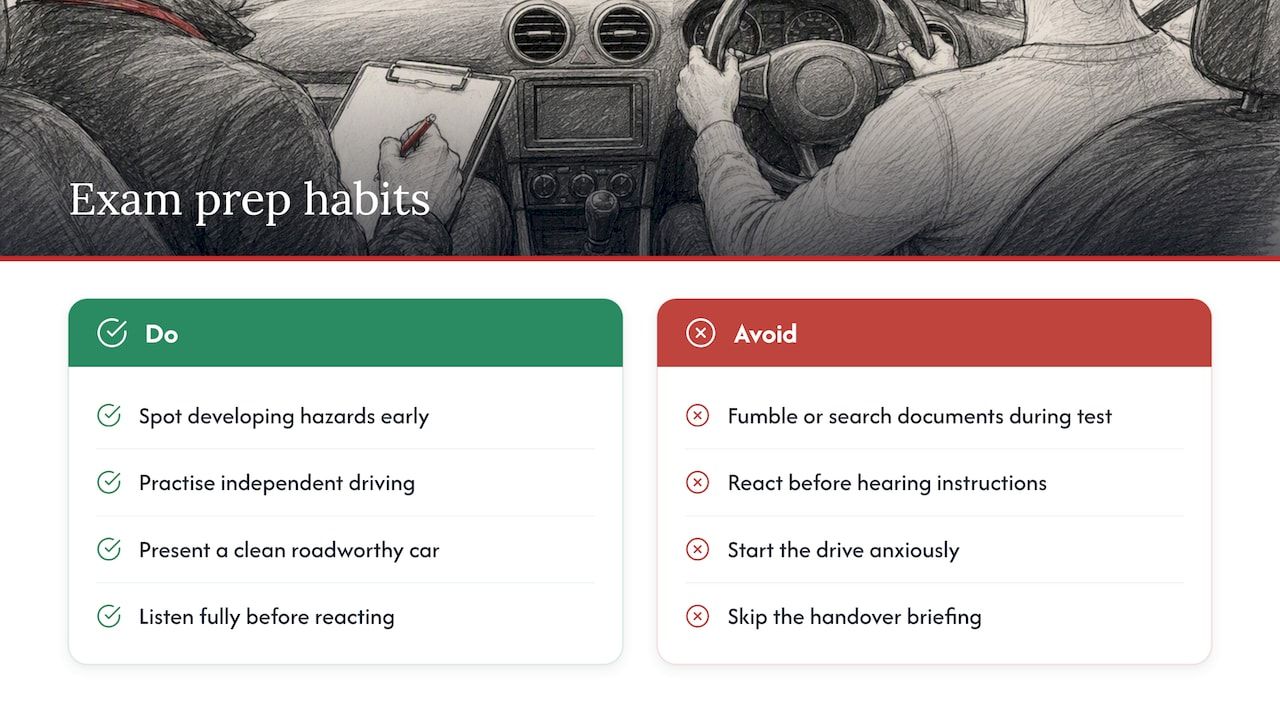
Preparation focuses on fault awareness and independent driving, so candidates recognise a developing situation before it becomes a serious fault rather than after.
Small habits make a real difference: presenting a clean, roadworthy car, having documents ready without fumbling, and listening fully to each instruction before reacting. None of this influences marking directly, but it removes the ambiguity that turns a borderline moment into a recorded fault.
Instructors also play a part in the handover itself, briefing learners on test centre routine beforehand so the drive starts calmly rather than anxiously.
Why understanding examiners matters
"Knowing how examiners work removes a lot of needless test day fear. In our experience, Examiners are a crucial part of instilling confidence in your driving with contructive and useful feedback. Learners tend to focus too much on the Examiners in the car whilst on test. They're there to do a job, not to make friends and certainly not to trick anybody. THEY ARE NOT OUT TO GET YOU! Preparation beats guesswork, and it is why our lessons and instructor training are built around the same standards examiners actually use."
— Dean Costello
Sources
For deeper detail, see DVSA guidance on test faults, the examiner assessment guidance, filming and recording rules, and appeal procedures. Those weighing driver training as a career more broadly may also find Cozys' Category D coach driver training useful background.
FAQ
What qualifications do I need to become a driving examiner?
You need a full manual driving licence held for a set number of years, to meet a minimum age requirement, and to stay within limits on penalty points at the time you apply, as set out in the official job details. Prior driving instruction experience is not required, since successful applicants complete full-time DVSA training instead.
Do driving examiners want you to pass?
Examiners are trained to apply fixed, impartial standards rather than to want any particular outcome. Whether a candidate passes depends entirely on staying within the official fault limits: no more than 15 driving faults and no serious or dangerous faults.
How many tests do driving examiners do a day?
A full-time examiner typically carries out around seven tests a day , according to DVSA recruitment materials, once debrief and paperwork time is included. Shift patterns generally run to a 37-hour week, with weekend and flexible options available.
How can I impress a driving examiner?
There is no scoring for impressing an examiner, only for meeting the assessment standard they are trained to apply. Focus on clear observation, smooth control and calm responses to instructions rather than trying to please them personally.
Can I use my own recording to challenge a test result?
No, personal recordings are not accepted as evidence to change a driving test outcome under official DVSA rules. Appeals only succeed where a procedural rule was not followed, not on disagreement with an examiner's judgement.