Beat the 4 Roundabout Test Faults: UK Rules and Instructor Drills
Beat the 4 Roundabout Test Faults: UK Rules and Instructor Drills

Give way to traffic already on the roundabout, coming from your right, unless a sign, marking or traffic light tells you otherwise. Before you get there, run through Mirrors, Signal, Manoeuvre: check your mirrors, signal your intention, then position and move only when it's safe. As a rule of thumb, stay left for a left turn or straight ahead, move right for a right turn or full circle, but always let painted lane markings override that default.
Key Points:
- Most drivers incorrectly assume the default rule of giving way to traffic from the right, but local signs, markings, or lights can override this.
- Proper lane selection and signaling depend on early approach planning and staying in lane through the roundabout, especially on multi-lane junctions.
- Irregularities like late lane changes, hesitation, or early signaling are the most common faults that lead to test failures and accidents.
- Pedestrians, cyclists, and large vehicles require extra caution, as cyclists stay in the left lane, and HGVs often take wider arcs or straddle lanes.
- Repeatedly circling a roundabout is legal if signals are correct and hazards are avoided; bail out or pull over if you're lost rather than continue circling.
Table of Contents
- What are the roundabout rules in the UK?
- What does the Highway Code say about roundabouts?
- How do you choose your lane and signal correctly on a roundabout?
- How do rules differ on mini, spiral and multi-lane roundabouts?
- What are the most common roundabout mistakes drivers make?
- How should you drive round roundabouts with cyclists, HGVs and pedestrians?
- How Costello's Driving School builds reliable roundabout habits
- What are the rules for horses and horse riders on roundabouts?
- Can you do a U-turn at a roundabout, and is it legal?
- Do emergency vehicles follow different roundabout rules?
- What happens if you break roundabout rules in the UK?
- Tips for new or international drivers unfamiliar with UK roundabouts
- Why habit beats perfection on roundabouts
- Where to check the official roundabout rules
- Sources
- FAQ
What are the roundabout rules in the UK?
The whole system runs on one principle: priority to the right, unless told otherwise. That single rule sits underneath everything else, but it only works if you pair it with a consistent routine on approach.
Every roundabout, mini or motorway-sized, asks you to run the same sequence before you commit:
- Check your interior mirror, then the mirror on the side you're about to signal.
- Look right as you approach, since that's where the danger comes from.
- Signal left for the first exit, no signal for straight ahead until you pass the exit before yours, and right for anything beyond that.
- Choose your lane early and stick with it. Road markings and signs always beat the general left/right default.
- Signal left as soon as you've passed the exit immediately before the one you want.
Driving instructors call this MSM (Mirror, Signal, Manoeuvre), sometimes stretched to MSPSL (Mirror, Signal, Position, Speed, Look) for roundabouts specifically, because positioning and speed matter as much as the signal itself.
Pro Tip: Practise saying the sequence out loud as you drive, "mirror, mirror, signal, position." It sounds daft, but it stops you skipping the look-right check under pressure, which is the single most common cause of a roundabout test fault.
What does the Highway Code say about roundabouts?
Rules 184 to 190 of the Highway Code form the legal backbone of every roundabout in the country, and they're worth knowing properly rather than by rough memory.
Rule 184 tells you to watch for signs, road markings and traffic lights on approach, and to act on what they say rather than assuming the default applies. Some roundabouts have a "give way" line that doesn't apply in the usual way, and a handful genuinely have no give-way markings at all, in which case you treat every approach as equal and proceed with extreme caution.
Rule 185 is the give-way principle itself: yield to traffic approaching from your right already on the roundabout, unless signs or markings say otherwise. If you spot a road marking showing you don't need to give way, or a mini-roundabout with unusual priority arrangements, that local instruction wins over the general rule.
Rule 186 governs signalling and positioning, and it's the rule most learners get wrong. It sets out that you should select your lane based on which exit you want, signal in good time, and hold your position through the circulatory carriageway rather than drifting between lanes. The Highway Code commentary on Rule 186 breaks this down further: left lane for a first exit, right lane for a right turn or a full circle, and markings override both when they're present.
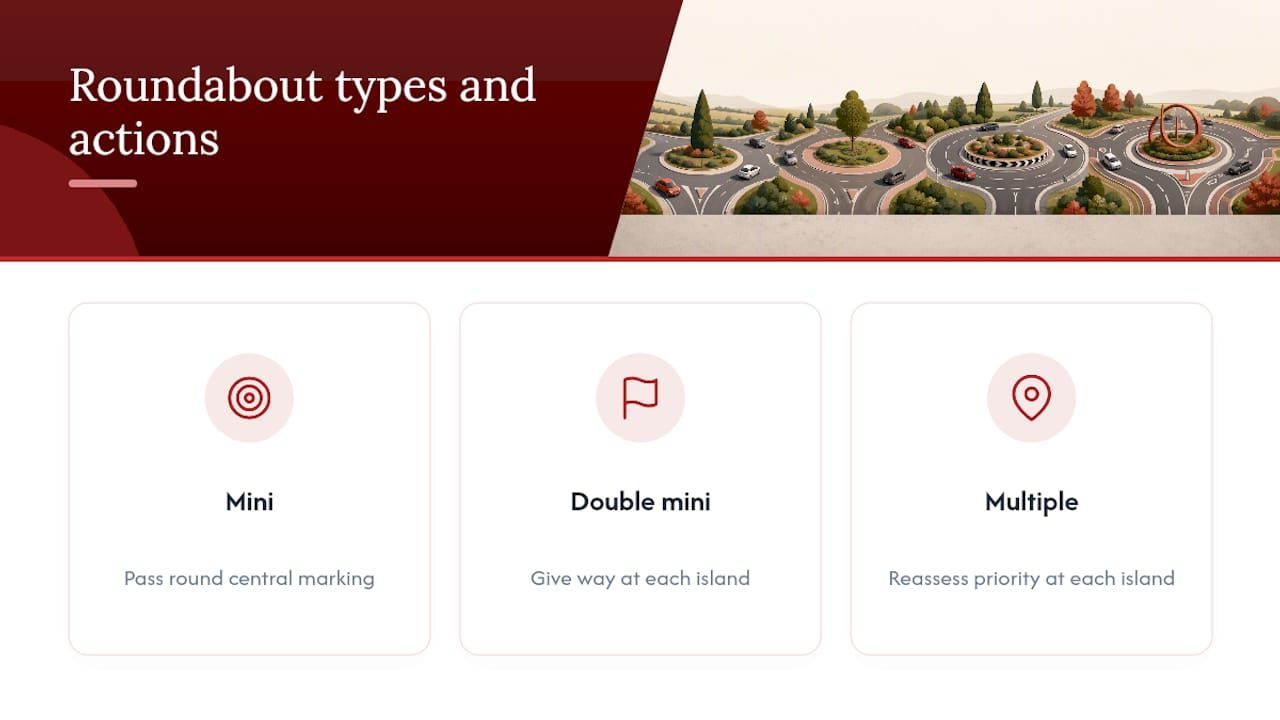
Rules 188 to 190 cover mini, double mini and multiple roundabouts. On a mini-roundabout you must pass round the central marking, and if you're driving a vehicle physically too large to do so, that's the only lawful exception. Double mini-roundabouts, often found where two junctions meet close together, are treated as two separate roundabouts. You give way at each one individually rather than trying to read them as a single system. Multiple roundabouts, common at motorway junctions, need the same approach applied fresh at every island rather than assuming your first read of priority carries through the whole junction.
How do you choose your lane and signal correctly on a roundabout?
Getting the lane and signal sequence right comes down to timing, not speed. Follow this order every time:
- Read the approach early. Look for advance direction signs and road markings well before the roundabout itself, not once you're already on top of it.
- Pick your lane based on your exit, not habit. Left lane for the first or second exit in most layouts, right lane for anything past the twelve o'clock position or a full circle back the way you came. If painted arrows on the road contradict this, the markings win every time.
- Signal left on approach only if you're taking the first exit. For a straight-ahead exit, don't signal at all until you've passed the exit before yours, then indicate left. For a right turn or full circle, signal right on approach and hold it until you've passed the exit immediately before your own.
- Hold your lane through the circulatory carriageway. This is where lane discipline matters most and where most drivers drift without realising, especially on wider, multi-lane roundabouts where the outside lane curves more sharply than it looks.
- Signal left the moment you pass the exit before yours , then move smoothly into your exit lane.
- On a spiral roundabout , the lane you enter in usually determines your exit directly, so lane choice needs to happen before you even reach the give-way line, not once you're circulating.
If you realise mid-roundabout that you're in the wrong lane, don't swerve across to correct it. Stay in your current lane, follow it round to whichever exit it leads to, and simply go round again or take the next safe turning to get back on route. A late lane change across markings is far more dangerous than an extra thirty seconds on the road.
How do rules differ on mini, spiral and multi-lane roundabouts?
Not every roundabout behaves the same way, and knowing the type in front of you changes what you do.
- Mini-roundabouts are flat, painted circles rather than raised islands, and you must pass round the central marking whenever your vehicle allows it. Give-way-to-the-right still applies, but there's far less road to work with, so signal a little later than you would on a full-sized roundabout, since signalling too early can confuse drivers waiting to emerge from side roads.
- Double mini-roundabouts , often two mini islands within metres of each other, are legally two separate junctions. Treat each one on its own merits rather than assuming priority carries through from the first to the second.
- Multi-lane roundabouts demand that you read overhead signs and lane arrows before you arrive, then commit. Changing lanes once you're circulating is one of the most frequent driving test faults, largely because drivers pick a lane late and try to correct it under pressure.
- Spiral roundabouts , sometimes called segregated-lane roundabouts, use painted lane dividers that spiral outward toward your exit. The lane you choose on entry effectively locks in your exit, so these reward drivers who plan two moves ahead rather than reacting lane by lane.
- Signal-controlled roundabouts add traffic lights into the mix, usually at busy junctions. Obey the lights first, but keep watching circulating traffic, since a green light doesn't guarantee the roundabout ahead of you is clear. Where permanent signs override the standard give-way arrangement, follow the sign, not the general rule.
What are the most common roundabout mistakes drivers make?
Four errors turn up again and again on UK roads and in test reports, and each one is fixable with a small change in habit.
- Emerging without giving way. Failing to yield to traffic already on the roundabout is treated as a serious or dangerous fault on the driving test, and it's the single most common reason for a straightforward accident at these junctions. Cutting across lane markings once you're moving carries the same weight.
- Signalling badly. Signalling right too early on approach to a straight-ahead exit confuses everyone behind and beside you. Just as bad is forgetting to signal left after passing your penultimate exit, which leaves following traffic guessing what you're about to do.
- Picking the wrong lane and trying to fix it live. Committing to a lane late, then swerving across markings to reach your exit, is exactly the move examiners mark down hardest. If you're in the wrong lane, follow it round rather than cutting across.
- Hesitating in a genuinely safe gap. Undue hesitation when there's a clear opportunity to go is its own test fault category, distinct from failing to give way. It also frustrates queuing traffic and increases the chance of a shunt from behind.
Examiners consistently flag observation, positioning and signalling as the three areas where roundabout faults cluster, which tells you where to focus practice time if you want results quickly.
How should you drive round roundabouts with cyclists, HGVs and pedestrians?
Roundabouts get genuinely dangerous when you stop watching for anything other than cars, and cyclists are the group most at risk.
Cyclists often stay in the left-hand lane even when they're heading straight ahead or turning right, because moving across multiple lanes on a bike is far riskier than staying put and taking a longer path round. Give them a full car's width of space if you're overtaking near a roundabout, and never assume a cyclist's lane position tells you their intended exit.
Long vehicles, particularly HGVs and buses, physically can't tuck into a normal lane on a tight roundabout. Expect them to straddle lanes or take a wider arc than you'd expect from a car, and hold back rather than trying to squeeze past on the inside.
Pedestrian crossings often sit just before or after a roundabout's exit and entry points, and they carry the same weight as any other zebra or signal-controlled crossing. Approaching drivers sometimes focus so hard on circulating traffic that they miss a pedestrian stepping out on the exit side, so keep scanning both.
Traffic lights change the default give-way rule entirely. Where lights control entry or the circulatory carriageway itself, obey the lights over the general priority-to-the-right rule, but still watch for vehicles already committed to crossing your path when the lights change.
How Costello's Driving School builds reliable roundabout habits
Rules on paper only help once they turn into automatic reactions under pressure, and that's where structured practice earns its keep.
A typical roundabout-focused lesson at Costello's Driving School starts with three short drills rather than one long session. The first is pure observation: approaching a quiet mini-roundabout repeatedly, doing nothing but narrating mirror checks and the look-right sequence out loud. The second drills lane commitment, picking a lane before the give-way line and holding it through the exit, even on a roundabout with confusing or faded markings. The third focuses purely on signal timing, since that's where instructors see the most inconsistency, particularly the habit of signalling right too early or forgetting to cancel a signal after exiting.
Instructors structure a single lesson around whichever fault shows up first in a warm-up loop, then repeat that specific roundabout, or a similarly shaped one nearby, until the correction becomes automatic rather than something the learner has to consciously think through.
If your test centre has particular roundabouts nearby that come up often, rehearsing them at the same time of day as your test matters more than most learners expect, since traffic density and light timing both change significantly between an 8am test slot and a 3pm one.
What instructors actually watch for: consistent mirror checks on every single approach, decisive gap acceptance rather than creeping forward and stopping, and a clean, committed exit without last-second lane drift.
What are the rules for horses and horse riders on roundabouts?
Horse riders follow the same basic priority rule as any other road user, giving way to traffic from the right, but the practical advice around them differs because horses are unpredictable and slow to manoeuvre compared with motor traffic.
Riders are generally advised to keep to the left-hand lane throughout, even when turning right, rather than attempting to move across lanes on a large roundabout. This mirrors advice given to cyclists, and for the same reason: crossing multiple lanes on horseback is far riskier than taking a longer path round the outside.
As a driver, the responsibility shifts firmly onto you. Give a horse and rider generous space, both passing and following, and never sound your horn or rev your engine near them, since a sudden noise can spook an animal into an unpredictable movement. Slow down well before you reach a roundabout if you see a horse rider ahead, and be patient if they take a wider or slower line than you'd expect from a cyclist or car.
If a horse rider needs to cross more than one lane to reach their exit, they may signal for other traffic to let them through, sometimes with a raised arm rather than an indicator, since horses obviously don't carry mechanical signals. Treat that gesture the same way you'd treat any other request to change lanes safely, and give way rather than pressing on regardless.
Horse riders are rare on busy urban roundabouts but far more common on rural ones near Essex and Suffolk villages, so slow down earlier than you think you need to whenever open countryside surrounds the junction.
Can you do a U-turn at a roundabout, and is it legal?
Yes, a full circle back the way you came is a legal manoeuvre at most roundabouts, and it's built into the standard signalling rules rather than being some grey-area workaround.
To do it properly, treat it like any right-turn exit: select the right-hand lane on approach (unless markings say otherwise), signal right, and hold that signal all the way round until you've passed the exit immediately before the one you entered from. Then signal left and exit as normal. This is functionally identical to taking the "last exit" available to you.
Mini-roundabouts are different, and this is where confusion often creeps in. Because you're legally required to pass round the central marking, a proper U-turn on a mini-roundabout means physically driving around that painted circle rather than cutting straight across it. Many drivers try to shortcut a mini-roundabout U-turn by swinging directly across the middle, which is both illegal and dangerous, since it puts you head-on against traffic that has right of way.
Multiple driving round a roundabout more than once, whether to buy time, double-check a lane, or genuinely take a full circle exit, isn't against the law in itself. What matters is that you signal correctly and don't create a hazard by cutting across lanes each time round. If you're circling repeatedly because you're lost or unsure which exit to take, that's a safety issue worth pulling over to resolve rather than a legal one.
Spiral and multi-lane roundabouts make U-turns considerably harder to judge cleanly, since the lane you need for a full circle often sits furthest from the kerb and requires early planning well before the give-way line.
Do emergency vehicles follow different roundabout rules?
Emergency vehicles responding on blue lights don't get a different rulebook for roundabouts. They get the same priority-to-the-right principle as everyone else, but with an expectation that other drivers will make way for them safely.
What changes is your responsibility as the driver being approached. When you see or hear an emergency vehicle with blue lights and sirens active near a roundabout, you're expected to consider how you can safely let it pass, which might mean holding your position at the give-way line a little longer, pulling slightly left if there's room, or simply not entering the roundabout until it has cleared through. You should never mount a kerb, cross a solid white line, or break another rule of the road purely to get out of an emergency vehicle's way, since that just creates a second hazard.
Emergency vehicle drivers themselves are trained to treat junctions and roundabouts with extra caution precisely because they can't assume every driver has seen or heard them in time, particularly with modern, better-insulated cars. They'll often slow markedly on approach to a roundabout even with lights and sirens running, rather than assuming right of way will be given instantly.
If an emergency vehicle is already on the roundabout ahead of you, treat it as you would any other vehicle already circulating: give way, don't try to overtake it, and let it complete its manoeuvre before you commit to your own.
What happens if you break roundabout rules in the UK?
Getting a roundabout wrong isn't just a test fault, it carries real legal weight on the public road.
Failing to give way to traffic already on a roundabout, when that traffic had priority, is treated the same as failing to give way at any other junction. This can result in a fixed penalty, points on your licence, or a more serious charge like careless driving if the failure causes a collision or a near miss serious enough to warrant police attention. Careless driving convictions typically carry penalty points, a fine, and in more serious cases a court appearance, with the exact outcome depending on the circumstances and whether anyone was hurt.
Ignoring a mini-roundabout's central marking by driving straight across it rather than round it is also an offence, since Rule 188 sets a legal requirement rather than a suggestion. The same applies to ignoring signal-controlled roundabout lights, which counts as a red light offence carrying its own fixed penalty and points if you're caught or reported.
Dangerous driving, a more serious charge than careless driving, can apply where a roundabout manoeuvre is so poor it creates an obvious risk of serious harm, such as accelerating through a clear give-way situation or aggressively cutting across multiple lanes at speed. That carries a much higher fine, a likely disqualification, and potentially a prison sentence in the most extreme cases.
For learner drivers, a serious or dangerous roundabout fault during the practical driving test results in an automatic test failure, regardless of how well the rest of the drive went.
Tips for new or international drivers unfamiliar with UK roundabouts
Drivers who've learned in a country without roundabouts, or where priority rules run the opposite way, often find the biggest adjustment isn't the roundabout itself but the direction of travel.
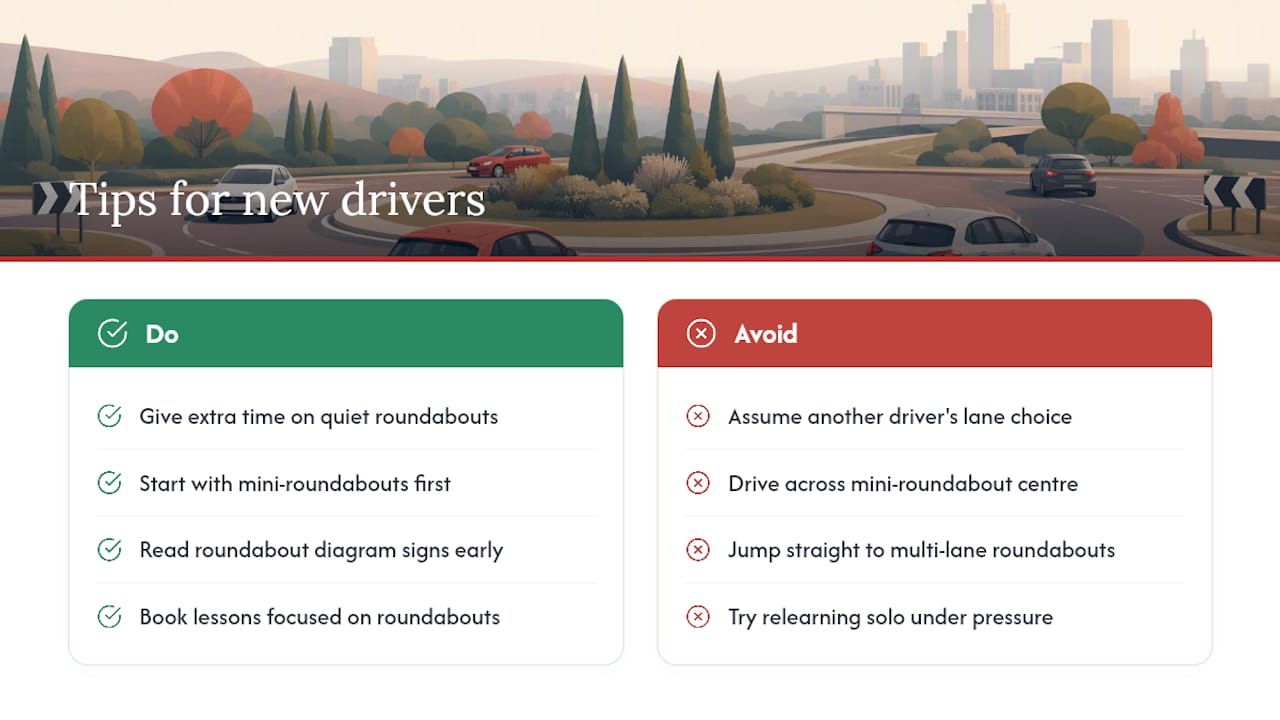
If you're used to driving on the right-hand side of the road, the whole roundabout rotates in the opposite direction to what feels natural, and give-way priority comes from what will initially feel like the "wrong" side. Give yourself extra time on quieter roundabouts before attempting busy ones, and consider a lesson or two focused purely on this adjustment rather than trying to relearn it solo under pressure.
Start with mini-roundabouts in a residential area rather than jumping straight to a multi-lane one. They move slower, give you more thinking time, and let you build the MSM habit before traffic density adds pressure.
Read UK road signs as you approach, since the small diagram showing the roundabout's layout and exits, usually on a blue or white sign before the junction, tells you far more accurately which lane to choose than trying to judge it from the roundabout itself. Many new-to-the-UK drivers underestimate how much these diagram signs are designed to be read at a glance and pre-plan.
If in doubt, follow the vehicle ahead of you rather than guessing, but never assume another driver's lane choice is correct simply because they made it confidently. Take extra care with the mini-roundabout central marking requirement too, since some countries permit driving straight across small islands, which is not legal here.
Booking a lesson focused specifically on roundabouts, rather than a general refresher, is often the fastest way to convert unfamiliar rules into confident habit, particularly if you're preparing for a full UK licence conversion with Category D Coach Driver Training.
Why habit beats perfection on roundabouts
Nobody drives a flawless roundabout every single time, and examiners don't expect it either. What they're actually assessing is whether your observation routine holds up consistently, lesson after lesson, junction after junction, because a driver who checks mirrors and looks right on autopilot is safer long-term than one who occasionally gets a single approach textbook-perfect.
That's the real gap between reading the Highway Code and driving confidently: repetition under realistic conditions. If roundabouts still make you hesitate, or you're prepping for a test and want the specific junctions near your test centre drilled properly, a focused lesson or refresher session closes that gap faster than reading rules alone ever will. For more practical breakdowns like this one, the Costello's Driving School blog covers other junction types and test-specific routes worth working through.
— Dean
Where to check the official roundabout rules
For the legal wording behind everything covered here, read rules 184 to 190 of the Highway Code directly on GOV.UK. DVSA's own junctions and roundabouts guidance sets out exactly what examiners look for, and nidirect's roundabout appendix offers a useful plain-English summary.
Sources
FAQ
Is it illegal to drive around a roundabout more than three times in the UK?
No, there's no legal limit on how many times you can circle a roundabout, provided you signal correctly and don't create a hazard by cutting across lanes. If you're going round repeatedly because you're lost, pull over safely to check your route rather than continuing to circle.
What are the four common mistakes drivers make at roundabouts?
The four biggest are failing to give way to traffic already on the roundabout, signalling incorrectly or not at all, picking the wrong lane and then swerving to correct it, and hesitating in a gap that was genuinely safe to take. Emerging without giving way and cutting across lane markings count among the most serious faults on the driving test.
What is not permitted on a roundabout?
You must not cut straight across the central marking of a mini-roundabout, change lanes unsafely once you're circulating, or ignore signs, lights and markings that override the default give-way rule. Overtaking within the roundabout itself, other than a cyclist or slower vehicle you can pass with clear space, is also unsafe and generally not advisable.
Who has priority at a three-way roundabout?
Traffic already on the roundabout, approaching from your right, has priority over anyone waiting to enter, exactly as it does on a standard four-exit roundabout. The number of exits doesn't change the underlying rule, though a three-way roundabout does typically give you a shorter distance to judge gaps and signal in time.
Recommended