Plan Around a 20 Week DVSA Wait With Your Intensive Course Timeline
Plan Around a 20 Week DVSA Wait With Your Intensive Course Timeline
Most intensive courses run between one and four weeks: a top-up block for near-test-ready learners takes 2-3 days, a fast-track for someone with some experience takes about a week, and a genuine beginner usually needs three to four weeks of solid daily training. The one thing no course can shorten is the wait for a DVSA practical test slot, which is currently running well beyond most people's expectations. Before any of that, you need a valid theory test certificate.
Key Points:
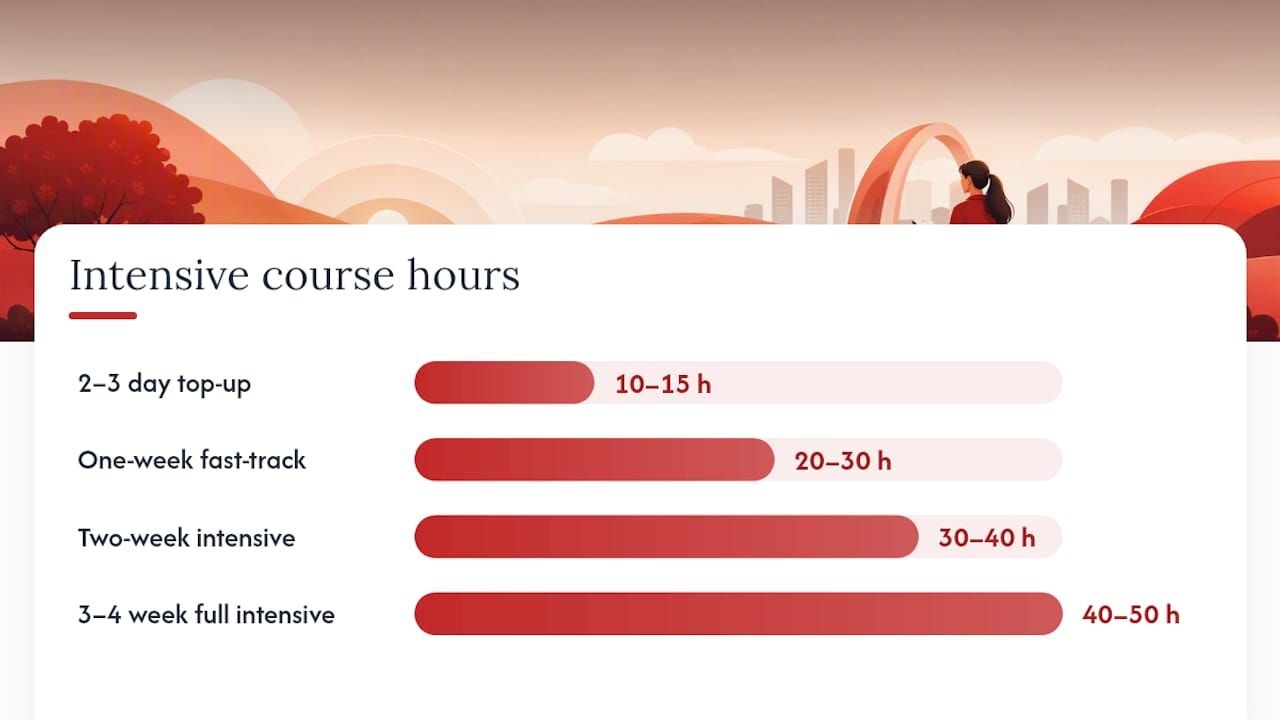
- The typical intensive driving course length varies from 2-3 days for near-test-ready learners to up to four weeks for beginners, with actual hours between 40-50.
- Progress depends heavily on prior experience, with more experienced learners often completing faster, but the total hours needed rarely decrease.
- The main bottleneck is securing a DVSA test slot, which nationally averages around 20 weeks of waiting, with regional differences affecting availability.
- Maintaining consistent practice, passing multiple mock tests, and avoiding fatigue significantly influence the speed and success of the course.
- Booking the theory test early and tailoring the course to your real starting point ensures a realistic timeline, as most providers cannot shorten the wait for test slots.
Table of Contents
- Intensive course timeline options by starting point
- What actually speeds up or slows down your course
- What a sample intensive week actually looks like
- Booking a test date around DVSA's actual calendar
- Are you actually ready, and how do you avoid burning out?
- Who's actually setting this timeline for you
- Why the calendar you want and the calendar you get are rarely the same thing
- Ready to plan an intensive course that fits your actual timeline?
- Sources
- FAQ
Intensive course timeline options by starting point
An intensive course timeline isn't a single fixed number. It flexes around how much driving experience you already have, and providers generally structure it into recognisable blocks.
- 2-3 day top-up. For learners who already drive confidently but need polish before test day, perhaps 10-15 hours of focused practice covering manoeuvres, independent driving, and mock tests. This suits someone who has had regular weekly lessons for months and just needs the final push.
- One-week fast-track. Around 20-30 hours across five or six days, aimed at learners with some prior experience, maybe six months of stop-start lessons, who need consistency more than fundamentals.
- Two-week intensive. The most common full package, typically 30-40 hours, built for learners starting from a moderate base who can commit most of their day for a fortnight.
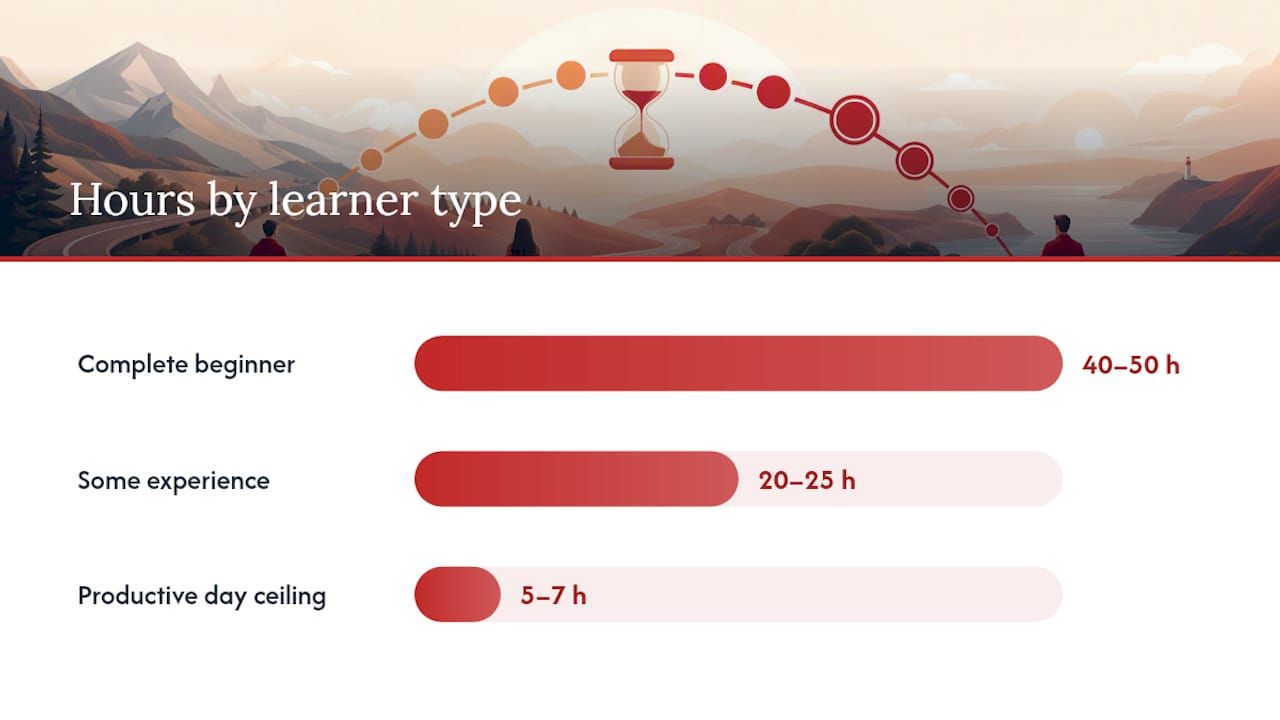
- Three to four-week full intensive. Closer to 40-50 hours, spread across a month, for near-beginners who need to build muscle memory from scratch without burning out in a week.
- Spread-over 3-12 weeks. The same total hours as the shorter blocks, but split into two or three sessions a week. This suits people juggling work or family commitments who still want faster progress than weekly one-hour lessons.
Whichever block you choose, the 45 hours of driving experience commonly cited as the benchmark for test readiness doesn't disappear just because the course is compressed. It gets packed tighter. Costello's Driving School's own guidance on lesson length and hour counts reflects this: the hours a learner needs rarely shrink, only the calendar around them does.
One thing every block shares: finishing the training is not the same as finishing the timeline. You still need a booked DVSA practical test, and that date is often the real bottleneck, not the lessons themselves.
What actually speeds up or slows down your course
Prior experience is the single biggest lever. A complete beginner starting from zero hours behind the wheel typically needs the full 40-50 hour range regardless of how the days are arranged. Someone with some experience, say 15-20 hours already logged, might complete a course in half that time. A retest candidate who failed on a specific fault often needs only a handful of targeted sessions.
Daily hour count matters more than most learners assume. Providers generally recommend 5-7 hours of instruction per day as the productive ceiling.
- Beyond around seven hours, concentration drops sharply and mistakes compound rather than correct themselves.
- Fatigue affects hazard perception and decision speed long before it affects physical control of the car.
- Splitting a long day into two sessions with a proper break tends to outperform one unbroken stretch.
Manual and automatic courses follow different curves. Automatic learners often progress faster early on because there's no clutch control to master, but manual test passes still carry more flexibility for future driving, so the choice affects both speed and long-term usefulness.
Instructor continuity is underrated. Switching instructors mid-course means re-explaining habits, fault patterns, and confidence levels each time, which eats into productive hours. A single instructor who tracks your progress daily adjusts the plan in real time instead of restarting the assessment each morning.
Pro Tip: Ask your instructor for a same-day fault log after every session. Seeing which specific faults recur (not just "needs more practice") tells you exactly how many more hours you genuinely need, rather than guessing.
Local test centre supply also shapes the plan. Some areas have far tighter DVSA capacity than others, so instructors familiar with your local test centres can advise realistically on when to actually book, rather than relying on national averages that may not reflect your postcode.
What a sample intensive week actually looks like
Course structures vary by provider, but the shape below reflects how a well-run intensive block is typically sequenced, whether it runs over three days or four weeks.
- 2-3 day top-up. Day one covers a full assessment drive plus manoeuvres; day two focuses on independent driving and trickier junctions; day three (if used) is a short consolidation session followed by a mock test the afternoon before the real one.
- One-week fast-track. Days one to two build core control and confidence in varied traffic; days three to four introduce independent driving, motorways where relevant, and night or rain practice if the season allows; day five is mock test plus feedback review; days six and seven are lighter, focused only on remaining weak points.
- Two-week intensive. Week one mirrors the fast-track pace but slower, giving more time to bed in each skill; week two shifts to full mock-test conditions from Monday, with Wednesday reserved for a detailed feedback review and Thursday for a final light session, since piling on hours right before test day rarely helps.
- Three to four-week full intensive. The first week covers fundamentals only, no test talk. Weeks two and three build complexity and independence. The final week tapers hours slightly and runs at least one full mock test, with the penultimate day set aside purely for consolidation and the last day kept deliberately light.
- Spread 8-12 week option. Two or three sessions a week of two to three hours each, with a mock test inserted roughly every fortnight to track whether progress is keeping pace with the calendar.
If your daily availability is limited, the fix isn't to cram more into fewer days. It's to extend the spread and keep each session inside that 5-7 hour window, even if that means choosing the 8-12 week structure over the two-week one.
Booking a test date around DVSA's actual calendar
Your theory test comes first, and there's no way round it: you need a valid pass certificate before you can book a practical test at all. The theory test costs £23 and covers multiple-choice questions plus a hazard perception section, so book it early enough that it doesn't stall the rest of your plan.
Once you're eligible to book practical, the calendar mechanics matter more than most learners realise:
- DVSA releases a new week of appointments at 6am every Monday, and those new slots typically sit around 24 weeks ahead.
- Cancellations create earlier openings at any time, which is why checking daily (not just Mondays) often pays off more than the 6am rush itself.
- Joining the Monday queue mainly helps if you're happy to test roughly six months out. If you want something sooner, cancellation-hunting is the more useful tactic.
Reporting from BBC News puts the average wait to book a test at around 20 weeks nationally, with a median gap between booking and actually sitting the test of about 11.1 weeks.
That national average masks real regional swings, and DVSA itself has acknowledged that progress on waiting times is uneven across Great Britain. A test centre near a major city may run tighter than one in a quieter area, so ask your instructor which local centres tend to move faster.
Failing a test doesn't just cost you the fee. It pushes you back into that same 20-week queue for a rebooking, which is precisely why rushing to a date before you're consistently passing mock tests is usually a false economy.
Are you actually ready, and how do you avoid burning out?
Three signals matter more than the calendar: consistent mock-test passes (not one lucky run), confident independent driving without prompts, and a fault log that's shrinking rather than repeating the same two or three issues.
- Track mock-test scores across the whole course , not just the final one. A single clean run the day before test day means little if the three before it were rough.
- Build rest into intensive blocks deliberately. A day with no driving, or a shortened afternoon session, prevents the fatigue-driven mistakes that tend to appear on day three or four of back-to-back training.
- If your test date slips , don't let weeks pass with zero driving. A short weekly session or a targeted refresher keeps independent-driving confidence and hazard perception from fading before your slot finally comes up.
Pro Tip: If you're facing a multi-month wait after finishing your intensive block, book one refresher lesson roughly every three weeks rather than none at all. It costs far less than restarting a chunk of the course from scratch.
Who's actually setting this timeline for you
Costello's Driving School has spent over 25 years building intensive course timelines around what's realistic locally across Essex and Suffolk, not just what a national average suggests. Every instructor is DVSA-approved and teaches both manual and automatic, and courses run everything from short top-ups to full Guaranteed Pass packages.
The school's approach leans on a relaxed, flexible schedule, including weekend availability, so learners aren't forced into unsustainable daily hours just to hit an arbitrary date. Lessons run in modern dual-controlled cars, and the same instructor training standards that underpin the school's own ADI Part 3 lesson planning work feed into how instructors sequence an intensive block day by day. That same rigour extends to the school's driving instructor training programme, which trains the next generation of ADIs to the same standard.
Why the calendar you want and the calendar you get are rarely the same thing
Most learners fixate on the shortest possible course length, as if fewer days automatically means faster driving. It doesn't. A four-day cram that leaves someone shaky on roundabouts is slower, in real terms, than a fortnight that gets them genuinely consistent, because the shaky learner fails and re-enters an 11-week queue.
The number that should drive your decision isn't "how few days can I book" but "how many consecutive mock tests can I pass without a coached correction." Chase that signal, let the instructor sign off on readiness, and treat the calendar date as a target to hit once you're actually there, not a deadline to force.
— Dean
Ready to plan an intensive course that fits your actual timeline?
If you've read this far, you already know the honest version: no provider can shrink DVSA's queue, but a good one can stop you wasting weeks inside it. Costello's Driving School plans every intensive block around your real starting point rather than a generic course length, so you're not paying for hours you don't need or short-changed on the ones you do.
An initial assessment covers three things: an honest hours estimate based on a short drive, the block length that actually fits your diary (from a 2-3 day top-up to the full three to four-week intensive), and a test-readiness checklist so you're not booking a DVSA slot on hope alone. If a guaranteed outcome matters more to you than the shortest possible calendar, the Guaranteed Pass course is worth a look, and if consecutive days simply aren't realistic around work or family, block bookings let you spread the same hours over several weeks instead.
Get in touch to check current availability and request dates that match your local DVSA test centre's realistic waiting time, not just a national average.
Sources
For the mechanics behind this article: book your theory test and book a practical test direct with DVSA, plus the AA's waiting-time tracker for regional detail.
FAQ
How long do intensive driving courses take?
Most run from 2-3 days for near-test-ready learners up to three or four weeks for beginners, with total hours usually falling somewhere in the 40-50 hour range. The finishing date still depends on when a DVSA test slot is actually available.
Can you still do an intensive driving course in the UK?
Yes, intensive courses remain widely available, but the practical test booking queue is the real constraint rather than course availability itself. Recent reporting puts the average wait to book a test at around 20 weeks, so it's worth booking your test slot as early as your training plan allows.
Which intensive driving course is considered the best in the UK?
There's no single national "best" course, since the right choice depends on your starting experience and local test centre waits. A provider with DVSA-approved instructors, flexible scheduling, and local knowledge of test-centre timing, like Costello's Driving School across Essex and Suffolk, tends to set more realistic expectations than a generic national package.
How many hours is a full-time college course in the UK?
This isn't specific to driving tuition, and figures vary widely by course and institution, so it's not something this guide can state reliably. For intensive driving courses specifically, expect daily sessions of roughly 5-7 hours rather than a full college-length day.
Do I need to pass my theory test before booking an intensive course?
You need a valid theory test certificate before booking the practical test, though most providers will start practical training beforehand. The theory test costs £23 and covers multiple-choice and hazard perception sections, so booking it early keeps your intensive course timeline on track.
Recommended