5 Habits That Keep UK Drivers Safe in Rain
5 Habits That Keep UK Drivers Safe in Rain
Slow down, double your following distance, and switch on dipped headlights the moment visibility drops. Disengage cruise control, avoid floodwater entirely, and if you feel the car go light and start to drift, ease off the accelerator and hold the steering straight rather than braking or turning sharply. Get these five habits right and you have already dealt with most of what wet roads throw at you.
Key Points:
- Maintain at least double the usual following distance in heavy rain to allow more reaction time and avoid slipping.
- Replace worn wiper blades and ensure tyre tread depth and pressure are adequate before rainy weather to prevent aquaplaning risks.
- Slow down significantly on motorways and avoid stopping on live lanes if visibility drops, instead exit at the next safe junction or service area.
- Ease off the accelerator and keep the steering straight if your car aquaplanes, then brake gently once contact with the road is regained.
- Prioritize early, smooth braking and gradual steering to reduce skids, and practice these habits with a qualified instructor for better wet-road control.
Table of Contents
- Before you set off: planning and pre-drive checks
- Vehicle checklist and visibility tips
- How to drive in rain: speed, spacing and braking
- Aquaplaning: signs and what to do
- Driving through standing water and floodwater: when to turn back
- Driving on motorways and dual carriageways in heavy rain
- After driving through water and what to do if you break down
- Instructor tips: practical drills and decision rules
- Keeping the windscreen clear with climate control
- Best practices for road positioning and lane choice
- How to handle skids and loss of traction
- Why harsh braking and sudden manoeuvres make things worse
- Pre-trip vehicle safety checks specifically for rainy weather
- Perspective: why rain driving advice matters and common mistakes
- Build wet-weather skills with instructor-led practice
- Sources
- FAQ
Before you set off: planning and pre-drive checks
Check the forecast before committing to a journey. The Met Office points out that skipping a non-essential trip during a forecast downpour is often safer than trusting your driving skill to compensate for it. If the trip can wait, let it.
When you do drive, plan a route that sticks to main roads and avoids known flood spots, dips, or fords, especially after several days of heavy rain when the ground is already saturated.
A brief check before you leave prevents many rain-related breakdowns:
- Ensure wiper blades clear the screen effectively without smearing or skipping
- Verify headlights, brake lights, and indicators function properly
- Confirm tyre tread and pressures are adequate
- Top up screen wash reservoir
Vehicle checklist and visibility tips
Worn wipers, soft tyres, and a dirty windscreen substantially worsen safety in ordinary rain. National Highways treats vehicle condition as part of driving skill, not a separate maintenance task, because a car that lets you see and be seen is doing half the work for you.
Run through this before wet weather sets in:
- Replace wiper blades at the first sign of streaking, chattering, or a missed patch. They're a cheap part with an outsized safety payoff.
- Switch to dipped headlights as soon as visibility drops, rather than relying on daytime running lights, which don't make you visible from behind in heavy spray.
- Check tyre tread depth across the whole width of each tyre. Worn tread channels less water away, which increases the risk of aquaplaning.
- Keep tyres at the correct pressure. Underinflated tyres distort the tread pattern and reduce grip exactly when you need it most.
Pro Tip: Run your air conditioning with the vents pointed at the windscreen even in summer rain. The compressor dries the air before it hits the glass, clearing mist faster than blowing warm air alone.
How to drive in rain: speed, spacing and braking
Wet-weather stopping distances run at least double what they are on dry roads, according to the Highway Code. At 30 mph, a dry stop takes roughly 23 metres; at 70 mph, roughly 96 metres. Wet tarmac stretches both figures considerably, so the working rule is simple: adjust your speed so you can stop within the distance you can actually see to be clear.
- Widen your gap. The usual two-second following rule needs stretching, often to double that in heavy rain, giving you room to react without panic braking.
- Slow down before the bend, not during it. Brake in a straight line, then steer smoothly through the curve. Braking and steering at the same time asks the tyres to do two jobs with grip that's already reduced, which is when cars lose traction.
- Treat wiper use as a speed cue. If conditions are bad enough to need your wipers on a fast setting, that's a signal to ease off, not push on.
- Switch off cruise control. It can't feel the road the way you can, and it will keep the throttle steady through a patch of standing water when your instinct would have backed off. National Highways flags this as one of the more overlooked risks in heavy rain.
- Remember the limit is a ceiling, not a target. The posted speed limit assumes dry, clear conditions. In rain, the safe speed is often well below it.
Aquaplaning: signs and what to do
Aquaplaning happens when water builds up faster than your tyres can channel it away, and the tyre lifts off the road surface entirely. You lose steering feel and braking grip in the same instant, which is why it catches so many drivers off guard.
Watch for these warning signs:
- The engine suddenly sounds louder and revs rise, because the driven wheels are spinning with less resistance
- The steering goes light and vague, with less feedback through the wheel
- The back of the car feels like it's drifting sideways, even on a straight road
If it happens, National Highways advises easing off the accelerator and holding the steering straight. Don't brake and don't steer suddenly. Wait for the tyres to make contact with the road again, then brake gently once grip returns. It's a deliberately unglamorous response, and that's the point: patience beats a dramatic correction every time.
Driving through standing water and floodwater: when to turn back
Don't drive through floodwater if there's any way around it. The Met Office warns that around 30 cm of moving water can float a car, and depth is often impossible to judge accurately from the driver's seat, especially at night or where the road markings have vanished under the surface.
If there's no alternative route:
- Choose the shallowest-looking point, usually the crown of the road rather than the gutter
- Proceed slowly in a low gear, keeping the revs up to stop water entering the exhaust
- Avoid following another vehicle too closely through water, as their bow wave increases depth
- Test your brakes gently once you're clear and back on dry road
When local signs, barriers, or official advice say a road is closed, treat that as final. Turning around costs you minutes; misjudging floodwater can cost a great deal more.
Driving on motorways and dual carriageways in heavy rain
Spray and speed make motorways their own category of risk in wet weather. Widen your following gap further than you would on an urban road, avoid sudden lane changes, and stick to a lane where surface water is less likely to pool, usually one of the middle lanes rather than the nearside where drainage often lags.
If visibility drops too far to continue safely, don't slow to a crawl or stop on the carriageway itself. Exit at the next safe junction or service area instead.
- Never stop in a live lane if you can reach a hard shoulder, slip road, or refuge area
- If you break down, get passengers out and away from the carriageway, behind a barrier where possible
- Call for recovery rather than attempting a roadside fix in live traffic
After driving through water and what to do if you break down
Water can coat your brake discs and pads, temporarily cutting their effectiveness right when you least expect it.
- Find a safe, quiet stretch of road and gently apply the brakes at low speed to dry them out and confirm they're responding normally.
- If the car breaks down in the rain, move it to the verge or hard shoulder if it's still driveable, and use hazard lights to warn other drivers.
- Get everyone out of the vehicle and away from moving traffic, particularly on faster roads.
- Call a recovery service rather than attempting a repair at the roadside. Poor visibility and spray make roadside work far riskier than it looks.
Instructor tips: practical drills and decision rules
A useful habit is practising early, straight-line braking on a quiet, wet road, well before any junction or bend, so it becomes automatic rather than a last-second scramble. Before committing to speed, run a quick mental checklist: can I see far enough ahead, is my gap wide enough, does the surface look glossy or textured, and is there any risk of water pooling ahead? Watch other drivers too. Brake lights flashing on repeatedly ahead usually mean standing water or reduced grip, and that's your cue to back off early rather than react late.
Keeping the windscreen clear with climate control
A clear windscreen is as important as clear roads, and misting is one of the most underrated hazards in wet weather. Warm, moist air from wet clothing and breath condenses fast on cold glass, and it can happen within seconds of getting in the car.
Set your climate control to air conditioning with vents aimed at the windscreen and side windows. The air conditioning compressor removes moisture from the cabin air, which clears mist far faster than blowing warm air alone, since warm damp air just creates more condensation on contact with cold glass. Recirculation mode should stay off in these conditions, because it traps the moist air you're trying to remove rather than drawing in drier air from outside.
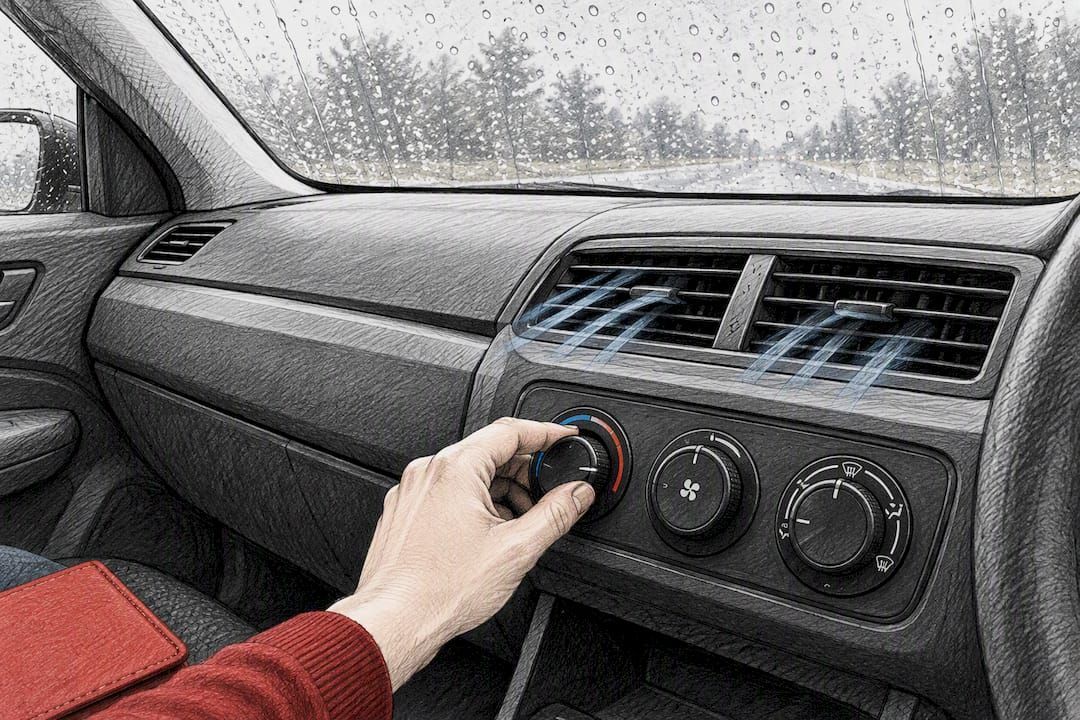
If the windscreen mists up quickly and repeatedly, that's often a sign the cabin air filter is due for a change or there's a slow leak letting damp air build up inside. Keeping the glass genuinely clean helps too. A streaky windscreen scatters headlight glare from oncoming traffic and makes misting harder to see through, so a proper clean with a dedicated glass cleaner removes the residue that ordinary washing misses. Crack a window slightly on a warm, wet day if the system is struggling to keep up, since a small amount of airflow exchange can clear a stubborn mist faster than the blowers alone.
Best practices for road positioning and lane choice
Where you place the car on the road matters more in rain than most drivers realise. Standing water collects at the edges of lanes and in wheel ruts worn into the surface by heavy traffic, so hugging the gutter or straddling a rut both increase your aquaplaning risk unnecessarily.
On single carriageways, position yourself slightly towards the crown of the road where drainage is usually better, while staying alert for oncoming traffic doing the same. On multi-lane roads, a middle lane often clears water faster than the nearside lane, which takes the brunt of run-off from the verge.
Avoid painted road markings and metal drain covers where you can, since both become notably more slippery when wet, particularly for motorcyclists but relevant for car tyres too, especially under braking. At junctions and roundabouts, give yourself extra room from the vehicle ahead rather than sitting close, since a wet surface means their sudden stop becomes your problem within a fraction of a second.
If you're following the crown of a country lane and see spray kicking up ahead of another vehicle, treat it as an early warning of standing water rather than waiting to feel it yourself. Adjust your position gradually rather than swerving. Sudden lane changes on a wet surface are exactly the kind of input that unsettles a car that's already working with reduced grip.
How to handle skids and loss of traction
A skid in the rain is rarely one single mistake. It's usually too much speed, a late brake, or a sharp steering input meeting a road with less grip than the driver expected. Understanding the type of skid helps you respond correctly rather than freezing or overcorrecting.
If the front of the car skids (understeer), it typically means you're asking the front tyres to steer more than they can grip, often while braking or turning too hard for the conditions. Ease off the brake and straighten the steering slightly to let the front tyres regain grip, then steer again once they respond.
If the rear skids (oversteer), the back of the car swings wider than intended, often on a bend taken too fast. Come off the accelerator gently, avoid braking hard, and steer into the direction the skid is taking you, correcting smoothly rather than snapping the wheel back.
The instinct in both cases is to do something dramatic. Resist it. Most skids resolve themselves once the driver stops adding extra inputs and lets the tyres settle. This is one of the reasons braking early and steering separately, rather than combining the two, matters so much in wet conditions: it removes the situation where a skid can start in the first place.
Modern cars with electronic stability control intervene automatically in many skids, cutting power to individual wheels to help you regain a straight line. It's a genuine safety net, but it works within limits set by physics. It cannot create grip that the road surface and your tyres don't have.
Why harsh braking and sudden manoeuvres make things worse
Every emergency input, hard braking, a sharp swerve, a snatched gear change, asks more of your tyres than a wet road can usually deliver. Tyres have a finite amount of grip to share between braking, steering, and accelerating, and in the rain that total amount is already reduced. Ask for more than it can give in one sudden movement, and something has to give: usually the front tyres losing steering grip or the rear stepping out.
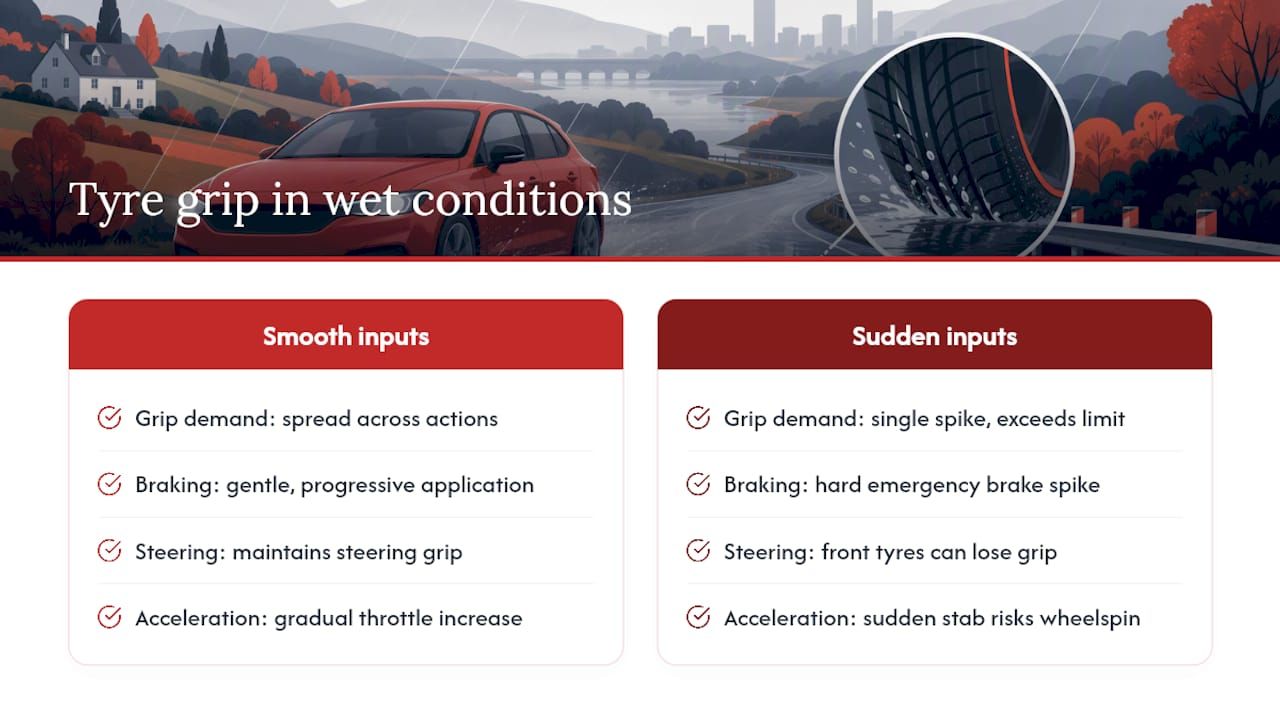
This is why the advice throughout this article keeps returning to the same principle: slow down early, steer smoothly, and brake in good time rather than at the last moment. A gentle, progressive brake application lets the tyres keep working continuously rather than locking or losing traction in a single spike of force. The same logic applies to acceleration out of a bend or a junction. A smooth, gradual increase in throttle keeps the tyres gripping; a sudden stab risks wheelspin on a wet surface, particularly in a lower gear.
Sudden lane changes carry the same risk, especially at speed. A quick swerve to avoid a pothole or a slow vehicle asks the tyres for lateral grip they may not have spare capacity for if you're also carrying speed into the manoeuvre. Wherever possible, plan your positioning early enough that you never need a sudden correction at all. That single habit, thinking further ahead than you would in dry weather, does more to prevent a skid than any reactive skill.
Pre-trip vehicle safety checks specifically for rainy weather
A five-minute check before setting off in wet weather catches the faults that turn a routine journey into a hazardous one. Rain magnifies small vehicle problems that dry roads would forgive.
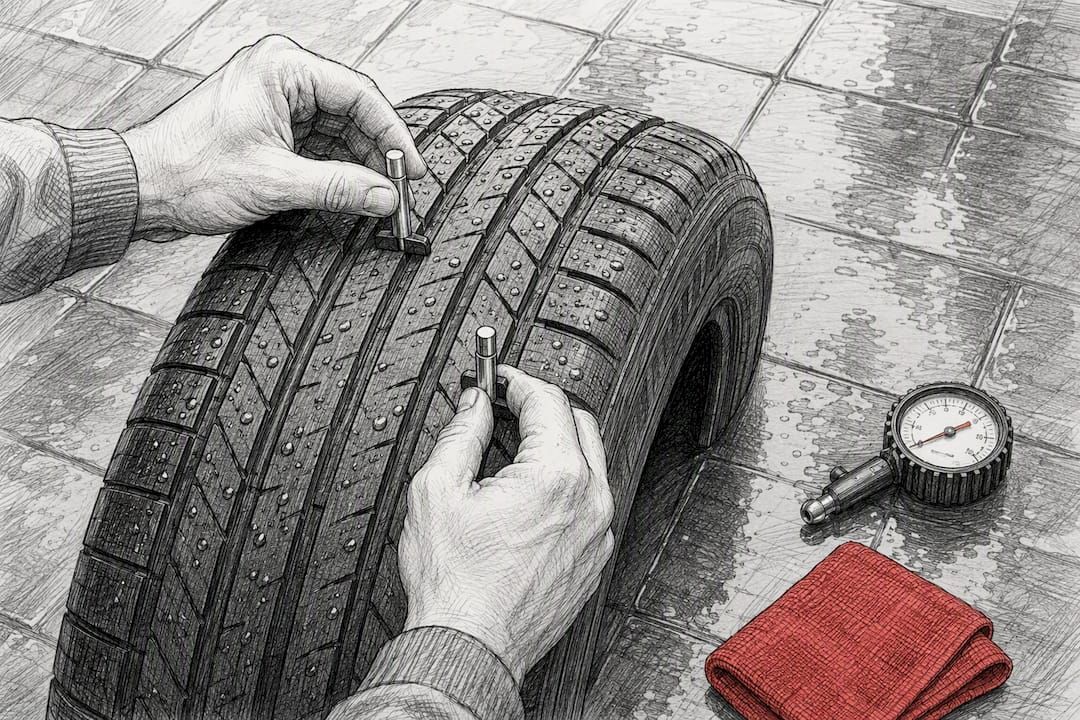
Start with your tyres. Check tread depth at several points across each tyre, not just one spot, since uneven wear can hide a dangerously thin patch. Confirm pressures are correct using the figures in your vehicle handbook, since both under and overinflated tyres reduce the tyre's ability to disperse water through its tread grooves.
Check every light works, including number plate lights and rear fog lights if fitted, since you'll rely on them being seen as much as you rely on seeing. Top up your screen wash with a proper additive rather than water alone, since plain water struggles to shift road grime and can freeze in cold, wet weather.
Inspect your wiper blades by running them once on a dry screen and watching for skipping, smearing, or a torn edge. Replace them if you spot any of these signs; they typically last a year or so before rubber degradation sets in. Check your washer jets aren't blocked, since a clear screen depends on getting fluid onto the glass in the first place.
Finally, glance at your brake pads or have them checked if it's been a while, since worn pads take longer to bite in wet conditions when discs are already coated with a thin film of water.
Perspective: why rain driving advice matters and common mistakes
The biggest error isn't ignorance of the rules. It's treating the speed limit as a target and trusting modern safety aids to cover the gap. Panicked overcorrection during a skid causes more incidents than the skid itself. Small, consistent habits, earlier braking, wider gaps, beat rare dramatic reactions every time.
— Dean
Build wet-weather skills with instructor-led practice
Reading about wet-road technique only gets you so far. Feeling how a car responds when you brake early on a wet bend, or how light the steering goes just before grip returns, is something you learn far faster with a qualified instructor sitting beside you, correcting habits in real time rather than after the fact. DVSA-approved driving instructors can help build wet-weather judgement into ordinary lesson time, not just a one-off session before a test.
If you're a learner still building confidence, standard manual and automatic lessons work through braking, hazard recognition, and speed adjustment in whatever conditions the day brings, including proper rain practice rather than lessons cancelled at the first drop. Nervous or returning drivers who want focused work on a specific weakness, wet-road control included, might get more from Driveability lessons, built around targeted confidence and control work rather than test preparation. Either way, the next step is simple: book a lesson and ask your instructor to prioritise wet-weather practice on the day.
Sources
FAQ
What are two tricks to avoid aquaplaning?
Slow down before you hit standing water rather than during it, since reduced speed gives your tyres more time to channel water away. Keep tyre tread and pressure correct, since worn or underinflated tyres lose their ability to disperse water and are far more likely to lift off the surface.
What should I do if my car starts aquaplaning?
Ease off the accelerator immediately and hold the steering straight without making sudden corrections. Wait until you feel the tyres regain contact with the road, then brake gently once grip has returned, following National Highways guidance on wet-weather recovery.
What should I consider before driving in heavy rain?
Check the forecast and consider whether the journey is essential, since postponing often removes more risk than any driving technique can. If you do drive, plan a route avoiding known flood spots and confirm your wipers, lights, and tyres are in good condition beforehand.
What should a driver do in heavy downpours?
Slow down so you can stop within the distance you can see to be clear, and widen your following gap well beyond the usual two-second rule. Switch on dipped headlights, turn off cruise control, and be ready to pull over safely if visibility drops too far to continue.
What should I do when driving on the motorway in rain?
Increase your following distance further than on ordinary roads, choose a lane less prone to standing water, and avoid sudden lane changes. If visibility becomes too poor to continue safely, exit at the next junction rather than slowing or stopping on the carriageway itself.
Does Costello's Driving School teach wet-weather driving skills?
Yes. DVSA-approved instructors build braking, hazard recognition, and wet-road judgement into standard manual and automatic lessons, rather than treating rain as a reason to cancel practice.
Recommended