The road types that matter for Romford Driving Test Routes
Practise the road types that matter for Romford driving test routes
This is paragraph text. Click it or hit the Manage Text button to change the font, color, size, format, and more. To set up site-wide paragraph and title styles, go to Site Theme.
Romford and Hornchurch practical tests mix busy town junctions, residential streets used for manoeuvres, and A-road or dual carriageway sections where the geography allows it. Expect 20 to 35 minutes of independent driving, and prioritise observation at complex junctions, independent driving decisions, and the four manoeuvres under real local traffic.
Key Points:
- Practising lane decisions at signalized junctions and managing rapid speed changes on arterial roads are key to avoiding faults during the test.
- Independent driving may involve different roads each time depending on sat nav directions or signposting, so focus on familiar road types rather than memorizing routes.
- Emphasizing observation around pedestrians, cyclists, and complex junctions reduces the risk of minor faults escalating into serious ones.
- Booking and practicing during similar times of day improve your familiarity with traffic patterns, which is crucial for passing at Romford.
- Local pass rates and waiting times vary, so regularly check official DVSA data and focus on mastering high-fault areas to improve success chances.
Table of Contents
- Romford test centre basics and what to expect on the day
- What road types and route features are commonly used from Romford
- Common challenge spots on Romford/Hornchurch routes and why candidates fail there
- How independent driving works on the test and how it typically appears on local routes
- Practical ways to practise Romford routes: instructor-led and virtual drills
- What examiners assess and the most common fail reasons at Romford
- Booking, pass rates and where to check Romford/Hornchurch centre statistics
- Local instructor perspective from Costello's
- How Costello's Driving School can help you prepare for Romford tests
- FAQ
- Sources
Romford Test Centre basics and what to expect on the day
The Driving Test Centre on Stanley Road is the local DVSA centre serving Romford and Hornchurch candidates, and it sits amid the residential streets and high-street junctions that feature heavily on local routes. Arriving with time to spare matters more here than at quieter centres, given how quickly nearby roads can back up at peak times.
On the day, bring:
- Your provisional licence (photocard).
- Confirmation of your theory test pass, where applicable.
- Glasses or contact lenses, if you need them to read a number plate at 20 metres.
The practical test itself runs through an eyesight check, a 'show me, tell me' safety question, general driving ability including independent driving, and a reversing manoeuvre, all within a session lasting roughly 40 minutes.
What road types and route features are commonly used from Romford
Routes around the Stanley Road centre draw on a cross-section of Romford's roads rather than one fixed loop. You'll typically encounter high-street junctions near the town centre, access points onto the A124 or A127, and the quieter residential roads examiners use for manoeuvres.
Because independent driving relies on sat nav directions or traffic signs, the exact road types you meet can shift from test to test. Two candidates leaving the same centre on the same morning might face different junctions entirely, depending on which way the satnav sends them.
Typical scenarios worth rehearsing:
- Filtering from a 30 mph residential road onto a faster A-road with little warning.
- Choosing the correct lane at a multi-lane junction before you've fully read the signage.
- Adjusting speed smoothly as you move from town centre traffic onto a dual carriageway slip road.
Treat any unofficial route map as a sample of these features rather than a script to memorise. The value is in knowing which road types turn up repeatedly, not in learning a fixed sequence of turns.
Common challenge spots on Romford/Hornchurch routes and why candidates fail there
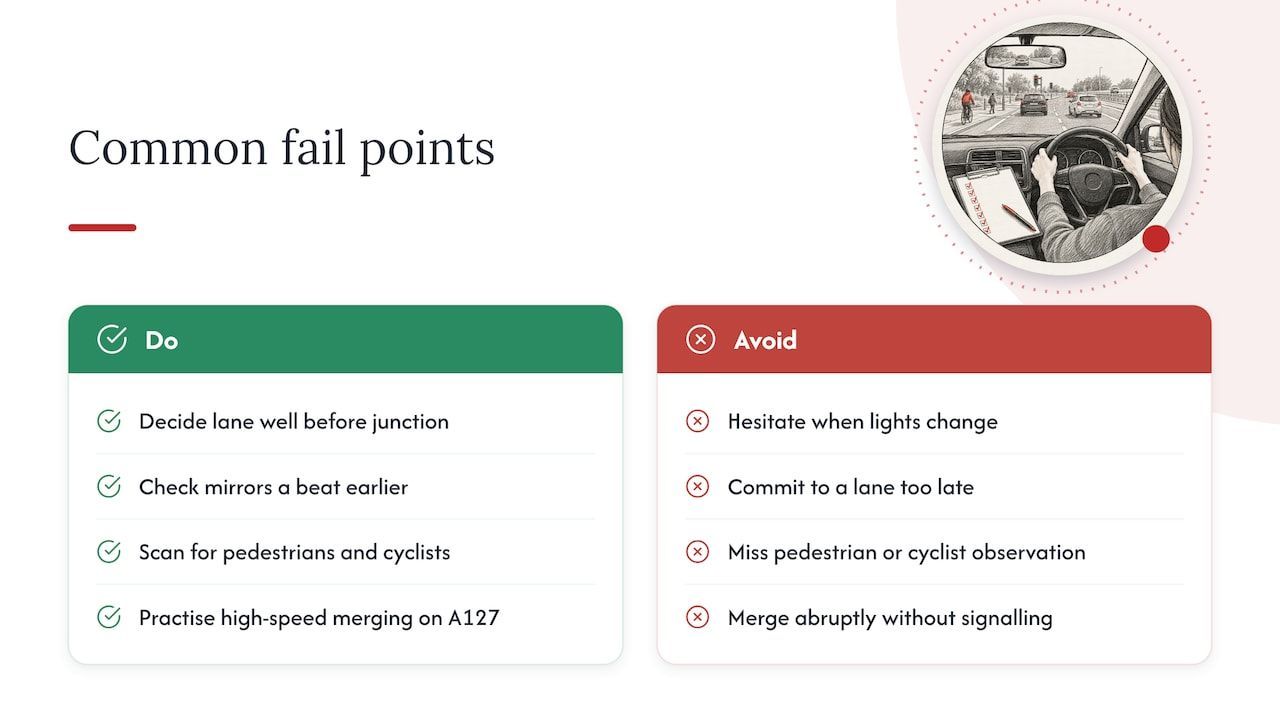
Signalised junctions with multiple lanes cause a disproportionate number of faults locally, mainly because candidates commit to a lane too late or hesitate when the lights change. Early observation and a firm lane decision well before the junction tend to separate confident drives from shaky ones.
Pedestrian crossings and cyclists are another recurring theme. Romford's town centre has steady footfall and cycle traffic throughout the day, and missed observation around pedestrians or cyclists is one of the most common reasons candidates pick up serious faults on urban routes, rather than anything to do with basic car control.
Where routes reach the A127 or similar arterial roads, candidates also need to manage rapid speed changes, sometimes moving from around 30 mph to 70 mph within a short stretch, which catches out drivers who haven't practised merging at speed.
Pro Tip: Practise checking mirrors a beat earlier than feels natural at every junction and crossing: the extra half-second is usually what examiners are actually marking.
How independent driving works on the test and how it typically appears on local routes
Independent driving on the Romford and Hornchurch test lasts roughly 20 to 35 minutes and can be guided by a sat nav, by following traffic signs, or by a mix of both, decided on the day.
A few things help this section go smoothly:
- Stay calm if you take a wrong turn: going off-route isn't a fault in itself, only how you handle the roads you end up on.
- Ask the examiner to repeat an instruction if you missed it rather than guessing.
- Keep checking mirrors throughout, even while concentrating on navigation.
To build this skill before test day, try following spoken map directions without commentary from your instructor, and practise holding your lane position while reading signs rather than swerving mid-decision.
Practical ways to practise Romford routes: instructor-led and virtual drills
Booking focused sessions with a local ADI remains the most efficient way to cover the junctions and road types that come up repeatedly within the test centre's radius, rather than trying to drive every possible road once.
Useful preparation habits:
- Use Google Street View to study tricky junctions and likely manoeuvre bays before you drive them for real.
- Review recent dash-cam footage of local roads to see how traffic actually behaves at the junctions you're worried about.
- Treat any crowdsourced route map as a guide to likely road types, not a fixed script to memorise turn by turn.
- Practise at the same time of day as your booked test, since traffic density on Romford's main roads shifts noticeably between mid-morning and rush hour.
Pro Tip: Repeat your most demanding roundabout or junction three or four times in one lesson rather than once across several lessons: repetition under slightly different traffic conditions builds the judgement examiners are looking for.
What examiners assess and the most common fail reasons at Romford
Examiners mark against a consistent set of criteria wherever you test: observation, speed control, positioning, signalling, and judging safe gaps. None of this is specific to Romford, but the local road mix tends to expose the same weak points repeatedly.
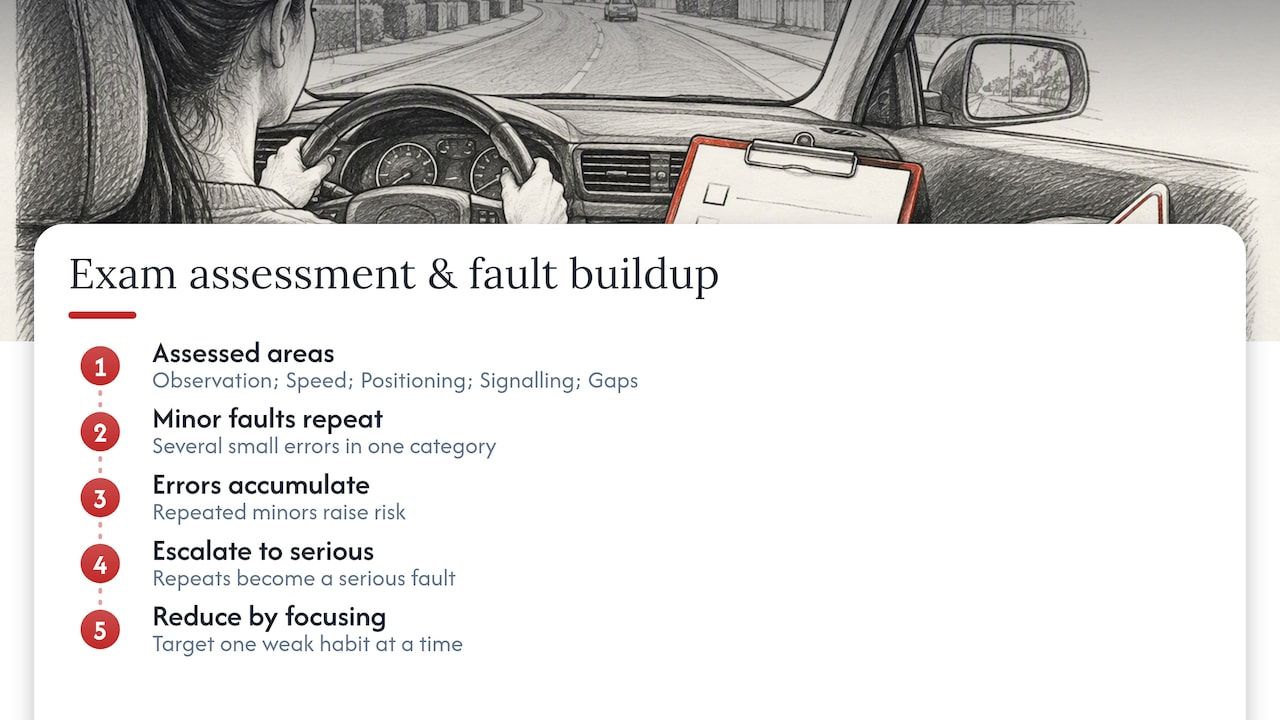
Poor observation at complex junctions, missing cyclists or pedestrians, and hesitant lane choice account for a large share of local faults. None of these are usually single dramatic errors. More often, a candidate picks up several minor faults in the same category, and once those repeat, they escalate into a serious fault.
Reducing cumulative error means targeting one weak habit at a time rather than trying to fix everything in a single lesson.
Booking, pass rates and where to check Romford/Hornchurch centre statistics
The DVSA publishes statistical datasets covering pass rates and waiting times by test centre, which is the only reliable place to check current figures for Stanley Road rather than relying on secondhand claims.
A few things worth knowing before you rely on those numbers:
- Pass rate reflects the whole candidate pool at a centre, not your own readiness, so route familiarity and practice still matter more than the headline figure.
- Waiting times affect how far ahead you need to book, and they can shift through the year.
- New test slots are released on a rolling basis, so checking regularly, rather than once, improves your chances of an earlier date.
- Rescheduling is possible but worth doing early if your original date doesn't suit.
Local instructor perspective from Costello's
Over 25 years teaching learners across Essex, Suffolk, and East London has shown us that candidates who struggle locally almost always struggle at the same handful of junction types, not at random. That's why we weight lessons heavily towards junction observation, independent driving drills, and mock tests that mirror the actual test format, rather than general road time.
— Dean
How Costello's Driving School can help you prepare for Romford tests
If you'd rather have someone map the junctions and manoeuvres above directly into your lessons, that's exactly what a local ADI session does. Costello's offers manual lessons at £37 to £38 per hour and automatic lessons at £42 per hour, alongside intensive courses for learners working to a deadline and a Guaranteed Pass Course at £2,200 for a one-off, outcome-focused programme.
A local instructor can build mock tests around the Stanley Road centre's typical road mix, focusing practice time on the junctions, crossings, and speed transitions covered earlier. Book a driving lesson or look into the Guaranteed Pass Course to get started.
FAQ
Which driving test route in London is the easiest?
There's no official "easiest" route anywhere in London, since the DVSA doesn't publish fixed test routes and examiners vary the roads used even from the same centre. Your best approach is practising the full range of road types near your own test centre rather than chasing a route reputed to be simpler.
How do I check driving test routes?
You can't check an official route, because the DVSA stopped publishing them and routes are managed by examiners on the day. Unofficial route maps and dash-cam reconstructions exist for some centres and are useful as a sample of likely road types, but should never be treated as a script.
What is the pass rate for the Hornchurch driving test route?
Pass rates are recorded by test centre, not by individual route, and the current figures for the Hornchurch area are published in the DVSA's statistical datasets. Checking that dataset directly gives you the latest figure rather than a secondhand estimate.
What are the top 10 hardest driving test centres in the UK?
Difficulty rankings for test centres vary depending on the source and the year, and there's no single official DVSA list ranking centres by difficulty. The more useful official measure is each centre's published pass rate, available through the DVSA's statistical data sets.
Sources