Leave 1.5m for Cyclists: Overtaking rules in UK with Instructor Tips
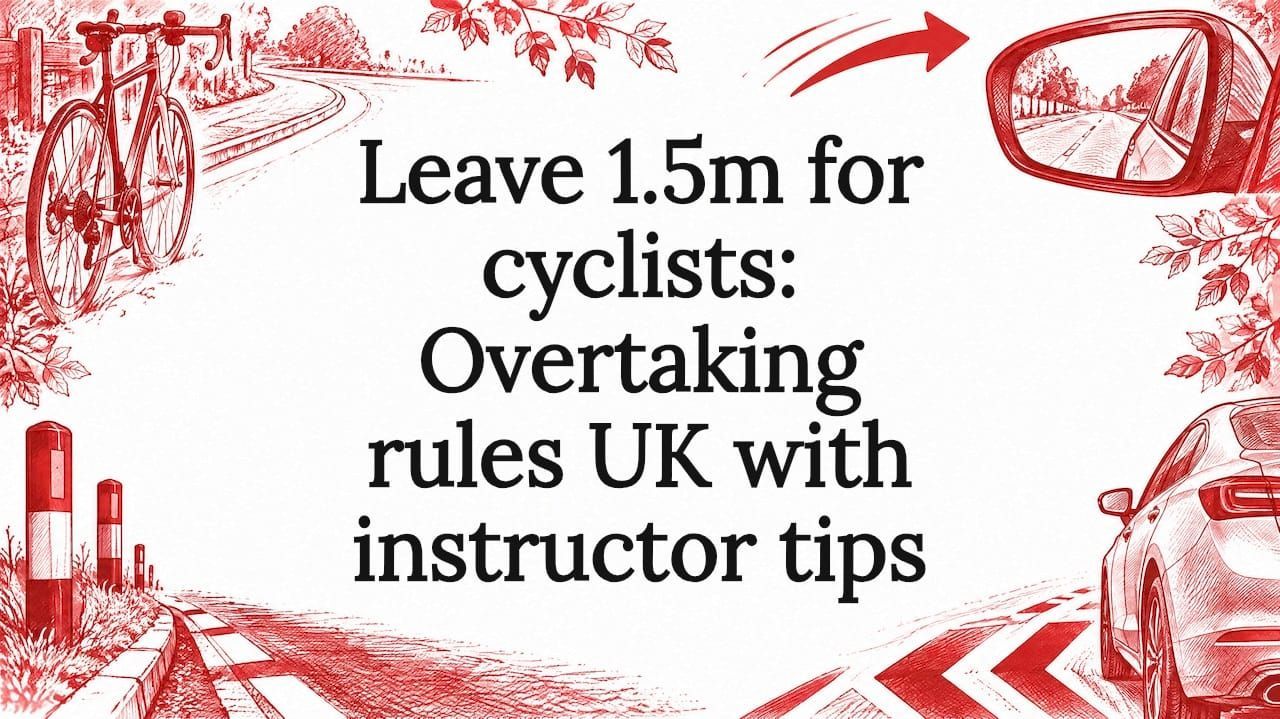
Leave 1.5m for cyclists: Overtaking rules UK with instructor tips
You may overtake when it is safe and legal; undertaking, or passing on the left, is usually discouraged and only acceptable in a few specific situations set out in the Highway Code. Before pulling out, check mirrors, signal clearly, scan your blind spot and give vulnerable road users proper clearance. The responsibility for a safe overtake sits entirely with the driver doing it.
Key Points:
- Overtaking must only be done when it is safe, legal, and involves proper mirror checks, signaling, and blind spot scanning, with no partial maneuvers.
- Passing on the left is lawful mainly in congested traffic, slip roads, or when lanes are traveling at similar slow speeds, but aggressive lane changes turn it reckless.
- Maintain proper space from vulnerable users, like cyclists and horse riders, leaving at least 1.5 meters at up to 30 mph and more in poor conditions; large vehicles require extra clearance.
- On motorways, keep to the left lane unless overtaking, and avoid lane hovering or weaving, which can cause careless or dangerous driving penalties.
- Practice making overtakes on quiet roads with guidance to improve judgment and reduce hesitation, ensuring that every maneuver can be completed safely before committing.
Table of Contents
- What the Highway Code says about overtaking
- When undertaking is allowed, and when it turns careless
- How to overtake safely: a step-by-step checklist
- Overtaking cyclists, horse riders and other vulnerable road users
- Motorway and dual carriageway lane discipline
- Penalties for careless and dangerous overtaking
- Lessons from the driving seat: common overtaking mistakes
- Why disciplined overtaking protects everyone on the road
- Get hands-on practice with overtaking and motorway driving
- FAQ
- Sources
What the Highway Code says about overtaking
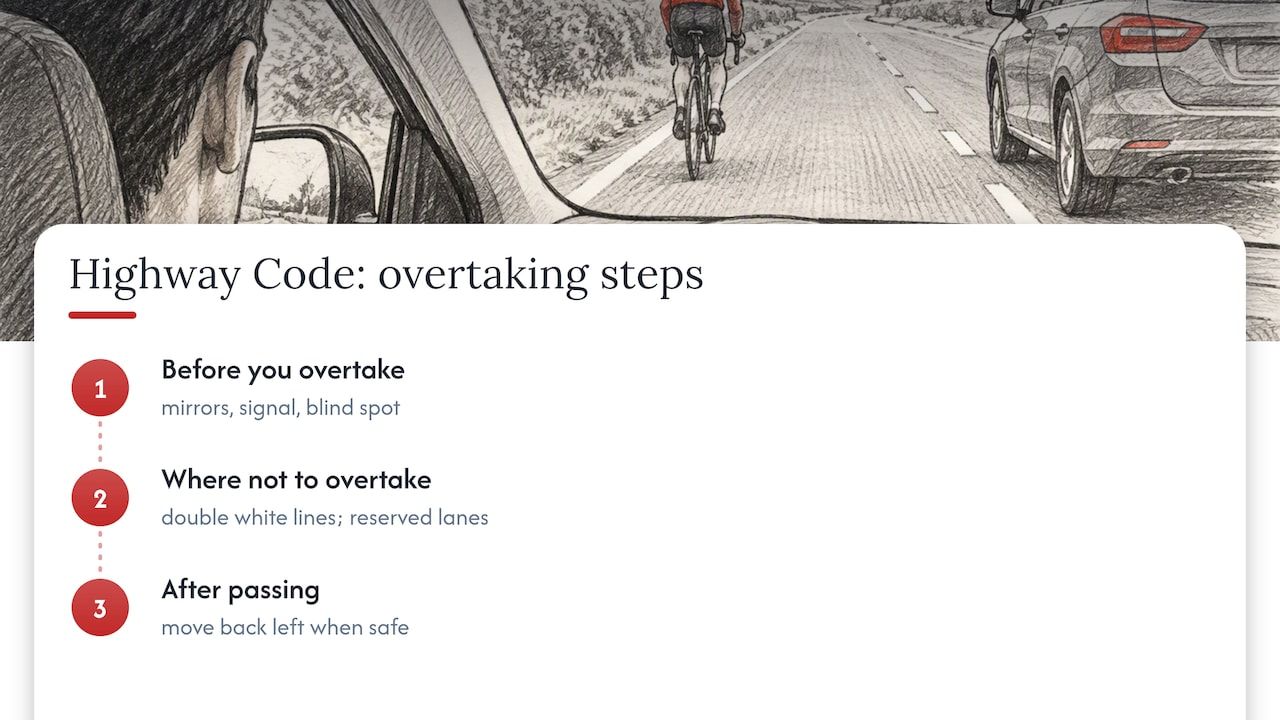
The Highway Code's rules on using the road set the legal framework for every overtake you make. Rules 162 to 167 state that overtaking must only be attempted when it is safe and legal to do so, and you must use your mirrors, signal in good time and check your blind spot before moving out. You should never begin a manoeuvre you cannot see through to completion.
Road markings carry legal weight here too. Double white lines with a solid line nearest you mean no overtaking, and signs banning overtaking apply exactly as written, even on a clear road. Reserved lanes, such as bus or cycle lanes, are off limits for overtaking manoeuvres during their hours of operation.
Once you have passed, Rule 267 requires you to move back to the left as soon as you can safely do so, without cutting in front of the vehicle you have just passed. Lingering in the right-hand lane or position after overtaking is both poor practice and a common fault instructors flag during lessons.
When undertaking is allowed, and when it turns careless
Undertaking, passing a vehicle on its left, is lawful in a narrow set of circumstances. The clearest example is congested traffic moving in queues, where lanes are travelling at similar, slower speeds and the vehicle ahead of you in the outer lane is simply going no faster. Filter lanes and slip roads are another accepted case: if you are correctly positioned to leave at a junction and traffic in your lane happens to be moving faster, you are not undertaking in the unlawful sense.
What tips this into careless or dangerous driving is weaving between lanes to find gaps, undertaking at speed on an open motorway, or cutting back in sharply once past. A driver who darts into the left lane solely to overtake, then swerves back across two lanes, has moved from a grey area into a punishable manoeuvre. The difference usually comes down to intent and traffic conditions: matching the flow of slow traffic is fine, engineering an advantage through aggressive lane changes is not.
How to overtake safely: a step-by-step checklist
Every overtake follows the same pattern, whether you are on a country lane or a dual carriageway.
- Look well ahead and confirm the road is clear of oncoming traffic, junctions, bends or hazards.
- Check your mirrors, then check your blind spot by glancing over your shoulder.
- Signal in good time so other drivers know your intention before you move.
- Move out smoothly and pass decisively, maintaining a steady speed without lingering alongside the other vehicle.
- Check your mirrors again and return to your lane only when there is a safe gap, without cutting in.
- Cancel your signal and settle back to an appropriate cruising speed.
DVSA guidance for driving examiners notes that poor overtaking judgement, particularly late mirror checks and misjudged space, is one of the more common serious faults recorded on test. Gap judgement is a skill built through repetition rather than theory alone.
Pro Tip: Practise overtaking on quiet roads with an instructor first, so you can focus on timing and space without the pressure of heavy traffic.
Overtaking cyclists, horse riders and other vulnerable road users
The Highway Code sets out specific clearances for vulnerable road users, and these are not suggestions. You should leave at least 1.5 metres when overtaking cyclists at speeds up to 30 mph, giving more room at higher speeds, and at least 2 metres for horse riders and horse-drawn vehicles travelling under 10 mph. In poor light, rain or fog, both the Highway Code and guidance on road users requiring extra care recommend giving more space still, or waiting if you cannot do so safely.
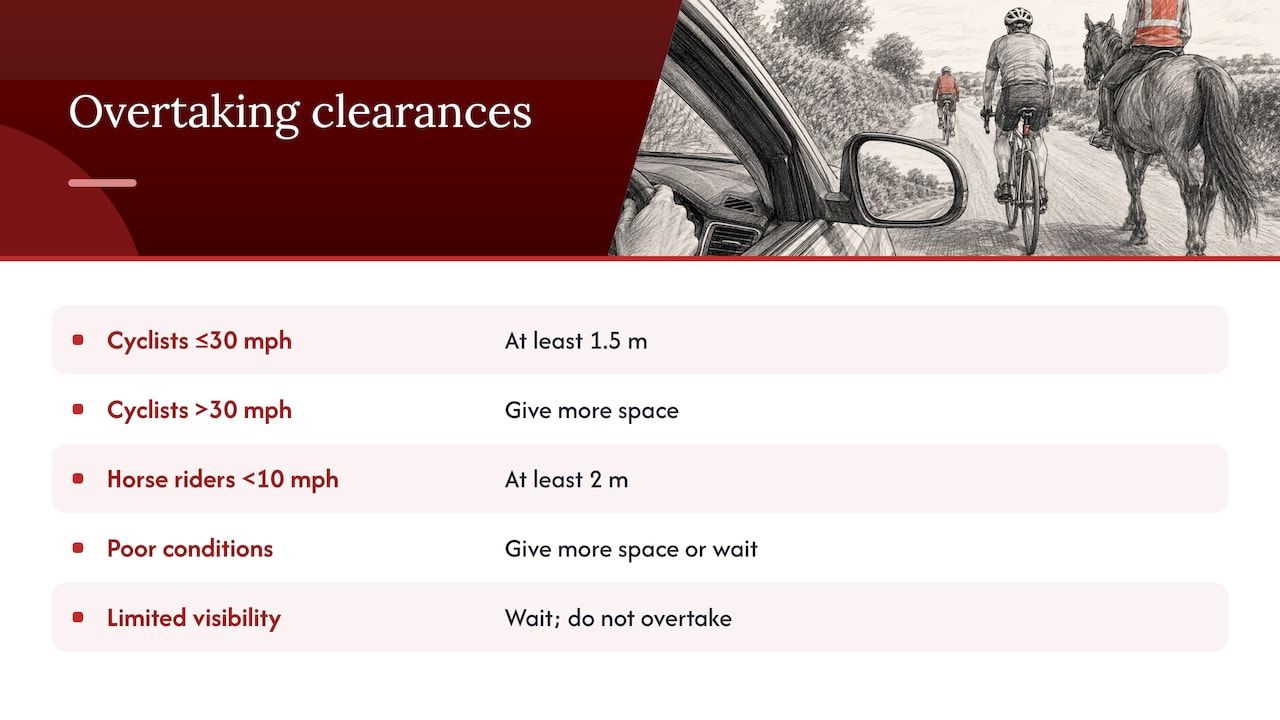
Large vehicles need their own approach: drop back to improve your view ahead before committing, and allow extra distance since lorries and buses take longer to pass. If you are approaching a junction, roundabout or a blind bend, or your visibility is limited for any reason, the right call is to wait rather than force an overtake.
Motorway and dual carriageway lane discipline
On a motorway, Rule 264 requires you to keep to the left-hand lane unless you are overtaking, then return there once you have passed safely. This is why sitting in the middle lane on a quiet motorway is both poor practice and, when it forces others to undertake, a contributing factor in careless-driving incidents.
The one recognised exception is congested or slow-moving traffic. Rule 268 permits you to stay in your lane even if that means passing vehicles on your right in a lane moving faster, as long as you are not deliberately changing lanes to get ahead. Slip roads bring their own judgement calls: joining traffic that is moving at a similar speed to your own, in your own lane, is not undertaking in the punishable sense. Weaving between lanes to gain places is where drivers cross the line.
Penalties for careless and dangerous overtaking
Undertaking itself is not a named offence, but careless or dangerous driving covers the behaviours that often come with it, aggressive lane changes, cutting in, or overtaking without enough room. A common outcome in straightforward careless-driving cases is a fine and penalty points, though the penalty rises where the manoeuvre causes a collision or puts another road user at clear risk.
Police can offer an educational course in lower-level cases, but prosecution becomes likely where there is injury, a near-miss with a vulnerable road user, or evidence of a deliberately reckless manoeuvre. Dashcam footage is increasingly used both to report dangerous overtakes and undertakes, and as evidence once a case reaches court.
Lessons from the driving seat: common overtaking mistakes
Learners tend to make the same handful of errors when practising overtaking: hesitating once committed, checking mirrors too late, or cutting back in before there is a proper gap. Instructors work on these through repeated low-traffic drills, building the habit of a full mirror, signal and blind-spot sequence before any lane change, rather than treating it as a box to tick.
A useful exercise is judging gaps at a standstill first, comparing how a 100-metre gap looks from the driver's seat against how it feels once moving at 50 mph. Breaking the decision into two steps, is it safe and legal to start, and can the manoeuvre be finished without cutting in, helps reduce the aborted, hesitant overtakes that unsettle following traffic.
Why disciplined overtaking protects everyone on the road
Overtaking is never a race against the vehicle ahead. The drivers who overtake well are the ones who treat every pass as optional right up until the moment it is safe, and who are just as comfortable abandoning the manoeuvre as completing it. If you are ever unsure whether your judgement on gaps and timing has slipped, a short refresher session is a quicker fix than learning the hard way on a motorway.
— Dean
Get hands-on practice with overtaking and motorway driving
Reading the Highway Code tells you the rules, but confidence on a live overtake comes from practice with someone watching your mirror checks and timing. We run refresher training for drivers who passed years ago and want to sharpen judgement on dual carriageways and motorways, alongside driveability lessons focused on specific skills such as overtaking, slip roads and lane discipline.
For learners still working towards their test, our manual and automatic lessons build these habits from the start in modern dual-controlled cars, and our intensive driving courses are suited to anyone who wants concentrated practice over a short period. Each option is taught by a friendly instructor.
- Refresher training : rebuild confidence and correct bad habits on dual carriageways and motorways.
- Driveability lessons : targeted sessions on overtaking, gap judgement and lane discipline.
- Intensive courses : concentrated practice for learners who want to progress quickly before their test.
Book a lesson through our driving lessons page and get specific, on-road feedback on your overtaking.
This article is general information, not a substitute for advice from a qualified lawyer. Consult a qualified legal professional about your own circumstances before acting on anything here.
FAQ
What should you do if you want to overtake a long slow-moving vehicle on a busy road?
Wait until you have a clear, uninterrupted view of the road ahead and enough space to complete the manoeuvre without rushing. If you cannot see far enough ahead or the gap looks tight, hold back rather than attempt a partial overtake, since long vehicles take longer to pass safely.
Can I park with two wheels on the pavement?
Pavement parking is generally discouraged under the Highway Code because it can obstruct pedestrians, particularly wheelchair users and people with pushchairs. Rules vary by local authority, with some areas enforcing specific bans, so it is worth checking local signage rather than assuming it is permitted.
What are the general driving rules in the UK?
UK driving is governed by the Highway Code, which sets out legal rules (marked "must" or "must not") alongside advisory guidance, covering speed limits, lane discipline, overtaking, and priority at junctions. Breaching the legal rules can lead to penalties, while the advisory guidance is used to establish what a careful driver would reasonably do.
What must you do when you are being overtaken?
Maintain your speed and position, and avoid speeding up, since this can turn a safe overtake into a dangerous one for the overtaking driver. If it is safe and reasonable to do so, you can ease off slightly to give the other driver more room to complete the manoeuvre.
Sources
Verified against official GOV.UK Highway Code sections and DVSA examiner guidance.