Can you pass with minor faults on your driving test?
Can you pass with minor faults on your driving test?
Yes. The DVSA allows up to 15 driving faults (commonly called "minors") and you can still pass. What actually fails you is different: any single serious fault or dangerous fault ends the test on the spot, regardless of how clean the rest of your drive was.
- Pass rule: 15 or fewer driving faults, with zero serious or dangerous faults
- Automatic fail: one serious fault or one dangerous fault, no exceptions
- Watch for escalation: repeating the same minor mistake several times can push it into serious territory
- Check the record: your digital test report shows exactly what was marked and why
Key Takeaways
Passing with minor faults is entirely normal; failing usually comes down to one serious mistake or the same minor repeated until it stops looking minor.
| Point | Details |
|---|---|
| Pass threshold | Up to 15 driving faults are allowed; 16 or more means a fail on accumulation. |
| Instant fail rule | Any single serious or dangerous fault ends the test immediately. |
| Escalation risk | Repeating the same minor mistake, such as stalling, can be judged as serious by an examiner. |
| Common fault areas | Mirrors, control, positioning, signalling and speed judgement account for most recorded minors. |
| Practice rhythm | Weekly mock tests paired with focused, single-fault drills reduce recurring minors fastest. |
Table of Contents
- What is a minor driving fault, and how does it differ from serious and dangerous faults?
- How many minors can you have before it becomes a fail?
- What are the most common minor faults, and how do you fix them?
- How do examiners record and explain your faults afterwards?
- A practice plan that actually reduces minors before test day
- How Costello's Driving School helps you cut minor faults
- What the fault rules actually tell you to prioritise
- Sources
- FAQ
What is a minor driving fault, and how does it differ from serious and dangerous faults?
A driving fault (the official DVSA term for what most people call a "minor") is a mistake that isn't potentially dangerous on its own. A serious fault is one that could have caused actual danger. A dangerous fault means real danger occurred, to you, the examiner, or someone else on the road. One serious or dangerous fault ends the test in a fail, no matter how well the rest of the drive went.
Here's the part learners often miss: examiners mark the effect of what you did, not the reason behind it. Forget to check your mirror and it has no consequence? That's a minor. Forget to check it and you have to swerve? That's serious, even though the cause, a missed mirror check, is identical in both cases.
To keep judgements fair across thousands of tests a week, examiners use a mental consistency check sometimes called the "16th fault" exercise: would this same mistake, repeated, still only be worth a minor at fault number 16, or would it have become dangerous by then? Official DVSA guidance uses this to keep marking standards consistent between examiners and test centres.
- Driving fault: no potential danger caused
- Serious fault: potential danger caused
- Dangerous fault: actual danger caused
How many minors can you have before it becomes a fail?
The number that matters is 15. Reach 16 driving faults and you fail on accumulation, even if every single one was minor and nothing was ever close to dangerous. Here's how the maths plays out in practice:
- 14 minors, no serious faults: you pass, even if the drive felt scrappy throughout.
- 16 minors, no serious faults: you fail purely on volume, under the official pass criteria.
- 3 minors plus one serious fault: you fail immediately when the serious fault is recorded, regardless of the low minor count.
- The same minor mistake three times in a row: an examiner can use discretion to judge that the pattern itself now represents a risk, and escalate it to serious.
That last scenario catches out more learners than people realise. Stalling once at a junction is a minor. Stalling repeatedly at every junction on a busier road starts to look like a control problem an examiner can't ignore.
What are the most common minor faults, and how do you fix them?
Most minors cluster around six areas, and the DVSA's own failure data backs this up: control, observation, signalling, positioning and speed show up again and again in test reports. Here's what causes each, and the single drill that fixes it fastest.
- Missed or late mirror checks. Practise timed mirror checks paired with commentary driving, saying out loud what you see and why you're checking, until it becomes automatic rather than an afterthought.
- Stalling or selecting the wrong gear. Run short, repeated clutch-control drills on a quiet road: pull away, stop, pull away again, focusing purely on the biting point until your foot stops thinking about it.
- Poor kerb positioning. Practise slow, repeated kerb-distance drills in a car park or empty road, correcting position in small increments rather than big swerves.
- Late or missed signals. Use cue-based signalling practice, picking fixed points (a lamppost, a road sign) as your trigger to signal, rather than reacting to junctions as they appear.
- Hesitation or misjudged speed. Paced driving exercises, where your instructor calls out target speeds on different road types, build the judgement that usually only comes with mileage.
- Rushed junction observations. Planned observation drills using fixed reference points (kerb lines, give-way markings) stop you pulling out on guesswork.
Pro Tip: Isolate one fault at a time. Spend an entire lesson only on mirror checks, or only on clutch control, before moving to the next. Trying to fix five habits simultaneously is how learners end up fixing none of them. Costello's Driving School builds this kind of hazard perception practice into lessons for exactly this reason.
How do examiners record and explain your faults afterwards?
Every fault, minor or otherwise, goes onto the digital test report under specific categories such as control, observation, and manoeuvres. The write-up obligations differ depending on how you failed.
- If you fail on 16+ accumulated minors, the report normally lists a full breakdown so you can see exactly where the faults piled up.
- If a single serious or dangerous fault causes the fail, the debrief tends to focus on that critical moment rather than every minor around it.
- Ask your examiner directly, at the debrief, which fault categories came up most, and request the emailed report the same day so you can go through it properly with your instructor.
A practice plan that actually reduces minors before test day
Unfocused practice rarely fixes recurring minors. What works better is a short, repeatable rhythm built around one mock test a week alongside two or three targeted lessons.
- Book one mock test weekly in the run up to your test date, treating it exactly like the real thing, nerves included.
- Isolate one fault per lesson. If mirror checks were flagged last time, that's the only thing you work on this week, with a clear, measurable goal (every mirror check called out loud, every time).
- Add junction and speed-judgement drills once control faults settle down, using fixed reference points rather than guesswork.
- Ask your instructor for specific feedback , not general encouragement. "You missed your mirror check twice at roundabouts" is far more useful than "that was good."
- Record a lesson on your phone occasionally and watch it back. Seeing your own hesitation at a junction lands differently than being told about it.
Pro Tip: A weekly mock test paired with focused drills between sessions tends to convert repeated minors into consistent good habits faster than scattered, general practice. Reading up on managing test-day nerves alongside this routine helps too, since anxiety is often what turns a fixed habit back into a shaky one under pressure.
How Costello's Driving School helps you cut minor faults
Costello's Driving School builds lessons around exactly the faults above: DVSA-approved instructors, dual-controlled cars for safer control practice, and structured mock tests as part of every course. The Guaranteed Pass package and pass-focused lessons target mirror use, junction observation, and control directly, tailored to each learner across Essex and Suffolk.

What the fault rules actually tell you to prioritise
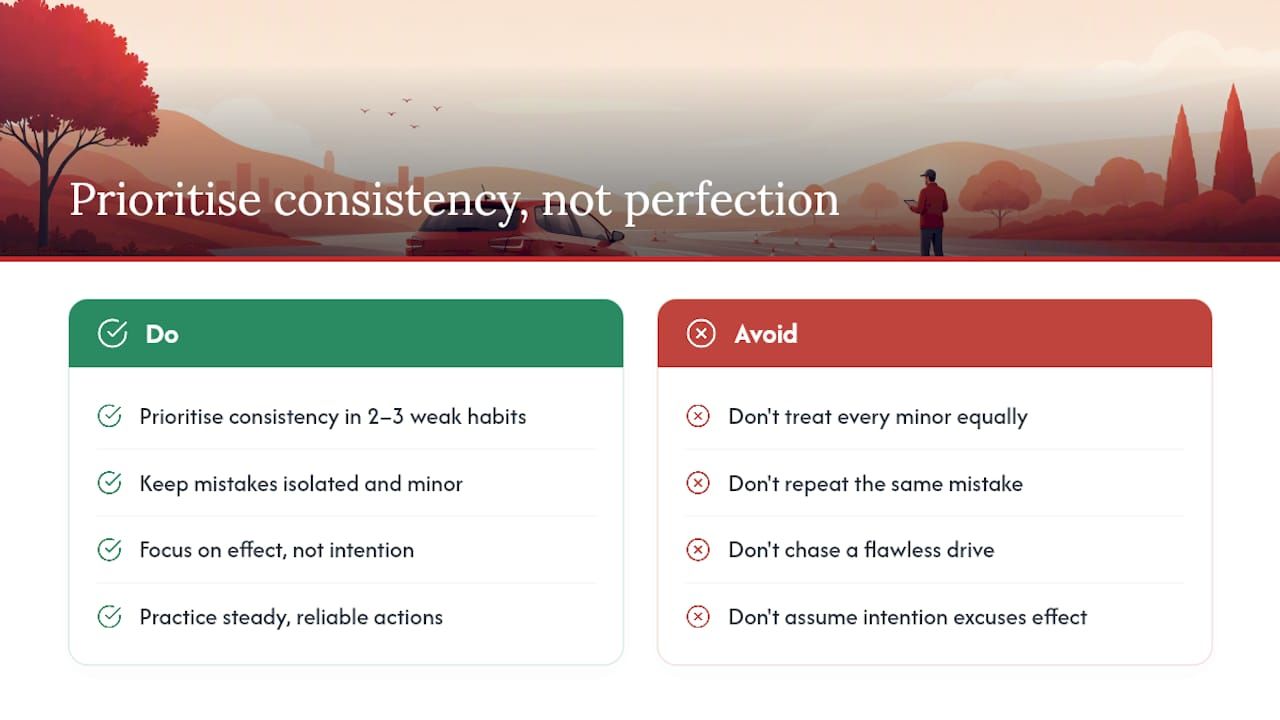
The conventional advice on minors is to "just be careful," which is close to useless. The DVSA's own marking guidance tells a more specific story: examiners watch for effect, not intention, which means its all about consistency. A slightly rough gear change that never causes a problem is worth less concern than a smooth one that occasionally forces you to react sharply potentially affecting other road users.
Where most learners go wrong is treating every minor as equally threatening. They aren't. A single missed mirror check barely registers. The same mistake three times in similar circumstances starts to look, in an examiner's eyes, like a pattern rather than a slip, and that's when discretion kicks in. If you're prioritising anything in the final fortnight before your test, prioritise consistency in your two or three weakest habits over chasing a flawless drive. Nobody drives a test flawlessly. The learners who pass are the ones whose mistakes stay isolated, minor, and never repeat themselves into something bigger.
— Dean
FAQ
What counts as a minor mistake in a UK driving test?
A minor, officially called a driving fault, is a mistake that isn't potentially dangerous, such as a hesitant mirror check or a slightly late signal. You can have up to 15 of these and still pass.
How many minors cause a driving test fail in the UK?
Reaching 16 or more driving faults fails the test on accumulation, even without a single serious or dangerous fault recorded.
Is there an official list of the 15 minor faults?
No fixed list of 15 named faults exists; 15 is simply the maximum number of driving faults you can accumulate and still pass. Common examples include mirror checks, gear selection, positioning and signalling, drawn from DVSA's failure data.
What are the top reasons people fail their driving test in the UK?
Observation at junctions, poor mirror use, and control issues like stalling or incorrect gear selection are among the most frequently recorded reasons for failure, according to DVSA's published failure statistics.
Recommended