When to hire or buy dual control cars for learners and ADIs
When to hire or buy dual control cars for learners and ADIs
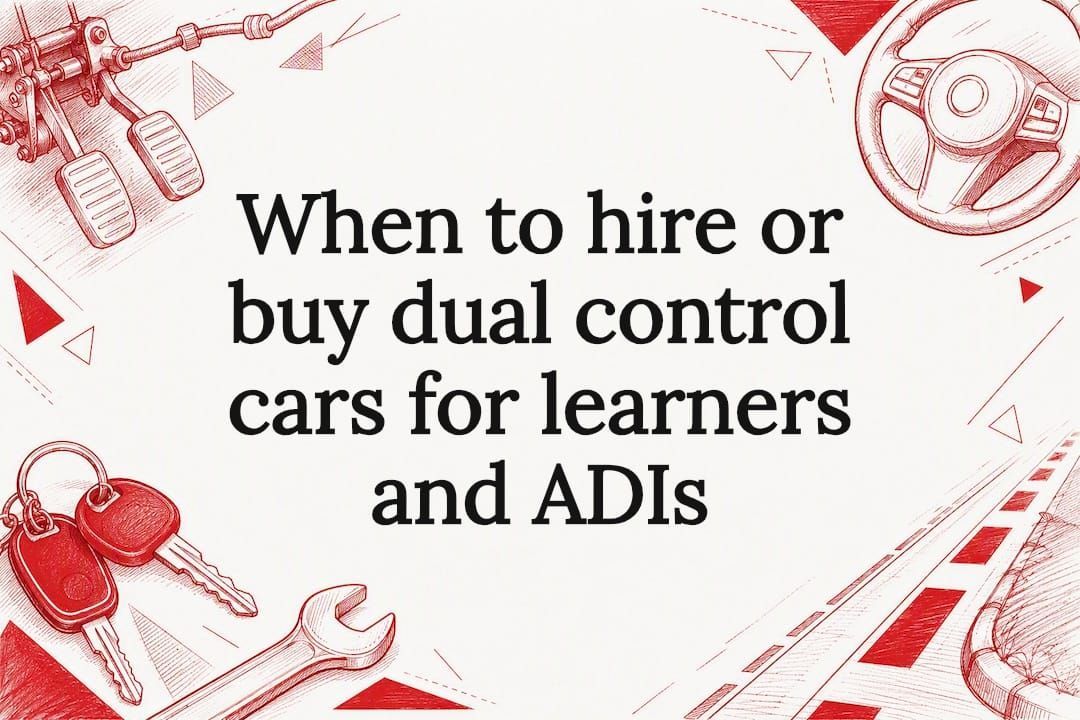
A dual control car is a manual or automatic vehicle fitted with a second brake pedal (and, in manuals, a second clutch) on the passenger side, giving an instructor direct control if a learner freezes, stalls, or reacts too slowly… If you're a learner needing supervised practice or motorway tuition, or an instructor setting up lessons, you need one. Costello's Driving School is one provider using modern dual-controlled vehicles across its lesson packages.
Key Points:
- Dual control cars are essential for safety and effective teaching, especially during initial lessons or motorway practice, with automatic models only requiring a second brake pedal.
- The mechanical linkage of dual controls remains functional without relying on electronics, which ensures safety even during electrical failures, but it does not enable steering control by the instructor.
- Fitting new dual controls takes a few hours to a day, and urgent checks before lessons should include pedal resistance, mountings, seat belts, mirrors, and valid paperwork; any mechanical inconsistency warrants immediate inspection.
- Short-term hiring is suitable for specific tasks like motorway practice, but long-term leasing or buying is more cost-effective for ongoing instruction, with clear oversight on insurance and installation certification crucial.
- Legal rules mandate a certified instructor, valid provisional license, and proper dual control installation, especially for supervised motorway driving and during practical driving examinations.
Table of Contents
- What is a dual control car and how does it work?
- Why do instructors rely on dual controls?
- Hiring, leasing or buying: what does it actually cost?
- What are the legal rules around dual control cars?
- Fitting, maintenance and pre-lesson checks
- How do you choose or hire the right dual-control car?
- How Costello's Driving School runs dual-control lessons safely
- When does hiring a dual-control car actually make sense?
- Ready to start? Book a lesson with modern dual-controlled vehicles
- Sources
- FAQ
What is a dual control car and how does it work?
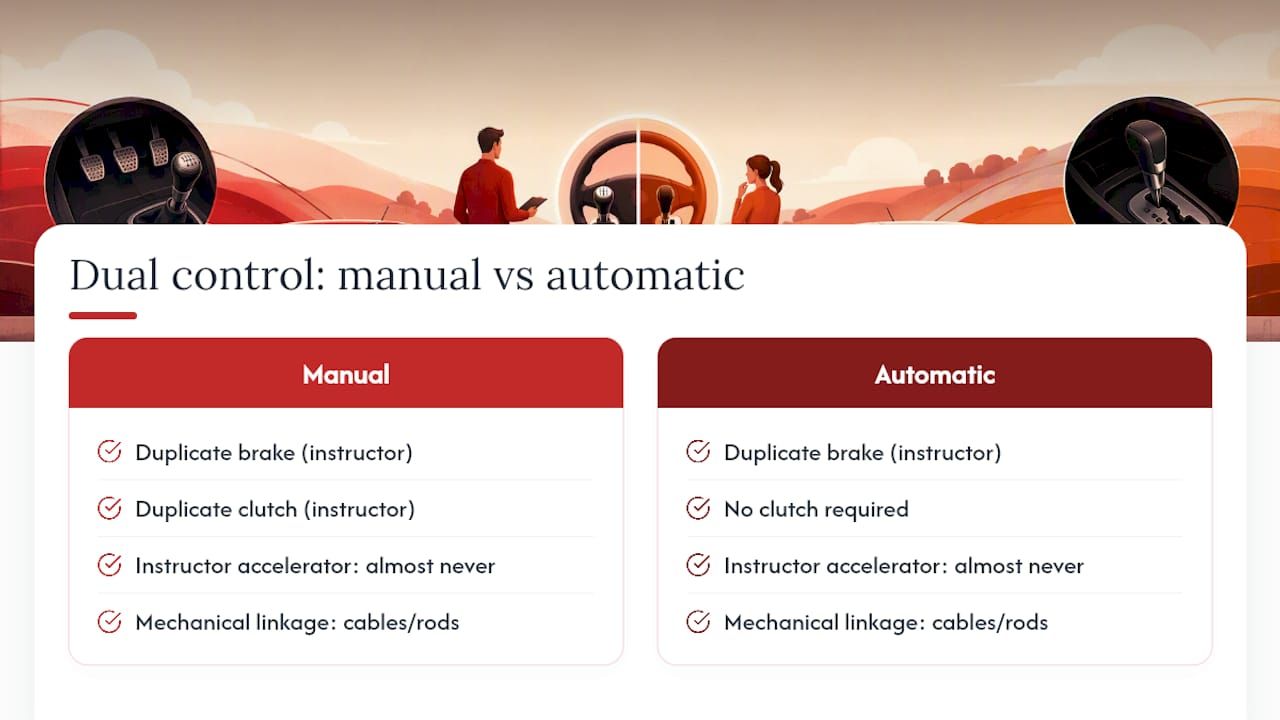
The mechanics are simple once you see them. In a manual dual control car, the instructor's footwell gets a duplicate brake and a duplicate clutch, wired through cables or rods to the same pedals the learner uses. Automatics only need a duplicate brake, because there's no clutch to manage and the accelerator stays firmly on the learner's side. Instructors almost never get a second accelerator pedal, and that's deliberate: dual controls exist to stop or slow the car, not to let an instructor drive it from the passenger seat.
The linkage matters more than most learners realise. A dual control system connects mechanically, through cables or rods, rather than depending purely on electronics, so it still works if the car's electrics glitch. That's a meaningful safety margin. What it doesn't give an instructor is any control over steering. If a learner drifts towards a kerb or another vehicle, the instructor can brake or declutch, but cannot physically steer the car straight.
Why do instructors rely on dual controls?
Two reasons, and they work together. The first is obvious: safety. A dual control pedal lets an instructor stop the car the instant a learner misjudges a junction, freezes at a roundabout, or stalls in traffic, preventing what could otherwise be a collision. The second reason gets less attention but matters just as much: teaching flow.
Instructors describe using dual controls as a "gradual release" method, stepping in early during a learner's first few lessons and easing off as confidence builds, which speeds up how quickly learners gain real autonomy behind the wheel. Rather than constantly correcting a nervous learner verbally, which breaks concentration and increases anxiety, the instructor can quietly manage the risk and let the lesson continue. Practitioner commentary backs this up directly: instructors treat dual controls as an active coaching tool and safety net, not just emergency kit gathering dust until something goes wrong.
That combination shows up in how lessons are actually run:
- Early lessons: instructor intervenes more, learner focuses purely on observation and coordination
- Mid course: intervention drops as basic control becomes automatic
- Pre-test lessons: dual controls used mainly as a psychological safety net, rarely touched
Pro Tip: Ask any instructor how often they've actually used the brake pedal in the last month. A low number is a good sign. It usually means the learner is progressing well, not that the car lacks proper controls.
Hiring, leasing or buying: what does it actually cost?
Most learners never need to think about this. Costs and access only become your problem if you're an instructor setting up to teach, or a school scaling up its fleet. Three realistic routes exist.
Short-term hire suits instructors covering a gap, or learners needing supervised motorway practice in a car they don't own. Providers typically bundle insurance, mileage allowances, and a fuel policy into the daily or weekly rate, so check exactly what's included before signing anything.
Long-term hire or lease is the standard route for working ADIs. These deals often fold in servicing and maintenance, which matters because a fault in a dual control system isn't something you want discovered mid lesson.
Buying and retrofitting suits instructors planning to stay with one vehicle for years. Fitting itself is mechanical work, but retrofitting can also affect your insurance quote, since modifying the vehicle needs declaring to the insurer.
Red flags to watch for in any hire agreement:
- Vague mileage caps buried in small print
- No clarity on who pays for wear to the dual control mechanism itself
- Insurance cover that excludes learner drivers specifically
What are the legal rules around dual control cars?
The rules split into two categories: who can supervise a learner, and where a learner can drive.
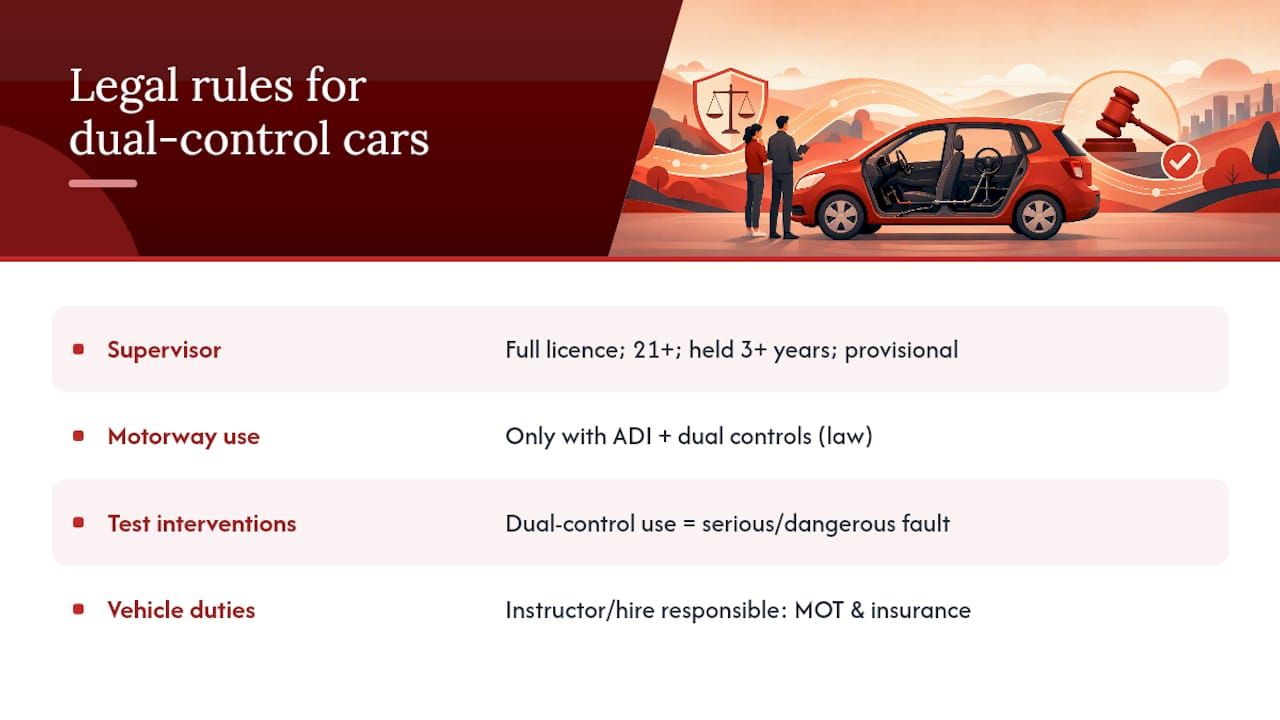
Supervision rules are set by DVSA guidance: a supervisor must hold a full licence for the vehicle category, be at least 21 and have held that licence for a minimum of three years. The learner needs a valid provisional licence throughout.
Motorway driving is the one area where dual controls stop being optional. Under gov.uk guidance, a learner can only drive on a motorway when supervised by an approved driving instructor in a car fitted with dual controls. This isn't guidance in the loose sense. The Motorways Traffic (England and Wales) (Amendment) Regulations 2018 inserted this exception into law specifically to permit supervised motorway practice, and it only applies when both conditions, ADI and dual controls, are met together.
During the practical test, examiners record any physical intervention through dual controls, and it typically counts as a serious or dangerous fault, often ending the test on the spot. Instructors and hire companies also carry responsibility for MOT status and insurance on any modified vehicle used for tuition.
Fitting, maintenance and pre-lesson checks
Fitting a dual control system is quick, professional work: most installers finish in a few hours to a full day, depending on the make and model, testing pedal travel and mounting security before signing the car back off for use.
Before any lesson, a competent instructor runs through this:
- Press both brake pedals fully to confirm equal resistance and travel
- Check pedal mountings for looseness or unusual play
- Confirm both seat belts and adjustable mirrors are functional on both sides
- Verify current MOT, insurance, and dual control certification paperwork is in the car
If a pedal feels spongy, delayed, or mechanically inconsistent between checks, pull the car from service and get it inspected by a certified installer immediately.
How do you choose or hire the right dual-control car?
Start with fit for purpose. If you're learning in a car with a clutch, you need a manual dual control vehicle with both duplicate pedals; if you're training on an automatic, a duplicate brake alone is standard, and choosing between the two shapes which cars are even relevant to you.
Before hiring or buying, confirm:
- Insurance covers learner drivers specifically, not just the named instructor
- The instructor is DVSA-approved, which matters for both legality and lesson quality
- The vehicle's dual control system was fitted by a certified installer, with paperwork to prove it
- Pedal condition and mounting security have been checked recently, not just at initial fitting
When talking to a provider, ask directly: who installed the dual controls, is there a warranty on the system, what's the cancellation policy, and is pricing genuinely all inclusive or padded with extras later. Reputable schools generally use recognised installer brands and can answer these questions without hesitation, since bespoke fitting per vehicle model is standard practice among serious installers.
Pro Tip: If a provider can't tell you who installed their dual controls or when they were last inspected, that's your answer. Walk away and find one who can.
Red flags include vague answers about insurance cover for learners, no proof of installer certification, and contracts that lock you in without a clear exit if the vehicle turns out to be poorly maintained.
How Costello's Driving School runs dual-control lessons safely
Some driving schools build their approach around extensive tuition experience, using modern dual-controlled vehicles in both manual and automatic forms. Instructors are often DVSA-approved, and lessons are structured across formats, including standard weekly lessons, intensive courses, and Guaranteed Pass packages, so learners can choose a pace that suits them.
Booking logistics stay straightforward: learners pick a lesson type through the driving lessons page, and prospective instructors interested in joining can look at the school's instructor training route to understand how DVSA-approved status and dual-control competence get built in from day one.
When does hiring a dual-control car actually make sense?
Short-term hire earns its cost when you need a specific outcome fast, motorway practice before a test, or a one-off session in a car type you haven't driven. For anything ongoing, arranging lessons with an instructor who already owns a well-maintained dual-control vehicle is simpler and usually cheaper over time. Nervous learners and those switching from manual often do better in automatics, where one less pedal means one less thing to worry about. Whichever route you take, confirm insurance and instructor credentials before the first lesson, not after.
— Dean
Ready to start? Book a lesson with modern dual-controlled vehicles
Costello's Driving School gives you a straightforward way to skip the hire-versus-buy decision altogether: book lessons in a well-maintained, modern dual-controlled vehicle without arranging insurance, checking installer paperwork, or negotiating a hire contract yourself.
Whether you need standard weekly lessons, an intensive course to pass quickly, or the structure of a Guaranteed Pass package, every instructor is DVSA-approved and every car is fitted with properly maintained dual controls, manual and automatic both available. If you're weighing up hiring a car privately against simply booking lessons, the second route removes the paperwork, the insurance checks, and the uncertainty over who fitted the pedals. Check availability and book directly through the driving lessons page to get a lesson slot that fits your schedule.
Sources
For the legal detail behind this guide, see gov.uk's guidance on supervising a learner driver and the 2018 motorway regulations amendment permitting supervised motorway lessons.
FAQ
How much does it cost to fit dual controls in a car?
Fitting costs vary by make, model, and installer, and typically take a few hours to a full day of mechanical work; buying and retrofitting only makes sense if you plan to keep the vehicle long term.
What is a car with dual controls?
It's a manual or automatic vehicle fitted with a second brake pedal, and a second clutch in manuals, on the passenger side, letting an instructor intervene directly if a learner needs help.
Is it hard to drive a dual control car?
No, driving one feels identical to any other car from the driver's seat; the duplicate pedals sit on the passenger side and don't interfere with normal driving at all.
Can you turn off dual controls in a car?
Dual controls aren't typically switched off, since the mechanical linkage stays active by design as a constant safety measure, though a well-fitted system stays unobtrusive when the instructor isn't using it.
Do I need a dual-control car for motorway lessons?
Yes. Under the 2018 amendment to motorway regulations, learners can only drive on motorways when supervised by an ADI in a car fitted with dual controls.
Recommended