ADI Part 3 Marking Sheet Explained: 17 Competencies
ADI Part 3 Marking Sheet Explained: 17 Competencies
The ADI Part 3 marking sheet is the form the DVSA examiner fills in while watching you teach a real pupil. It has 17 competencies in three areas: lesson planning, risk management, and teaching and learning strategies. Each one is scored from 0 to 3, giving a maximum of 51. You need 31 to pass, and you fail automatically if you score 7 or less for risk management. Here is what each line means, how the scores add up, and how to prepare for them.
Key Takeaways
- The sheet has 17 competencies across three areas, each scored 0 to 3, for a top score of 51.
- 31 to 42 is Grade B, 43 to 51 is Grade A, and 30 or below is a fail.
- A risk management score of 7 or less is an automatic fail, however well the rest of the lesson goes.
- Examiners mark the elements behind each competency, so prepare at that level, not just the headline wording.
- A PDI (trainee) holds a pink badge and an ADI (fully qualified) holds a green one. Passing Part 3 is the step between them.
Table of Contents
What the marking sheet is and how the test runs
The Part 3 test checks your instructional ability: can you teach a pupil to drive, not just drive well yourself. The DVSA publishes the ADI Part 3 test report form on GOV.UK. Examiners use a digital version of it on the DES app to mark lesson planning, risk management and teaching and learning strategies.
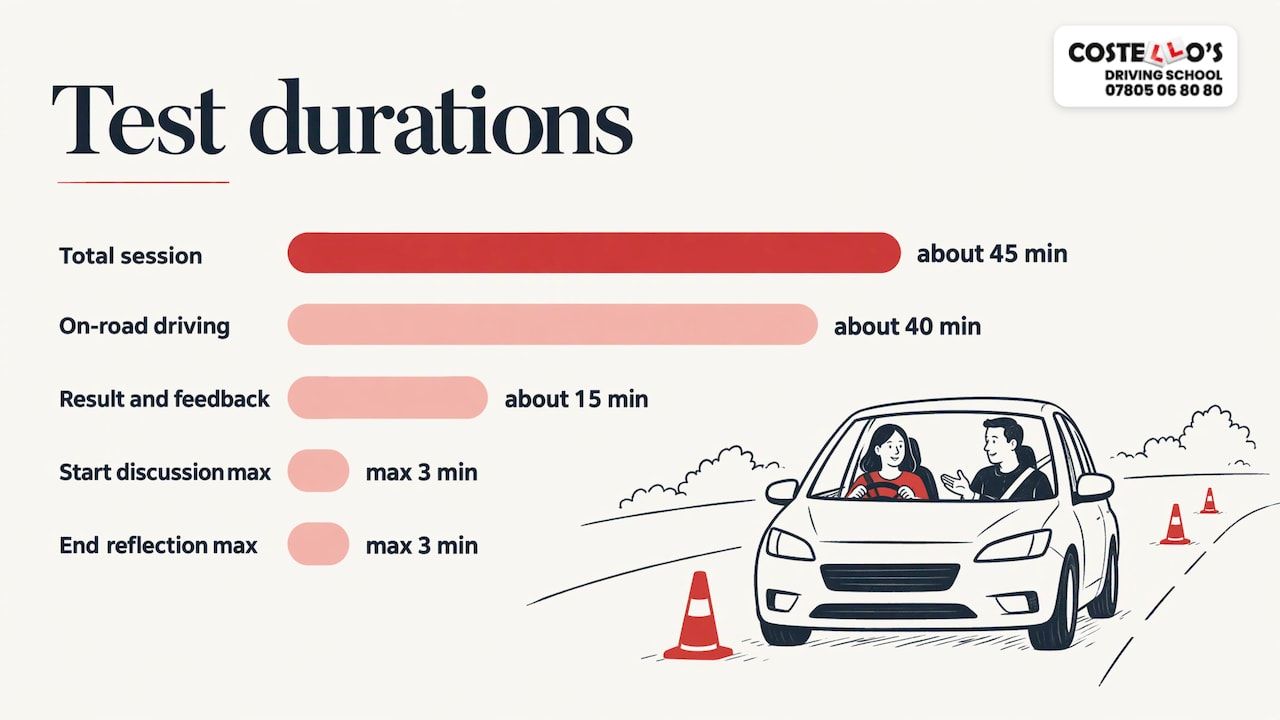
You bring a pupil with you, and the test is a real lesson. DVSA examiner guidance describes the session as about 45 minutes in total, with roughly 40 minutes on the road. There is a short discussion beforehand about the pupil and their training records. Afterwards you get about 15 minutes for the result and feedback, according to the DVSA guidance for examiners.
The DVSA's own description of the test sets out the shape of the lesson:
- Spend no more than 3 minutes at the start discussing lesson goals and risk management with your pupil.
- Let the pupil drive for about 40 minutes.
- Do not spend the whole lesson on a manoeuvre. A short recap is allowed.
- Allow no more than 3 minutes at the end for reflection.
The form also records the lesson theme and the driving areas you covered. The options include junctions, town and city driving, interaction with other road users, dual carriageways and faster-moving roads, defensive driving, use of mirrors, rural roads, motorways, eco-safe driving, a recap of a manoeuvre, commentary, a recap of the emergency stop and independent driving. There is also a review section. It flags the two automatic-fail conditions and whether you were advised to seek further development, as shown on the official marking sheet.
At the end of the test the examiner talks through your performance. Your result and the completed report are then emailed to you, according to the GOV.UK test result page.
How the scoring works
Every competency is marked on the same four-point scale, as set out in the DVSA examiner guidance:
| Score | Meaning |
|---|---|
| 0 | No evidence of competence |
| 1 | A few elements of competence demonstrated |
| 2 | Competence demonstrated in most elements |
| 3 | Competence demonstrated in all elements |
The scores are totalled across all 17 lines. The same GOV.UK page gives the grades:
| Total score | Result | What it means |
|---|---|---|
| 0 to 30 | Fail | You will not join the ADI register |
| 31 to 42 | Grade B | You can join the ADI register |
| 43 to 51 | Grade A | High standard of instruction, and you can join the register |
There are two ways to fail whatever your total. You score 7 or less in risk management, or the examiner stops the lesson because you put yourself or someone else in danger.
A worked example
The three areas do not carry equal weight, because they contain different numbers of competencies. Lesson planning has 4 lines (a maximum of 12), risk management has 5 (a maximum of 15) and teaching and learning strategies has 8 (a maximum of 24). Imagine a candidate who scores:
- Lesson planning: 8 out of 12
- Risk management: 12 out of 15
- Teaching and learning strategies: 14 out of 24
That is 34 in total, a Grade B pass. The risk management score is well clear of the automatic-fail line. Now change one thing. If the same candidate scored 7 for risk management and 20 for teaching, the total would be 35, which looks like a pass. They would still fail, because the risk management floor overrides the total.
Marking has to be consistent
Examiners are told to mark consistently across related competencies. The DVSA's own example is that scoring 0 for identifying the pupil's learning goals but 2 or 3 for an agreed, appropriate lesson structure does not hold together. Without goals, a structure cannot be agreed or appropriate. In practice, a weak start to the lesson tends to pull down the lines that depend on it.
The pass mark and the pass rate
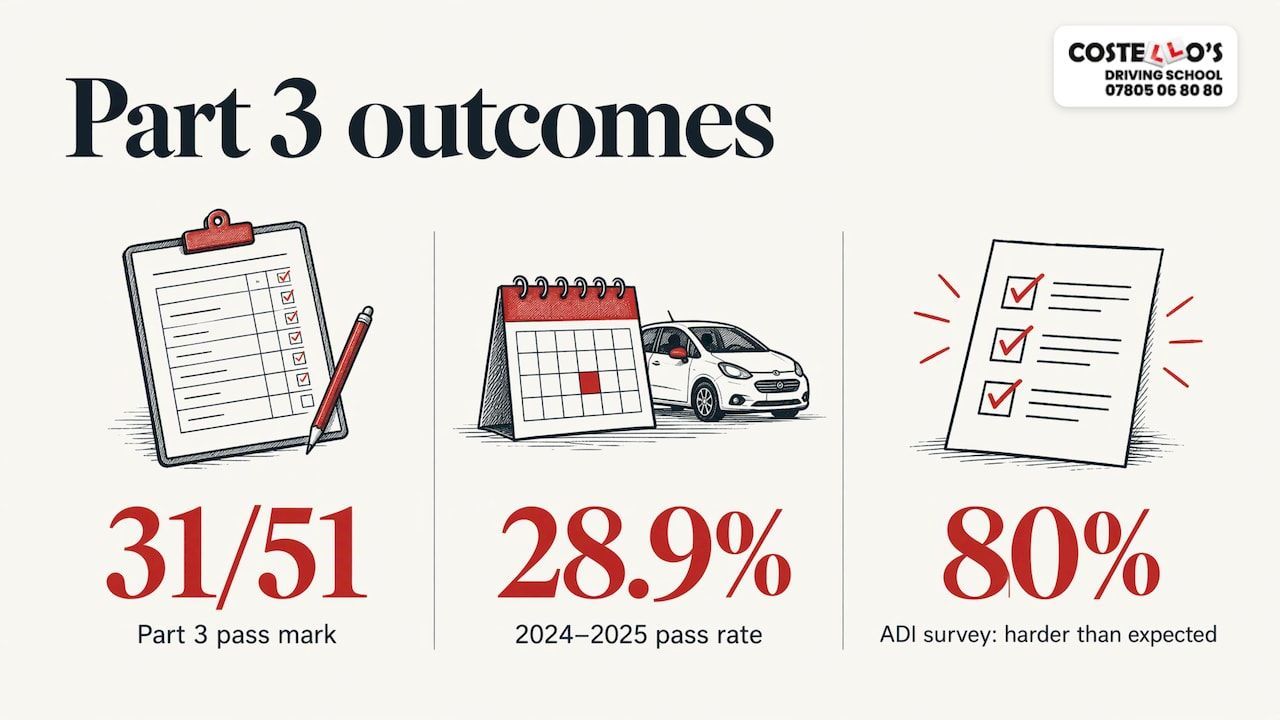
The Part 3 pass mark is 31 out of 51. In a March 2023 post, the DVSA said it would remain at 31 while the pass mark for standards checks, the later checks on qualified ADIs, was proposed to rise from 31 to 33. The DVSA reported a Part 3 pass rate of 28.9% for 2024 to 2025. It also said 80% of surveyed ADIs who took Part 3 found it harder than expected. The test rewards trainees who prepare against the marking sheet itself rather than relying on being a good driver.
The 17 competencies, area by area
The wording below follows the DVSA marking sheet. The plain-English notes are ours.
Lesson planning (4 competencies, 12 marks)
This area covers what happens before the car moves and how you adjust during the lesson.
- Identifying the pupil's learning goals and needs. Ask what the pupil wants from the lesson and what they find difficult. Do not decide for them.
- An agreed lesson structure appropriate to experience and ability. The plan should be agreed with the pupil, not announced to them, and it should suit where they are in their learning.
- Practice areas that are suitable. The roads must let the pupil practise the agreed topic. A junction lesson on a road with no junctions scores badly.
- Adapting the plan when appropriate. If the pupil struggles or finds it easy, change course. Sticking rigidly to the plan counts against you.
The DVSA guidance says these competencies are built from smaller elements in the National Driver and Rider Training Standards. For the first line, those elements include asking suitable questions, actively listening, recognising body language and dealing with weaknesses during the lesson. That is the level to practise at. "I asked what they wanted to work on" is not enough if you never listened to the answer or noticed the pupil's hesitation.
Risk management (5 competencies, 15 marks)
This is the area with the automatic-fail floor, so it deserves the most attention.
- Shared responsibility for risk understood. You and the pupil agree at the start who is responsible for what, including when you will step in.
- Directions and instructions that are clear and timely. Give them early enough to act on, in language the pupil follows.
- Awareness of the surroundings and the pupil's actions. You should be seen to scan the road ahead and watch what the pupil is doing.
- Timely and appropriate intervention. Step in when you need to, neither too late nor so early that the pupil never learns.
- Feedback on safety-critical incidents. If something happens, deal with it properly with the pupil, ideally when it is safe to talk.
The pull between lines 4 and 5 trips up many trainees. Intervening is a skill, not a failure. A trainee who lets a situation develop to prove the pupil is independent risks a very low score here. One who jumps in constantly gives the pupil no chance to think.
Teaching and learning strategies (8 competencies, 24 marks)
This is the biggest area, and it is where a Grade A usually comes from.
- A teaching style suited to the pupil. A nervous pupil, a confident one and a pupil who needs detail all need different handling.
- Encouraging analysis and responsibility. Ask questions that make the pupil think about what happened and why, so they own their learning.
- Using opportunities and examples. Use what the road gives you, such as a real junction or a cyclist, to make points memorable.
- Technical information that is comprehensive and accurate. What you say must be correct and complete, down to rules, stopping distances and procedures.
- Timely feedback. Tell the pupil how they did soon enough for it to help, and in a way they can use.
- Queries followed up and answered. If the pupil asks something, deal with it properly rather than moving on.
- A non-discriminatory manner. Treat the pupil with respect, without assumptions based on who they are.
- End-of-session reflection. Help the pupil sum up what they learned and what comes next.
With eight lines, a few points on each add up. A trainee who gets 2 across all eight scores 16, while one who drifts between 1 and 2 loses several marks without any single dramatic error.
Using the sheet to prepare
The sheet works best as a checklist you apply to your own training lessons, not something you read the night before.
- Mark yourself line by line. After each practice lesson, score the 17 competencies honestly, then compare with your trainer's marks. Differences show where you are misjudging yourself.
- Work on the weakest area first, but guard risk management. A total can be rescued by strong teaching marks. Risk management below 8 cannot.
- Prepare the opening and the close. The first three minutes set up lesson goals and risk. The last three produce reflection. Both are quick, and both feed several competencies.
- Practise adapting. Plan a lesson, then deliberately change the pupil's level or the conditions, so you learn to alter the plan without losing the thread.
- Choose a pupil you can teach honestly. The lesson is real, so pick someone whose learning needs you understand.
The result is yours either way. If you pass, you can apply for your first ADI badge. You must do so within 12 months of passing Part 3, or you will have to pass all three qualifying tests again, as the GOV.UK result page states.
ADI and PDI: what is the difference?
People searching for the Part 3 sheet often also want to know the two titles.
- PDI stands for Provisional Driving Instructor. It is the trainee stage, with a pink badge, after you pass the theory test (Part 1) and the driving ability test (Part 2). You then work towards Part 3.
- ADI stands for Approved Driving Instructor. It is the full qualification, with a green badge, and it comes after you pass Part 3 and are accepted onto the register.
In practice, the Part 3 test is the gate between pink and green. The same 17 competencies are used again later in standards checks on qualified instructors, with the examiner giving the grade after about 15 minutes, as described on the standards check page. So the sheet matters well beyond the test day.
On insurance, a trainee and a fully qualified instructor are different statuses, and cover is arranged for each. Tell your insurer as soon as your badge changes, and ask them to confirm what your policy covers at each stage.
Training for Part 3 with Costello's
If you want to become an instructor, the Part 3 marking sheet is the standard your training is built around. We offer DVSA-approved driving instructor training in Essex, Suffolk and East London, delivered one to one, and we have a track record of all our trainees qualifying as DVSA ADIs. Our franchise packages start from £40 per week, and you can see how they work on our driving lessons page.
If you are weighing up a new career, get in touch with Costello's Driving School to talk about where you are in the process and what training would suit you.
Our view on the marking sheet
We have been teaching in Essex and Suffolk for over 25 years, and we think the marking sheet is the fairest description of good teaching that the DVSA has produced. It does not ask whether you can drive. It asks whether the person next to you is learning.
That is why we train one to one. Seventeen competencies are too many to absorb from a book. A trainee needs someone in the passenger seat marking those lines with them, lesson after lesson, until the pattern is natural. Our instructors work with learners who are nervous, learners who are in a hurry and learners who want to pass as soon as they can. That variety is what trains you to adapt your plan and your style, which is exactly what the sheet rewards.
Our advice to every trainee is to treat risk management as the foundation. A pupil who feels safe will talk, ask questions and take feedback. When that is in place, the other marks follow.
Dean
FAQ
What score do I need to pass ADI Part 3?
You need 31 out of 51. A score of 31 to 42 is Grade B and 43 to 51 is Grade A, and both allow you to join the ADI register. You fail automatically if you score 7 or less for risk management or the examiner stops the lesson because of danger.
How many competencies are on the Part 3 marking sheet?
There are 17, split into lesson planning (4), risk management (5) and teaching and learning strategies (8). Each is scored from 0 to 3. The same structure is used in standards checks for qualified instructors.
Is the Part 3 test a real lesson?
Yes. You take a pupil with you and teach for about 40 minutes of a 45-minute session. There is a short discussion beforehand and feedback afterwards. The examiner marks how well you plan, manage risk and teach, not how well you drive.
What is the difference between a PDI and an ADI?
A PDI is a trainee instructor on a pink badge, working towards Part 3. An ADI has passed all three tests, joined the register and holds a green badge. Passing Part 3 is the final test before you can apply for the green badge.
What happens after I pass Part 3?
You can apply for your first ADI badge. You must apply within 12 months of passing, or you will have to take all three qualifying tests again.
Sources
- Approved driving instructor (ADI) part 3 test: marking sheet (GOV.UK)
- ADI part 3 test report form (DVSA, September 2022)
- ADI part 3 test report form, competency wording (GOV.UK)
- Guidance for examiners: the instructional ability test, Part 3 (GOV.UK)
- ADI part 3 test: what happens during the test (GOV.UK)
- ADI part 3 test: your test result (GOV.UK)
- ADI standards check: what happens at the standards check (GOV.UK)
- Why we're thinking about raising the ADI standards check pass mark (DVSA blog, 2023)
- Working together to progress and protect the driving instructor profession (DVSA blog, 2026)