Driving Test Myths in the UK: What Is True and What Is Not
Driving Test Myths in the UK: What Is True and What Is Not
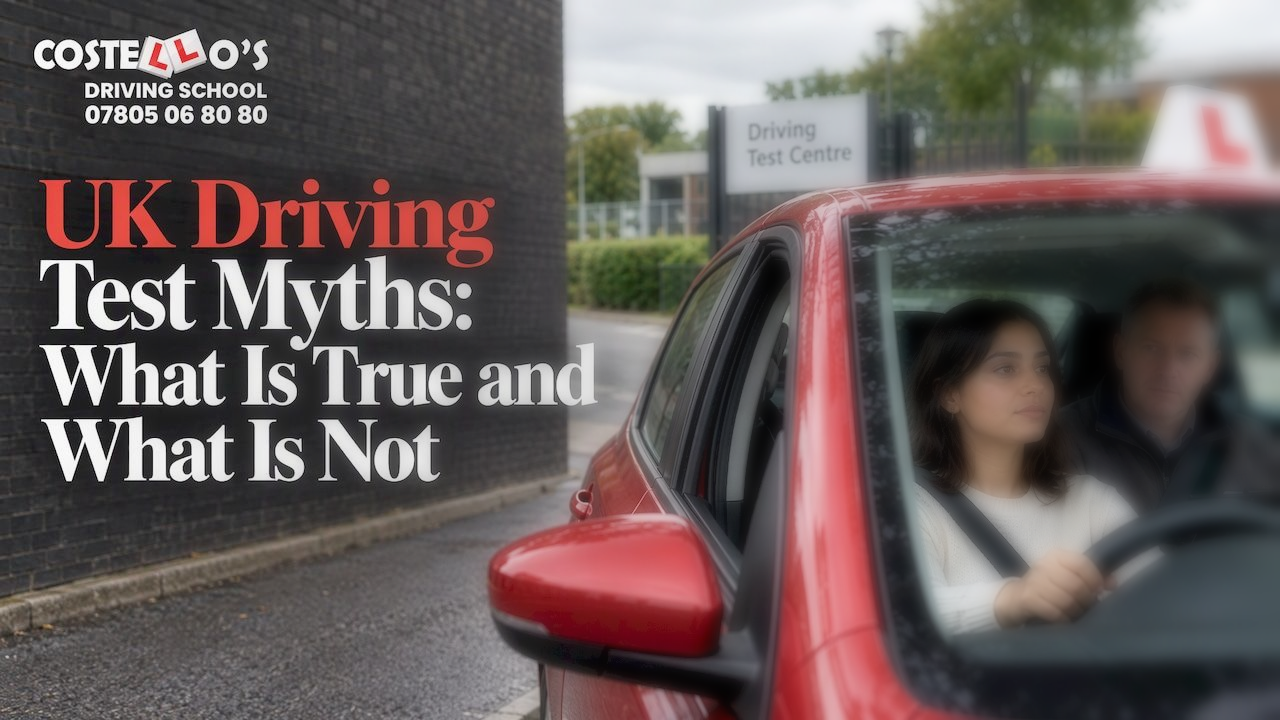
Most driving test myths fall apart when you read how the DVSA (Driver and Vehicle Standards Agency, the body that runs the test) actually marks it. Examiners have no pass or fail quotas, one mistake does not end your test, and you do not need to drive perfectly to pass. Below we go through the myths learners repeat most, with the official rule behind each one, so you can walk into your test calmer and better prepared.
Key Takeaways
- Examiners are not given pass or fail targets: your result depends on your driving against the marking criteria.
- You can pass with up to 15 driving faults (minors), as long as you have no serious or dangerous fault.
- A single mistake does not stop the test unless the examiner thinks your driving is a danger to other road users.
- The test changed on 24 November 2025: fewer stops, fewer emergency stops and longer independent driving.
- Confidence on test day comes from practice in realistic conditions, not from superstitions about the examiner.
Table of Contents
- How the test is actually marked
- Myth 1: Examiners have a pass or fail quota
- Myth 2: One mistake means you have failed
- Myth 3: Stalling is an automatic fail
- Myth 4: You have to drive perfectly to pass
- Myth 5: Hesitating or driving slowly keeps you safe
- Myth 6: The test is the same as it was when your parents took it
- Myth 7: Examiners will fail you for a tiny eyesight or car problem you did not expect
- Myth 8: You cannot change your test time without losing your fee
- What myth-busting does not change: preparation
- Our view on driving test myths
- Lessons and courses that fit how you learn
- FAQ
- Sources
How the test is actually marked
Before the myths, you need the marking system, because nearly every myth is a misunderstanding of it. GOV.UK describes three kinds of fault:
- Driving fault (a minor): not potentially dangerous, but could become serious if you keep repeating it.
- Serious fault: something potentially dangerous.
- Dangerous fault: something that involves actual danger to you, the examiner, the public or property.
You pass with no more than 15 driving faults and no serious or dangerous faults. Sixteen or more driving faults, or a single serious or dangerous one, means a fail. On the result sheet, if the examiner had to step in with an instruction or take control to avoid an incident, the result shows "examiner took action".
So the test is not a hunt for errors. It is an assessment of whether you drive as a safe, competent driver would. Keep that in mind and the myths below become easy to spot.
Myth 1: Examiners have a pass or fail quota
This is the most common myth, and it is false. In a Freedom of Information response, the DVSA stated that examiners are not instructed, required, encouraged or expected to pass or fail a set number or percentage of candidates, and that no pass-rate or fail-rate targets exist. Results are determined by how you perform against the assessment criteria. The only monitoring is quality assurance, which checks that examiners mark consistently.
The DVSA's own Ready to Pass campaign has a section dedicated to driving test myths, and this one is on it.
What this means for you: there is no "bad day" where the examiner needs to fail someone, and no good day where they must pass someone. Your only job is to drive safely and to the standard.
Myth 2: One mistake means you have failed
Learners often drive the rest of the test in a panic after a slip. They do not need to. GOV.UK is clear that you can carry on after a mistake, and it might not affect your result if it is not serious. The examiner will only stop the test if they think your driving is a danger to other road users.
This is why the 15-minor allowance exists. A late mirror check, a wide turn or a poor gear change can be a driving fault and you can still pass. The practical advice is simple: let the mistake go, reset, and concentrate on the next junction. The next junction is where most tests are decided.
Myth 3: Stalling is an automatic fail
Stalling is on the DVSA's list of myths for good reason. RAC Drive explains that stalling in itself is just a minor fault. Stalling when moving off from parked usually earns a minor. The picture changes if you stall at a busy junction or roundabout and hold up or endanger other traffic, because then the examiner is judging the danger, not the stall.
If you are learning in a manual car, the lesson is to restart calmly, check your mirrors and surroundings, and move off safely. If stalling worries you more than anything else, an automatic car removes the problem entirely, and some learners find it lets them focus on road awareness. We teach both manual and automatic lessons, so the choice is yours to make based on how you want to drive after you pass.
Myth 4: You have to drive perfectly to pass
The marking system is built around a safe and competent driver, not a flawless one. The DVSA's examiner guidance sets out what it calls the first rule of assessment: would this fault, on its own, in an otherwise perfect drive, cause a fail? If not, it is a driving fault and the test goes on.
Two details are worth knowing:
- A breach of the law is serious. Not responding to a red light, for example, is a serious fault and an automatic fail.
- Repeating a minor matters. A candidate who keeps committing the same driving fault throughout the test cannot be regarded as competent, so the repeated fault can be marked as serious.
That second point is the one worth acting on. Having 10 different small slips is far safer than making the same one ten times. If your instructor keeps pointing out one habit, such as checking mirrors late before a turn, fix that one first.
Myth 5: Hesitating or driving slowly keeps you safe
Many nervous learners believe that being cautious cannot hurt. It can. RAC Drive notes that driving unnecessarily slowly can result in a minor, or even a serious fault if it endangers others or causes significant delays.
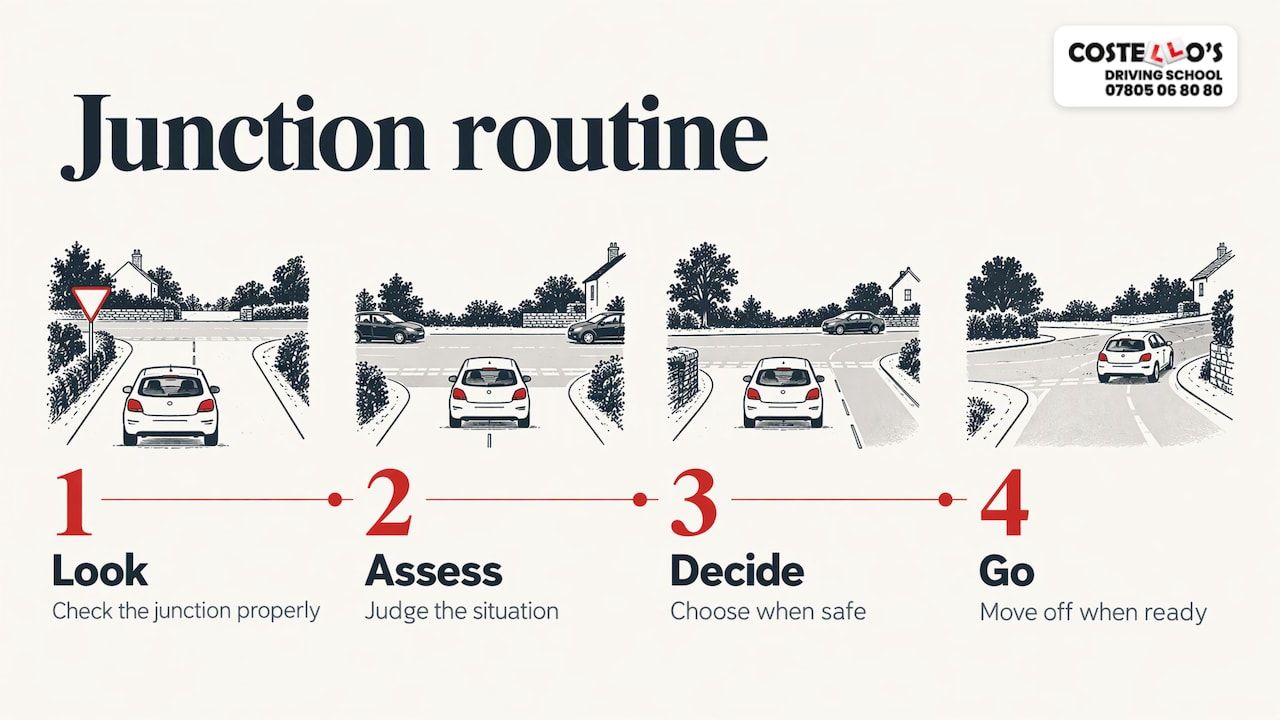
The flip side is also true: a short pause to check a junction properly is not a fault. The same source says failing to make effective observations at junctions is the most common reason for failing a test outright. Waiting to look properly is good driving. Creeping, stopping for no reason or holding up a queue is not.
The fix is a routine you can repeat under pressure: look, assess, decide, then go. Practise it until it is automatic. Nerves make you rush or freeze, and a habit you have drilled is the best protection against both.
Myth 6: The test is the same as it was when your parents took it
The test has been adjusted recently, and old advice from friends and relatives may be out of date. From 24 November 2025 the DVSA made permanent these changes, according to its Despatch blog:
- Three stops instead of four.
- The emergency stop exercise comes up in 1 in 7 tests instead of 1 in 3.
- The independent driving section, using a satnav, traffic signs or both, can run for the full duration of the test.
The DVSA said the changes followed a trial at 20 test centres in April 2025. The practical effect is that the test feels more like a normal drive and gives you more time to follow directions on your own. Do not rely on an old story about the emergency stop: you may not be asked to do one at all, but you should still be able to do it.
Your practice should reflect this. Spend more of your lessons on longer routes with a satnav or following road signs, and on a wide range of road types, rather than only rehearsing manoeuvres.
Myth 7: Examiners will fail you for a tiny eyesight or car problem you did not expect
Part of the test is a fixed set of checks, and knowing them in advance removes a lot of fear. GOV.UK says you must read a number plate from 20 metres for new-style plates, and failing the eyesight check ends the test before you drive. This is a safety requirement, not a trick. If you wear glasses or contact lenses to drive, wear them on the day and for every lesson.
The vehicle safety questions are also published in advance by the DVSA, so there is nothing to be surprised by. Learn them well before the day.
If you take the test in your own car rather than an instructor's, a tidy, fresh interior helps you feel settled, and there is a guide to getting rid of car odours if something lingers. The examiner is marking your driving, not your air freshener, but a comfortable cabin helps you concentrate. Our lessons use modern dual-controlled cars, so you can practise in the kind of vehicle the test requires.
Myth 8: You cannot change your test time without losing your fee
Learners sometimes sit tests they are not ready for because they think moving the date is costly. The DVSA's Ready to Pass page states that it is free to change your appointment time if you do it at least 10 full working days (Monday to Saturday) before the test. Rules on how often you can move a booking and where it can be moved to have been tightened in recent years, so check the official booking service for the current limits before you plan around a change.
The point stands: if your instructor tells you that you are not yet consistent, moving the date in good time is far better than paying for a fail.
What myth-busting does not change: preparation
Knowing the rules lowers anxiety, but it does not replace driving time. Three habits make the biggest difference:
- Practise junction observations until they are automatic. They are the leading cause of outright fails.
- Drive routes you do not know. The longer independent drive means you will be following a satnav or signs for much of the test.
- Mock-test under pressure. Do a full-length mock with your instructor, marked on the same minor, serious and dangerous scale, and work on the faults that repeat.
If you are nervous, tell your instructor early. A patient instructor can break the test down into stages so that each one feels familiar.
Our view on driving test myths
Most of the learners who come to us are not afraid of the car. They are afraid of the story they have heard about the test: that the examiner is out to catch them, that one slip is the end, that everyone else passes first time.
The marking system says something calmer. It asks whether you are a safe, competent driver, and it allows for human error. When we take learners out, we use that. We build lessons around the faults that actually decide results, such as junction observations and repeated habits, instead of around superstition.
We also know a relaxed learning environment matters. Our instructors are DVSA-approved and friendly, we teach manual and automatic, and we offer lessons in evenings and at weekends, so you can learn at a pace that suits you. For nervous drivers, refresher and confidence-building lessons are there to rebuild trust behind the wheel.
With over 25 years of experience across Essex and Suffolk, we have seen that people pass sooner when they are taught what the test really asks of them.
Dean
Lessons and courses that fit how you learn
If you want a test-ready routine rather than guesswork, we teach learners across Essex, Suffolk and East London. Manual lessons are £37-£38 per hour and automatic lessons are £42 per hour, taught by DVSA-approved instructors in dual-controlled cars. You can see the options on our driving lessons page.
FAQ
Do examiners fail more people at certain times of day or year?
No. The DVSA has stated that examiners are not given pass or fail targets over any period, and results depend on your performance against the marking criteria. Your best approach is to book a time when you are alert and used to driving, such as the time of day you usually have lessons.
How many minors can I get and still pass?
You can have up to 15 driving faults and still pass, provided you have no serious or dangerous faults, according to GOV.UK. Sixteen or more driving faults means you fail. Remember that repeating the same minor can lead to it being marked as serious.
Can I fail for being too nervous?
Nerves are not a fault in themselves. The examiner marks what you do, not how you feel. What matters is whether nerves lead to rushed observations, hesitation or stalling at a busy junction. Practising realistic routes and telling your instructor how you feel helps a great deal.
Does the examiner mark me down if I ask for a direction to be repeated?
No. Asking for clarification is not a fault. If you are unsure which way to go, it is safer to ask than to guess. The independent driving section is about following directions, and you can still ask if you are unclear.
Sources
- Driving test faults and your result, GOV.UK
- Understanding your driving test result, GOV.UK
- Driving test: what happens during the test, GOV.UK
- DVSA examiner guidance: guide to assessment and marking
- DVSA Ready to Pass: taking the driving test
- DVSA Despatch blog: making adjustments to the driving test
- DVSA Freedom of Information response on examiner pass and fail targets
- RAC Drive: what is a driving test fail?
- Diamondbrite: how to remove car odour