Mini Roundabouts: Tips for Learners and Nervous Drivers
Mini Roundabouts: Tips for Learners and Nervous Drivers
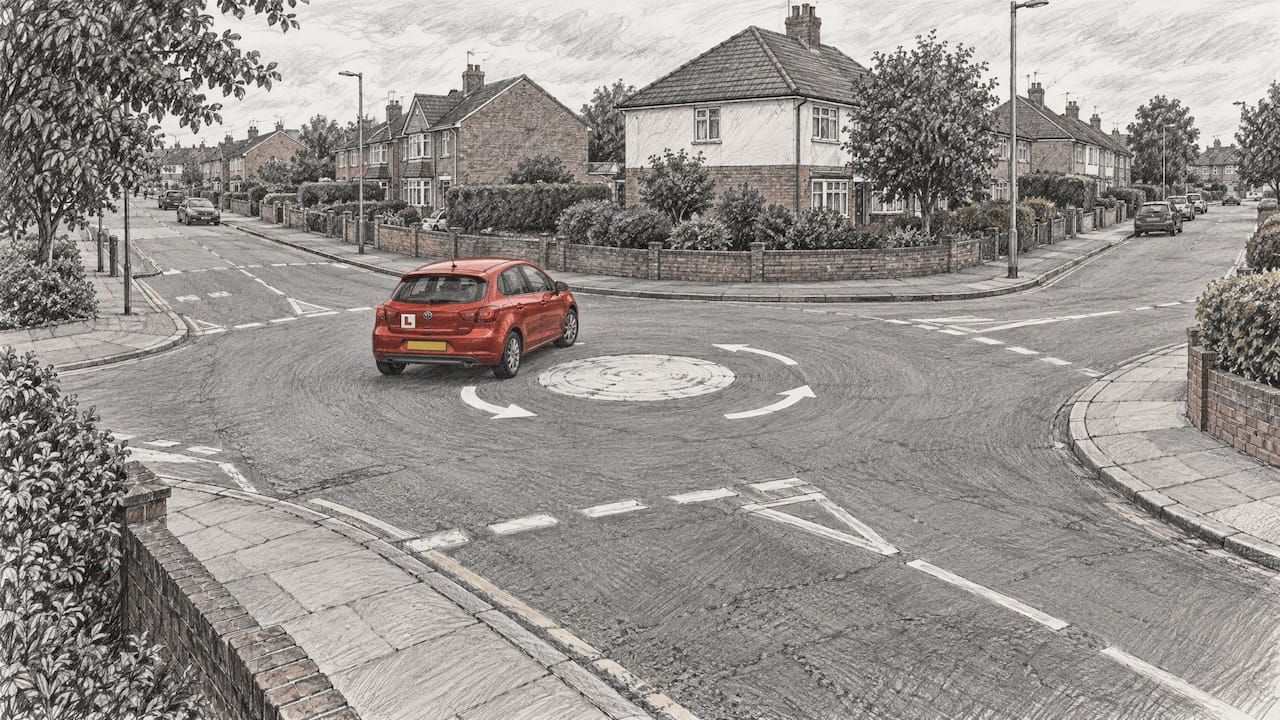
A mini roundabout is a normal roundabout squeezed into a space of a few metres, so you have less room, less time and less warning. The way through is simple: approach as you would any roundabout, give way to traffic from the right, steer round the white circle rather than over it, and let your observations decide when you go, not other drivers' indicators. At Costello's we teach this routine to learners across Essex and Suffolk, and it is the same routine whether you are 17 and booking a first lesson or an adult returning to the wheel with shaky confidence.
Key Takeaways
- Approach a mini roundabout as you would a normal one, and give way to traffic coming from your right.
- Cars and vans must pass round the central white circle. Only large vehicles that physically cannot do so may drive over it.
- Slow down early and look right in good time, so you can enter smoothly instead of stopping or pulling out hard.
- Treat other drivers' signals as a guide, not a promise, because they are often late, missing or wrong.
- Practise on real local mini roundabouts with an instructor, because the layout and traffic flow differ from one to the next.
Table of Contents
- What counts as a mini roundabout
- The rules in plain English
- How to approach a mini roundabout step by step
- Can you go all the way round a mini roundabout?
- What to do when the roundabout is crowded or nobody moves
- Sharing the junction with cyclists, pedestrians and big vehicles
- Common mini roundabout mistakes and how to avoid them
- Tips for nervous drivers
- Practising mini roundabouts with Costello's
- Our view on teaching mini roundabouts
- FAQ
- Sources
What counts as a mini roundabout
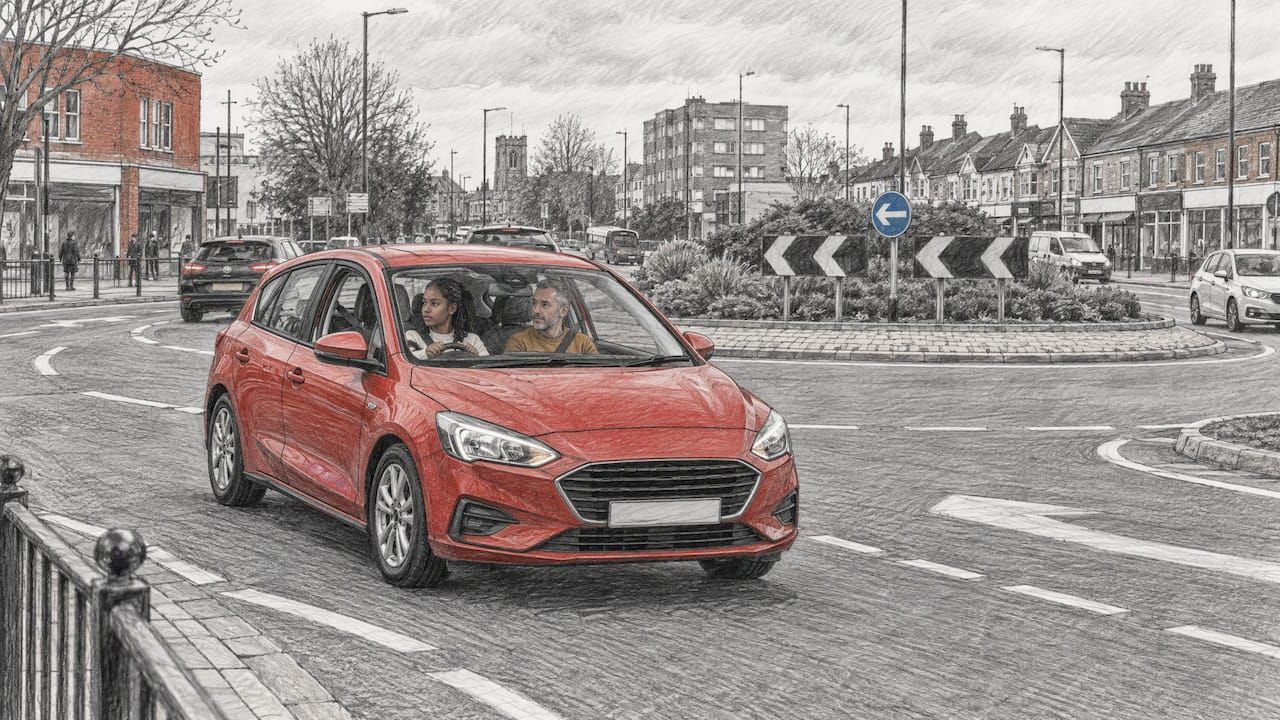
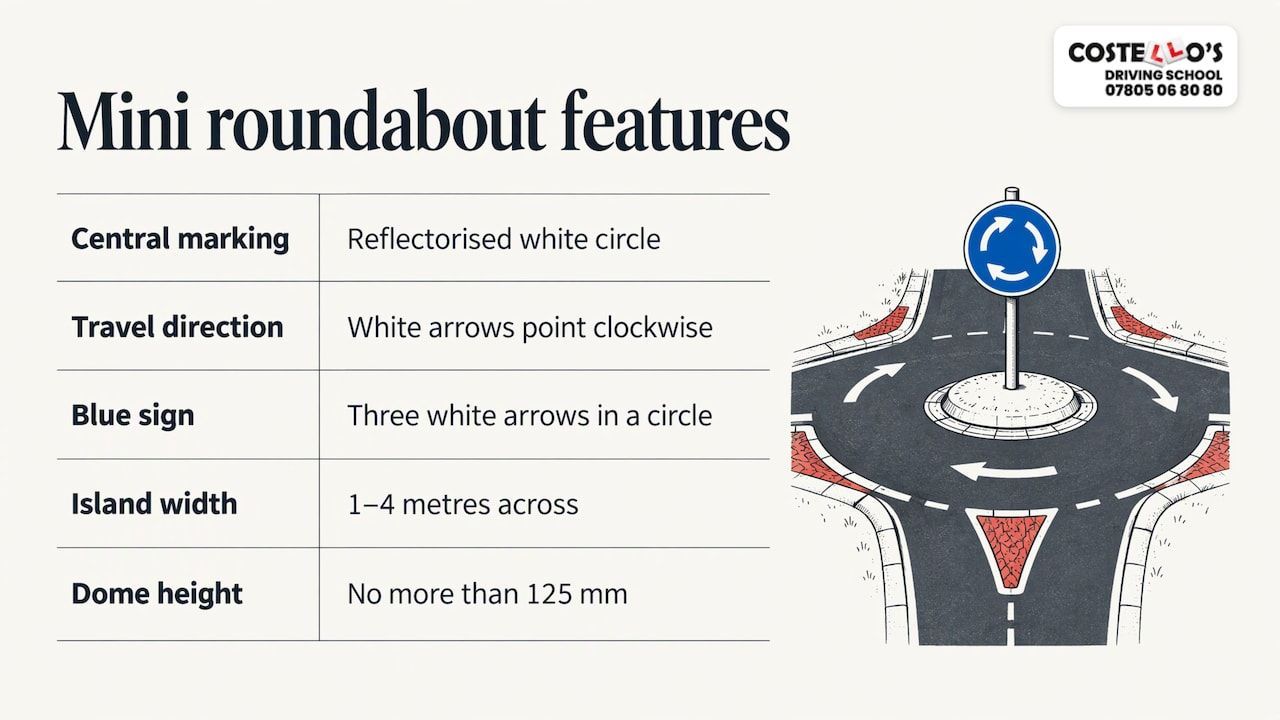
A mini roundabout is marked by a white painted circle in the middle of the junction, with white arrows showing the clockwise direction of travel. The Department for Transport's good practice guidance on mini roundabouts describes the central island as a reflectorised white marking, which can be flat or slightly domed. A DfT report on the same subject gives its size as between 1 and 4 metres across, and says the dome is no more than 125mm high so that larger vehicles that cannot get round it can drive over it.
The sign to look for is blue and circular, with three white arrows chasing each other round. It is an instruction to give way to traffic from your immediate right. You will mostly meet them on roads with a 30 mph limit or lower, which means the junction arrives quickly and the gaps between vehicles are small.
The rules in plain English
The Highway Code covers mini roundabouts in rules 185 to 188. In short:
- Rule 185: give priority to traffic approaching from the right, unless signs, markings or traffic lights say otherwise. Watch for vehicles already on the roundabout, because they may not be signalling correctly, or at all.
- Rule 188: approach a mini roundabout in the same way as a normal one. All vehicles must pass round the central markings, except large vehicles that are physically unable to. There is less space to manoeuvre and less time to signal, so you should avoid U-turns and be ready for others making them.
The Highway Code's current rules have not changed for mini roundabouts recently. According to the Highway Code updates page, the last roundabout-related change was in January 2022, when priority for cyclists was added to rule 186. The most recent amendments listed, up to 22 October 2025, concern traffic signs and Scottish parking rules.
How to approach a mini roundabout step by step
The DVSA's Ready to Pass? guidance expects you to handle mini roundabouts using the mirrors, signal, manoeuvre routine and the position, speed, look routine. Here is how that works in practice.
1. Spot it early and check your mirrors
Look for the blue sign and the white circle as far ahead as you can. Check your mirrors before you slow, so you know what is behind you and can brake smoothly.
2. Choose your speed and position
Slow down on the approach so that you can stop if you need to, but do not crawl. Position yourself as you would at a normal roundabout. For a left turn, signal left and stay in the left of your lane. For a right turn or going full circle, signal right and keep towards the centre of the road, per rule 186. For going straight on, you do not normally need a signal on the way in.
3. Look right, then look ahead
The give-way rule means your eyes go right first. But do not freeze there. The DfT guidance notes that the small scale makes the rule less straightforward because vehicles are so close together, and that hesitation from confusion can lead to longer queues. Look right, judge the gap, then look where you want to go.
4. Go when it is safe, and steer round the circle
If the road is clear, go. Do not stop out of habit. Steer round the white circle as though it were a kerb: for a right turn, keep the circle on your right and go round its far side. Look at your exit, not at the paint in front of your bonnet. Driving Mastery makes the same point for a second exit: your path curves around the centre, not through it, and you should steer smoothly rather than with a sharp turn.
5. Signal for your exit, only if it helps
At a large roundabout you signal left after passing the exit before yours. At a mini roundabout the exits are so close together that this signal can mislead a driver waiting at the next arm into thinking you are turning into an earlier road. Rule 103 of the Highway Code says to signal only when it helps and cannot mislead, and this guide applies that to mini roundabouts. Your instructor will show you which junctions need the signal and which do not.
6. Check the exit and build speed gradually
Pedestrians may be crossing the road you are leaving by. Rule 187 tells you to give them plenty of room. Once clear, accelerate progressively.
Can you go all the way round a mini roundabout?
Yes. Rule 186 covers going full circle: signal right, approach from the right-hand side of the road, and keep right until you need to exit. What you cannot do is cut across the middle. The DfT-commissioned good practice paper says drivers who pass over the central island open themselves to possible prosecution, and notes that normally cars should be able to avoid the marking. Failing to follow the mini roundabout sign is an offence for a car driver, according to the DfT guidance.
What to do when the roundabout is crowded or nobody moves
Sometimes every arm has a car waiting. The regulations do not say who goes first. The principle that settles it, as one explainer puts it, is that whoever moves in a way that forces another driver to brake or swerve is in the wrong. So:
- Do not rely on flashing headlights or gestures.
- Make eye contact if you can, and move only when your path is clear.
- If someone else moves, let them through, then go.
If you cannot get round the circle because of a large vehicle, stay back and give it room. Buses and lorries may need to drive over the marking, and rule 187 reminds you that long vehicles may take a different course from the one you expect.
Sharing the junction with cyclists, pedestrians and big vehicles
Rule 186 asks you to give priority to cyclists on the roundabout and not to cut across cyclists or horse riders in the left-hand lane continuing around. Rule 187 adds pedestrians crossing approach and exit roads, vehicles straddling lanes, and motorcyclists. If you want a deeper look at sharing the road with riders, our guide to overtaking and leaving 1.5m for cyclists is a good companion.
Common mini roundabout mistakes and how to avoid them
The DfT guidance records that many drivers overrun the central island, do not give way, do not indicate and do not slow down. It also observes that drivers on the main road often treat a mini roundabout as an obstacle to negotiate rather than a junction to control their way through it. Combined with other published lists, the usual errors are these.
| Mistake | Why it goes wrong | What to do instead |
|---|---|---|
| Driving over the white circle | Offence for cars and vans, and can fail a test if blatant | Steer round it like a kerb |
| Looking right too late | Braking hard or pulling out in front of someone | Slow early, look right on the approach |
| Stopping when the road is clear | Confuses drivers behind and wastes a safe gap | Judge the gap and go |
| Misleading left signal | A waiting driver thinks you are turning earlier | Signal only if it helps and cannot mislead |
| Arriving too fast | No time to give way or spot pedestrians | Reduce speed in good time |
| Wrong position | Confuses others about your exit | Follow rule 186 for your exit |
| Trusting other drivers' signals | Their signals are often late, missing or wrong | Use signals as a guide only |
On the test, the RAC's roundabout guide says that missing a clear, safe chance to join can be marked as a serious fault, while blatantly driving over the centre can fail a test and clipping it is unlikely to. Our own guide to roundabout test faults goes through these in more detail.
Tips for nervous drivers
Mini roundabouts can feel hectic because everything happens close and fast. Some habits make them calmer:
- Break it into pieces. Mirror, speed, look right, go. Say the order to yourself until it is automatic.
- Look early. The sooner you see the junction, the more time you have, and time is what a mini roundabout takes away.
- Do not wait for perfection. A safe gap is enough. Sitting still when the road is clear is itself a mistake.
- Repeat the same junction. Driving the same mini roundabout several times at different times of day builds familiarity quickly.
- Keep your junction checks sharp. Our guide to junction and mirror checks shows how to drill the routine.
Practising mini roundabouts with Costello's
Reading the rules gets you only part of the way. The skill is in judging gaps and steering smoothly, and that takes repetition on real roads with a calm instructor beside you. Costello's offers manual lessons at £37-38 per hour and automatic lessons at £42 per hour, taught by DVSA-approved instructors in modern dual-controlled cars across Essex and Suffolk. We also run intensive courses, refresher lessons and a £2,200 Guaranteed Pass course, and our evening and weekend slots suit busy adults and students. If you are in the area, see our lessons in Colchester or Chelmsford, or view all lesson options and prices.

If you are a qualified driver who feels rusty on junctions, our refresher training is designed to rebuild confidence. And if teaching others appeals to you, we offer driving instructor training.
Our view on teaching mini roundabouts
We teach mini roundabouts as a judgement skill, not a memorised rule. Pupils who know that the circle is a kerb and that the right-hand gap decides everything tend to stop hesitating, and hesitation is where most mistakes begin.
Our instructors are patient and specialise in nervous learners, so we build the routine slowly: approach, look, go. We want you to be able to read the junction yourself, not just copy what we do.
With flexible lesson times, including evenings and weekends, you can practise at quieter moments first and then at busier ones, so the real test feels familiar.
Dean
FAQ
Can I go all the way round a mini roundabout?
Yes. Signal right, approach from the right-hand side and keep right until you leave, as set out in rule 186 of the Highway Code. You must still pass round the central markings rather than across them.
Can I drive over the middle of a mini roundabout?
Not in a car or van. Rule 188 requires all vehicles to pass round the central markings, except large vehicles that physically cannot. Driving over it when you could have gone round risks prosecution.
Who has priority at a mini roundabout?
Traffic approaching from your right has priority, unless signs or markings say otherwise. Watch for vehicles already on the roundabout, and give priority to cyclists on it.
Do I need to signal at a mini roundabout?
Signal your intention before entering if you are turning left or right. If you are going straight on, you do not normally signal on approach. Give a left signal for your exit only if it helps others and cannot mislead them.
Sources
- The Highway Code: Using the road (159 to 203)
- The Highway Code updates
- DfT: Mini roundabouts good practice guidance
- DfT: Mini roundabouts report
- Mini-roundabouts: Enabling Good Practice
- DVSA Ready to Pass? Junctions, roundabouts and crossings
- Mini Roundabout Rules: Who Goes First and When to Signal
- Taking the second exit at a mini roundabout
- Highway Code Mini Roundabouts: Rules and Navigation
- RAC Drive: Roundabouts guide for drivers
Recommended