Smooth Gear Changes: A Step-by-Step Guide for Learners
Smooth Gear Changes: A Step-by-Step Guide for Learners
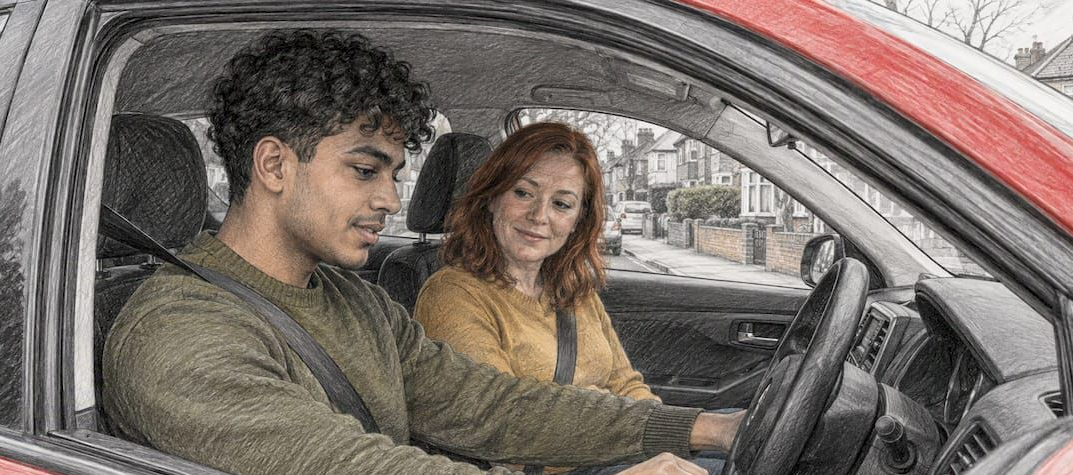
Smooth gear changes come from one habit: every pedal movement is gradual and finished before the next one starts. Lift off the accelerator, press the clutch fully down, select the gear, then bring the clutch up and the throttle in together. Jerks, grinding and stalls almost always come from rushing that sequence. With a patient DVSA-approved instructor beside you in a dual-controlled car, you can practise it at your own pace until it becomes automatic, which is how our learners across Essex and Suffolk build it.
Key Takeaways
- Smoothness is a sequence, not a trick: off the accelerator, clutch down, change gear, clutch up gently with the throttle returning.
- A jerk usually means the clutch came up too fast. Grinding usually means the clutch was not pressed fully to the floor.
- Smooth braking follows the same rule as smooth clutch work: build the pressure early, then ease off gradually as your speed drops.
- The DVSA expects you to change gear smoothly and in good time, and to use a mirrors, signal, manoeuvre routine before changing speed or direction.
- Short, regular lessons with feedback in the moment build clutch feel faster than guessing alone.
Table of Contents
- Why smooth gear changes matter on your driving test
- How to change gear smoothly, step by step
- Moving away: where smoothness starts
- Revs, gears and knowing when to change
- Changing down without a jolt
- Why your gear changes feel jerky, and how to fix them
- Braking smoothly: progressive braking
- Mirrors, signal, manoeuvre and approaching junctions
- Practising smooth gear changes with us
- Our view on smooth driving
- FAQ
- Sources
Why smooth gear changes matter on your driving test
The DVSA's learning to drive syllabus says you must be able to coordinate the clutch and gears smoothly when moving away, changing gear or stopping. It also covers the risks of not fully releasing the clutch, known as riding the clutch. The same page expects you to use the gears smoothly and effectively to hold your speed, and to change gear smoothly and in good time.
That means smoothness is not a nicety. It is part of what you are taught and assessed on. It also makes the car calmer for you and your passengers, and it helps you stay in control while your attention is on mirrors, junctions and other road users. A driver who is fighting the pedals has less attention left for the road.
Nerves make it harder, because tense legs press and lift pedals in sudden movements. If that sounds like you, the fix is not more force of will. It is repetition in a calm setting, with someone who lets you go slowly.
How to change gear smoothly, step by step
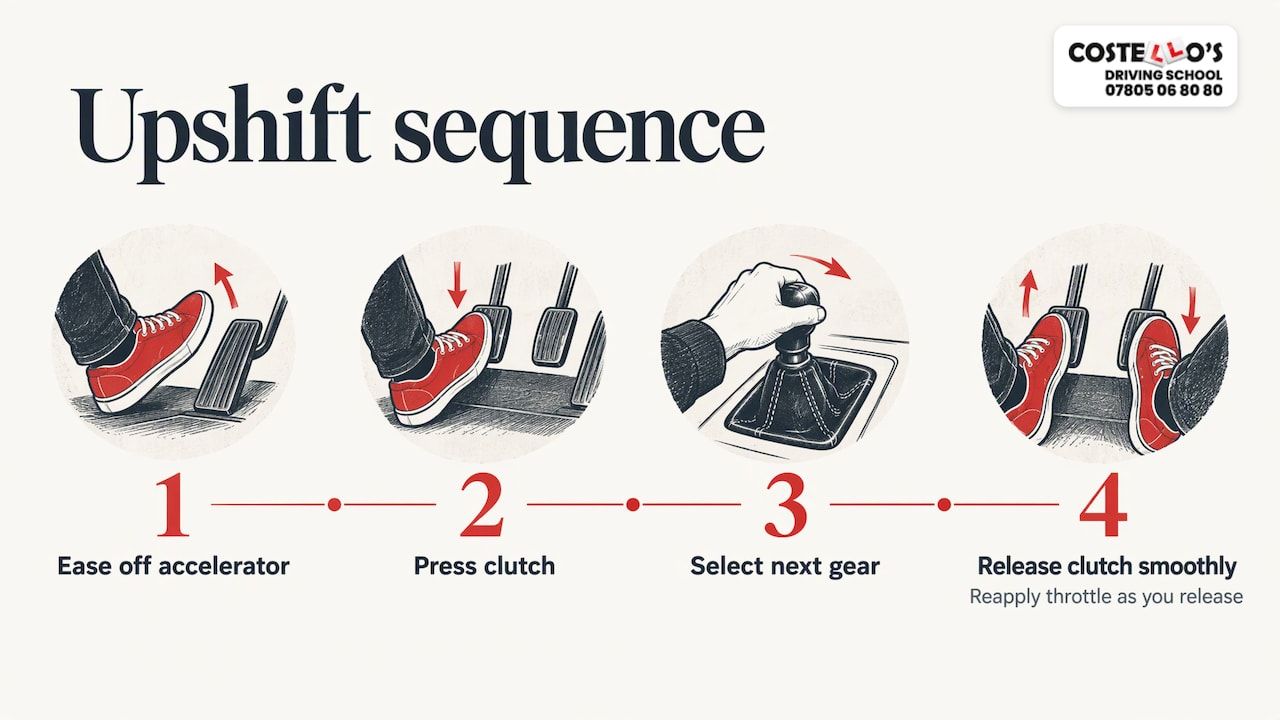
Here is the basic upshift sequence, for example second to third, as Kwik Fit's guide to changing gears sets it out: lift your foot off the accelerator, press the clutch down, move the gear stick into the next gear, then gently release the clutch while applying throttle again.
1. Ease off the accelerator
Do this before the clutch goes down. If you press the clutch while the engine is still pulling hard, the revs flare and the car lurches when you come back up. Where it goes wrong: learners lift and press at the same instant, which leaves the engine screaming for a moment.
2. Press the clutch fully to the floor
Press it smoothly and all the way. A half-pressed clutch is the main cause of grinding. Keep your heel on the floor so your foot moves from the ankle, not the whole leg. Where it goes wrong: stamping the pedal down, which makes the whole car feel abrupt.
3. Move the gear lever without force
Guide the lever, do not shove it. Most gearboxes have a catch that stops you selecting first from second at speed, so if the lever resists, go back to neutral and try again rather than pushing. Where it goes wrong: looking down at the lever instead of the road. Learn the pattern by feel.
4. Bring the clutch up smoothly
Release it steadily until the plates start to meet, then continue without pausing. Rushing this is the most common cause of a jolt. Kwik Fit puts it simply: staying calm and fluid is what stops the car responding with a jerk.
5. Add throttle as the clutch comes up
The throttle returns gently as the clutch finishes lifting. The two pedals trade places like a seesaw: one rises as the other falls. Once the clutch is fully up, take your foot off it completely so you are not resting on it.
This is the step where in-car feedback helps most. You cannot see your own pedal balance, but an instructor can feel the car and tell you straight away whether the clutch came up a touch too fast. Our instructors teach in modern dual-controlled vehicles, so you can try the sequence with a safety net while you find the feel.
Moving away: where smoothness starts
The first gear change of every drive is pulling away, and it sets the tone. The sequence for a smooth move-off is: clutch down, select first, a little gas, then lift the clutch slowly until you feel the bite point. That is the moment the engine note dips slightly and the car wants to creep. Hold the pedal steady there, release the handbrake, then ease the clutch fully up as you add gas.
Two things matter here. First, give the engine enough revs, because too few and the car stalls. Second, do not hold the car on the bite point while waiting at a junction. Use the handbrake and only bring the clutch up when you are ready to go. The DVSA syllabus specifically flags riding the clutch as a risk to understand.
If hills make your move-offs messy, our guide to hill start drills for manual cars walks through the handbrake and bite point routine step by step.
Revs, gears and knowing when to change
"How many revs before changing gear?" has no single answer, but there is a sensible range. According to Kwik Fit, most petrol cars prefer a shift at roughly 2,500 to 3,500 RPM, while diesels are usually happier between 2,000 and 3,000 RPM. If your car has no rev counter you can rely on sound: change up when the engine begins to sound as though it is working too hard.
In a learner car you are usually in a lower-speed environment, so shifting in good time matters more than hitting a number. Some practical rules:
- Change up as your speed builds, rather than holding a low gear with a loud engine.
- Change down if the engine is struggling, or when you need more control, for example on a hill.
- Choose the gear before a hazard, not in the middle of it.
- Plan ahead so you change gear once, not three times.
The Ready to Pass? campaign also notes that using the highest appropriate gear and avoiding unnecessary acceleration and braking reduces fuel consumption, which is a good reason to plan your gears early.
Changing down without a jolt
Downshifts feel rougher because the engine has to speed up to match the lower gear. Slow down first with the brake, so most of your speed is lost before the gear change. Then clutch down, select the lower gear, and bring the clutch up smoothly.
A more advanced technique is to blip the accelerator before releasing the clutch, which matches engine speed to wheel speed. Kwik Fit's guide describes this for downshifts. You do not need it to pass your test. Most learners get a smooth result simply by braking first, changing gear, and releasing the clutch gently.
Why your gear changes feel jerky, and how to fix them
| What you notice | Usual cause | What to change |
|---|---|---|
| Jerk or lurch on upshift | Clutch released too quickly, or rushing the motion | Slow the clutch lift and coordinate with the throttle |
| Grinding noise | Clutch not pressed fully to the floor | Press it all the way down before moving the lever |
| Stall when moving off | Clutch lifted too fast or too few revs | Add a little more gas and lift the clutch slowly to the bite point |
| Engine screams between gears | Throttle held down during the change | Lift off the accelerator before pressing the clutch |
| Lever will not go in | Forcing it, or the gearbox speed catch is engaged | Return to neutral and try again without force |
The causes in the table follow Kwik Fit's troubleshooting advice, which also says that grinding that persists with the clutch fully down may mean the clutch needs adjusting. If you stall, press the brake, return to neutral, restart and try again, never force the lever.
Most learners cure jerks by slowing down. Take a breath, make each movement smaller and slower than feels natural, and let speed come later. If you are practising in a quiet area, repeat the same change ten times in a row. The aim is for your left foot and left hand to know the rhythm without thinking.
Braking smoothly: progressive braking
Smooth braking is the same skill as smooth clutch work. The advanced driving test guidelines from RoSPA, which the DVSA monitors, say brake application should be smooth and progressive, with pressure reduced gradually as speed is lost, generally in one smooth operation per hazard. The same document says clutch use should be smooth, with good balance against the accelerator, and that you should not ride or excessively slip the clutch.
In practice that gives you a simple technique:
- Look early. The sooner you spot a hazard, the more gently you can slow down.
- Start light. Squeeze the brake pedal rather than stabbing it.
- Build as needed. Increase pressure if you need to lose more speed.
- Ease off before stopping. Release a little pressure just before the car stops, so you do not nod forward at the end.
- Clutch last. Press the clutch down just before you stop, to avoid stalling, not at the start of the braking.
The common error is braking late and hard, then softening it in a panic. Harsh braking is also one of the things the test is looking out for, so working on it early pays off.
Mirrors, signal, manoeuvre and approaching junctions
Smooth driving is mostly planning. The Highway Code, in Rule 161, tells you to use all mirrors frequently and in good time before you signal or change direction or speed, and reminds you: Mirrors, Signal, Manoeuvre. Before moving off, use all mirrors, check blind spots, signal if necessary, and make a final all-round check.
The order matters because it gives you time. When you check your mirrors first, you know what is behind you before you brake. When you signal next, other road users know your plan. Only then do you brake, change gear and steer.
A good approach to a junction looks like this:
- Mirrors early, before you reduce speed.
- Signal if it helps others.
- Brake progressively, finishing most of your slowing before the turn.
- Select the right gear for the speed you will reach, one change if possible.
- Look both ways and decide before you commit.
The Ready to Pass? campaign advises using mirror, signal, manoeuvre and the position, speed, look routine consistently. Junction observation and checking mirrors when changing direction are also among the faults examiners see most, so these habits are worth drilling. Our guide on drilling junction and mirror checks goes into that in more detail.
And if you worry that one slip could end your test, read about the independent driving part, where one wrong turn will not fail you.
Practising smooth gear changes with us
Smoothness comes from time in the seat with feedback you can act on. We teach manual lessons at £37 to £38 an hour and automatic lessons at £42 an hour, with flexible times including evenings and weekends, so busy adults and teenagers can practise regularly. Our instructors are DVSA-approved and friendly, and we specialise in helping nervous learners feel relaxed behind the wheel.
If you want a faster route, we also run intensive courses, refresher and confidence-building lessons, and a Guaranteed Pass course at £2,200. You can see lessons and prices on our driving lessons page, or find local lessons in Colchester and Chelmsford.

If you already drive but have lost your confidence, our refresher training is built for that. And if you are thinking of teaching others to drive, our driving instructor training is one-to-one.
Our view on smooth driving
Smooth driving is not a talent some people are born with. It is a habit, and habits come from calm repetition.
Most of the learners who come to us are not bad at driving. They are rushing. They are worried about the car behind, or the examiner, or stalling, and the worry makes the feet quicker than the head. The first thing we do is slow everything down.
That is why we put so much weight on a relaxed lesson, a patient instructor and a modern dual-controlled car. You can only learn clutch feel when you are not afraid of getting it wrong. Once the clutch, the brake and the mirrors all happen in the same unhurried rhythm, the test becomes an ordinary drive.
Whatever your age or your schedule, our aim is the same: to get you driving smoothly and passing sooner.
Dean
FAQ
Should you release the clutch slowly or quickly?
Slowly through the bite point, then smoothly the rest of the way. Releasing it too fast is the usual cause of jerks and stalls. Once the clutch is fully up, take your foot off it completely so you are not riding it.
How many revs before changing gear?
As a rough guide, petrol cars usually change at around 2,500 to 3,500 RPM and diesels at around 2,000 to 3,000 RPM, according to Kwik Fit. If you have no rev counter, listen for the engine working too hard. Your instructor will help you find the right moment in your lesson car.
Why is my gear shifting not smooth?
The commonest reasons are releasing the clutch too quickly, not pressing it fully down, or keeping your foot on the accelerator during the change. Slow each movement down and coordinate your feet. Regular lessons let an instructor spot which one it is.
How do I brake smoothly?
Look ahead, press the brake lightly, build pressure as needed, and reduce it gradually as your speed falls. Aim for one smooth braking action per hazard. Press the clutch down just before you stop.
Does the mirror, signal, manoeuvre order really matter?
Yes. The Highway Code reminds drivers of the sequence in Rule 161, and the DVSA syllabus expects you to use a systematic routine whenever you manoeuvre. It gives you time to check what is around you before you slow down or turn.
Sources
- Learning to drive a car syllabus, Unit 2: Guide and control a vehicle (GOV.UK)
- How To Change Gears In A Manual Car (Kwik Fit)
- Advanced Car Test Guidelines for Candidates and Tutors (RoSPA)
- The Highway Code: Using the road, rules 159 to 203 (GOV.UK)
- Observation, signalling and planning, Ready to Pass? (GOV.UK)
Recommended