Automatic Driving Lessons: The Benefits for New Learners
Automatic Driving Lessons: The Benefits for New Learners
The main benefit of automatic driving lessons is that you learn to drive without a clutch or a gear stick, so all your attention goes on steering, observation, road position and reading other road users. Many learners find that makes lessons calmer and test readiness quicker. At Costello's Driving School we teach automatic lessons across Essex and Suffolk at £42 per hour, in modern dual-controlled cars with DVSA-approved instructors, and this guide explains who gains most and what to know before you book.
Key Takeaways
- With no clutch and no gear changes, an automatic lesson has fewer things to coordinate, so nerves and stalling drop and confidence builds sooner.
- Automatic learners typically need 25 to 35 hours of lessons to reach test readiness, against an average of 45 for manual learners, so a higher hourly rate can still make a sensible total.
- Automatics suit nervous learners, busy adults, people on intensive courses and learners with physical disabilities or medical conditions.
- A pass in an automatic gives you an automatic-only licence, and you can add manual later by passing a manual test.
- Automatic lessons at Costello's cost £42 per hour, and evening and weekend slots are available.
Table of Contents
- What an automatic lesson takes off your plate
- Are automatic lessons easier to learn in?
- Fewer hours for many learners
- What it costs: a worked example
- Who benefits most from learning automatic
- Automatic is now mainstream
- What your licence allows
- How to get the most from your automatic lessons
- Automatic lessons with Costello's
- Our view on learning automatic
- FAQ
- Sources
What an automatic lesson takes off your plate
In a manual car, a new driver is doing several jobs at once. You balance the clutch against the accelerator to pull away, choose the right gear for the speed, and change gear while steering and watching the road. Each of those is learnable, but together they take up much of your attention in the first lessons.
An automatic car removes the clutch pedal and the gear stick from that list. You have two pedals, accelerator and brake, and the gearbox chooses the gear for you. In practice that means:
- No stalling. Stalling at a junction or a roundabout is the moment many new drivers dread. Automatics carry very little risk of stalling, so a pause at a busy junction is not a crisis.
- Smoother hill starts and manoeuvres. There is no clutch bite point to find on a slope or in a tight parking space, so you can concentrate on where the car is going.
- More attention for the road. Mirrors, signals, hazard perception and judging speed get your full focus from the first hour.
- A simpler start. Your first lesson can be about steering and road awareness rather than pedal coordination.
That is the real answer behind the question many learners type: automatic lessons are easier to start, because there is less to master before you can drive with confidence. In a survey reported by the Driving Instructors Association, 41% of automatic learners said they chose it because they expected it to be easier, and 37% because they expected to learn quicker.
Are automatic lessons easier to learn in?
Yes, in the sense that matters during lessons: the physical workload is lower. You are not splitting your left foot and left hand between clutch and gears, so the learning curve in the first weeks is gentler.
That does not mean you stop being taught. A good automatic lesson still covers everything a safe driver needs: junctions, roundabouts, dual carriageways, country lanes, independent driving, reversing and parking, and the show me, tell me questions. What changes is the order of difficulty. In a manual car, the first lessons are often spent on clutch control before you can go anywhere interesting. In an automatic you can be on real roads sooner, which is where most useful learning happens.
For many people that earlier progress is the confidence boost. You finish a lesson having done more driving and less fighting with the car, and you come back to the next one feeling positive.
One useful point from industry commentary: every automatic drives slightly differently. A petrol automatic, a hybrid and an electric car with regenerative braking each respond differently when you lift off the accelerator. Learning with an instructor who explains this, in a car you are used to, helps you to adapt when you later drive a different automatic.
Fewer hours for many learners
The official figure often quoted is that the typical learner takes around 45 hours of professional lessons, plus private practice, to pass. BBC Bitesize reports the DVSA figure as 45 hours of lessons plus 22 hours of private practice. There is no legal minimum number of lessons, and everyone learns at their own pace.
Automatic learners tend to need fewer. The Guardian reports 25 to 35 hours to reach test readiness for automatic learners, compared with about 45 for manual. That is an average, not a promise, and your own number depends on your age, your starting point, how often you drive and how much you practise between lessons. Our guides on how many driving lessons you need to pass and driving lesson length explain how to judge your own progress.
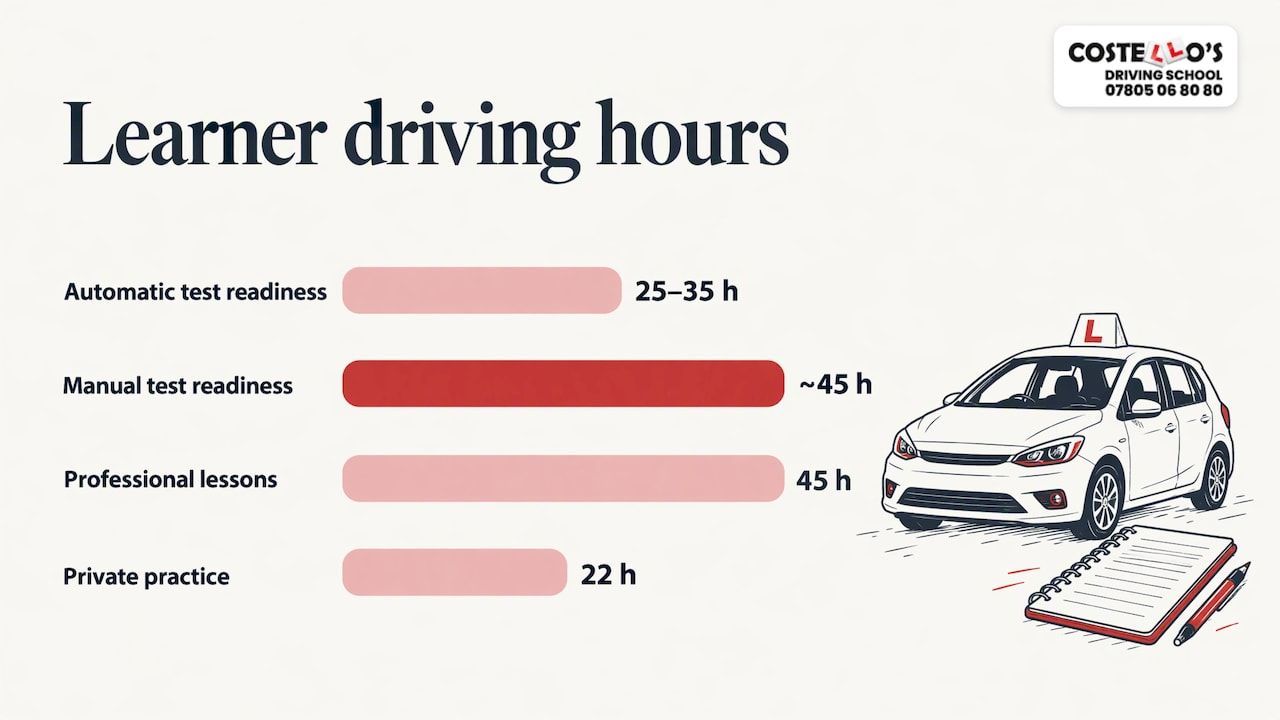
Fewer hours matters for more than money. It means less time between starting and being test-ready, which is useful if you have a deadline such as a new job, university or a family move.
What it costs: a worked example
Our published rates are £42 per hour for automatic lessons and £37 to £38 per hour for manual. The hourly price is higher for an automatic, so the fair comparison is the total for the hours you are likely to need. This is an illustration using the averages above, not a quote or a guarantee:
| Route | Typical hours | Hourly rate | Lesson total |
|---|---|---|---|
| Automatic, lower end | 25 | £42 | £1,050 |
| Automatic, upper end | 35 | £42 | £1,470 |
| Manual, average | 45 | £38 | £1,710 |
On those averages, an automatic learner at the upper end of the range still spends less on lessons than the manual average. Your own total could be higher or lower, because it depends on how quickly you progress. Block booking discounts can lower the hourly cost further, and our driving lesson prices guide shows what else goes into a learning budget, such as the theory test, the practical test fee and a car for practice.
Who benefits most from learning automatic
Nervous learners
If the thought of driving makes your stomach turn, an automatic removes the biggest source of mid-lesson panic. You cannot stall, you do not have to find the right gear under pressure, and your instructor can keep the pace slow and calm. Our instructors specialise in working with nervous drivers, in a relaxed setting, and a first lesson can simply be about getting used to the controls in a quiet area. Our Driveability lessons are also available for learners who want to build skills and confidence at their own pace.
Teenagers preparing for their test
If you are 17 and want to pass as soon as you are ready, automatic lessons let you spend your hours on road awareness rather than on gears. Learners who already have an automatic car at home benefit even more: 31% of automatic learners in the same survey chose automatic because they already had an automatic car in the family, so practice between lessons is easy.
Busy adults
If you are fitting lessons around work and family, fewer total hours means fewer bookings to find. We offer flexible scheduling, including evenings and weekends, so lessons can fit around your week rather than the other way round.
Learners on an intensive course
A short, concentrated course is demanding. Learning a clutch and gears at the same time as everything else in a few days can be a lot. In an automatic, the intensive hours go on road skills. We run intensive driving courses in Essex and Suffolk; get in touch to talk through what would suit your timetable.
Learners with physical disabilities or medical conditions
Automatic cars have only two pedals, and the gearbox does the hard work. That makes them more inclusive for learners with physical disabilities or medical conditions. If you have a condition that affects how you drive, tell us when you enquire so we can plan your lessons around it. You must also tell the DVLA about any medical condition that could affect your driving.
Automatic is now mainstream
Automatic is no longer a niche choice. A BBC News report said a quarter of driving tests in England, Scotland and Wales in the previous year were taken in automatic cars. Instructors are responding to that change, and the cars on the road are changing with it: hybrids and electric cars are automatic by design, so the skills you learn carry over to the vehicles many drivers now buy.
The point is practical. If your first car is likely to be a hybrid, an electric car or an automatic of any kind, learning in one means you pass your test in the type of car you will drive afterwards.
What your licence allows
Here is the one rule worth knowing before you book. If you pass your test in an automatic car, you can only drive automatic cars. A manual test pass covers both types.
This is a simple choice rather than a barrier, and it is reversible. Under GOV.UK rules:
- You can start learning manual at any time without applying for a new provisional licence.
- You follow the usual learner rules, including displaying L plates and being accompanied by a qualified driver.
- You do not need to retake the theory test.
- You book the manual test by phone with the DVSA, not online.
- If you fail the manual test, you can keep driving automatic cars.
There is also talk of a lighter route to manual entitlement. The AA's president has called for automatic drivers to be able to drive manual cars after extra training and an assessment, but that is a proposal, so check GOV.UK for the rules that apply when you book.
So the decision comes down to the car you expect to drive. If you are confident your future is automatic, or an automatic is the car that lets you start driving sooner, learn in one.
How to get the most from your automatic lessons
- Book regularly. Consistent lessons build skills faster than occasional ones. A weekly lesson of one or two hours is a common pattern, and a block booking brings the hourly cost down.
- Practise in an automatic. If someone in your family has one, extra practice between lessons speeds you up. Your instructor can advise on what to practise.
- Keep your eyes up. The extra attention you gain is only useful if you spend it on observation, hazard perception and planning ahead. Use it.
- Learn the car's behaviour. Ask your instructor to explain creep, how the car holds on a hill and how it slows when you lift off the accelerator.
- Plan your test. Test waiting times are long in many areas: nearly three-quarters of test centres in Great Britain reported waits close to the 24-week legal maximum as of March 2025. Book your test early, so that your lessons peak when your date arrives.
Automatic lessons with Costello's
We have taught learners across Essex, Suffolk and East London for over 25 years. Our automatic lessons are £42 per hour, taught by friendly DVSA-approved instructors in modern dual-controlled cars, with evening and weekend lessons for people who work or study during the day. Block booking discounts are available, and we also offer refresher and confidence-building lessons for people returning to driving.
If you want a fixed plan to the finish line, our Guaranteed Pass course is a one-off £2,200. To see all lesson types and book, visit our driving lessons page, or start from the Costello's home page.
Our view on learning automatic
We have taught for over 25 years, and the change we notice most is how many learners walk in already worried about the car itself: the clutch, the stalling, the gears.
For those learners an automatic is not a shortcut, it is a better starting point. When the car stops being the problem, the learner starts to see the road, and that is where real driving skill comes from. We would rather you spent your hours on observation, anticipation and judgement than on clutch control.
That is why we put a lot of work into the relaxed side of lessons. A calm instructor, a modern dual-controlled car and a pace that suits you matter as much as the gearbox. Evenings and weekends are there so lessons fit your life and you keep a rhythm, which is what makes the hours count.
If you are choosing between manual and automatic, tell us how you expect to use your licence, and we will help you decide. If automatic is right, you will start with a car that lets you concentrate on driving.
Dean
FAQ
Are automatic driving lessons easier?
They are easier to begin, because you have no clutch and no gear changes, so there is less to coordinate and almost no risk of stalling. You still learn every road skill a safe driver needs. Many learners find their confidence builds quickly because they spend lessons on real driving.
How many automatic lessons do I need?
There is no set number. Automatic learners typically need 25 to 35 hours to reach test readiness, but your age, previous experience and amount of practice all change that figure. Your instructor will tell you how you are progressing and when you are ready for a test.
How much do automatic lessons cost with Costello's?
Our automatic lessons are £42 per hour. Manual lessons are £37 to £38 per hour. Block booking discounts are available, and our lesson price guide explains the wider budget.
Can I drive a manual car after passing in an automatic?
Not until you pass a manual test. You can begin learning manual whenever you like on the same provisional licence, you do not retake the theory test, and you book the manual practical by phone with the DVSA. If you do not pass, you keep your automatic entitlement.
Are automatic lessons good for nervous drivers?
Yes. With no stalling and no gears to find under pressure, a nervous learner can concentrate on one thing at a time. Our instructors are used to nervous learners and keep lessons patient and relaxed.
Sources
- UK driving instructors shift to automatic cars, The Guardian
- Upgrade an automatic car driving licence to a manual one, GOV.UK
- Should you learn to drive in an automatic? Driving Instructors Association
- Automatic Driving Tests: A Growing Trend Revealed, Driving Instructors Association
- How long does it take to learn to drive? BBC Bitesize
- What is driving the decision to learn in a manual or automatic car, BBC News
- Automatic drivers and manual licences, Birmingham Live
Recommended