City Driving Tips: Stay Calm and Safe on Busy Urban Roads
City Driving Tips: Stay Calm and Safe on Busy Urban Roads
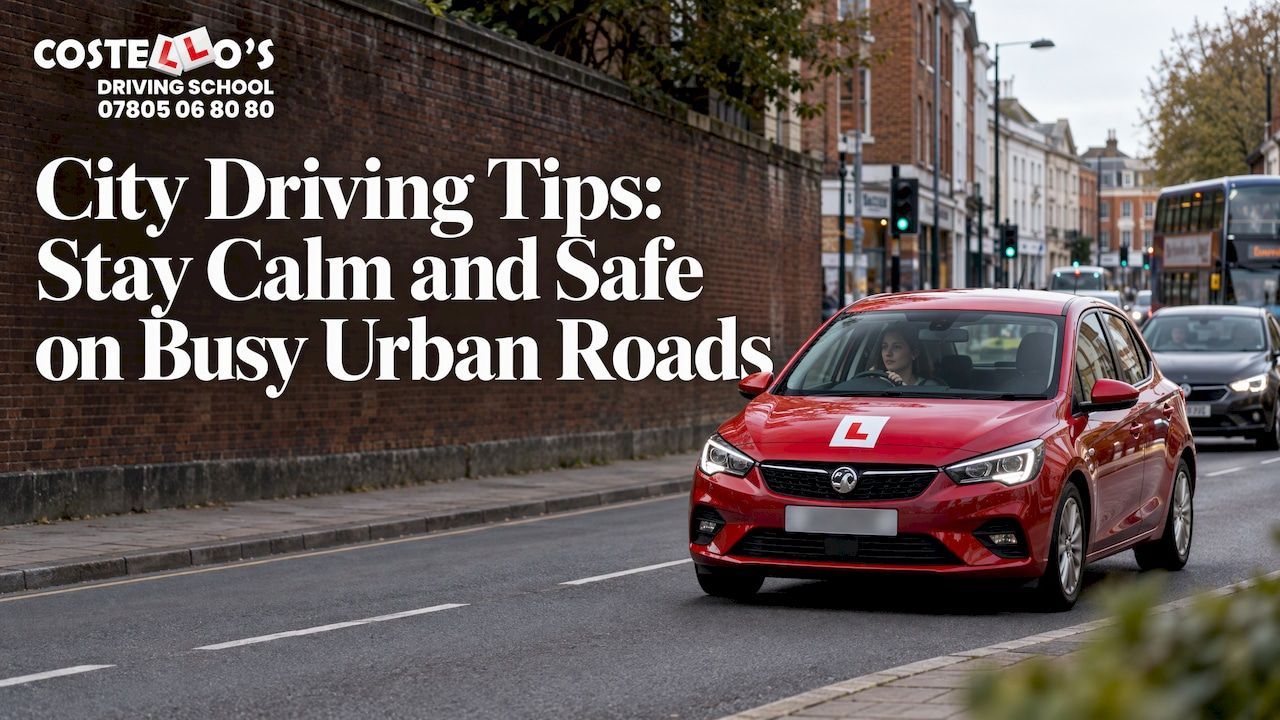
The best city driving tip is to slow your thinking down, not your car: plan the route, scan far and near all the time, leave space around you and give vulnerable road users priority. Those habits come from the DVSA's own driving standard, and they are what lets a nervous learner or a new driver handle a busy town centre without panic. At Costello's Driving School we teach them in real traffic across Essex, Suffolk and East London, with friendly DVSA-approved instructors in dual-controlled cars.
Key Takeaways
- Plan before you set off: know your route, allow extra time and avoid rush hour while you are still building confidence.
- Scan continuously, close to the car and far ahead, so hazards never surprise you.
- Pedestrians, cyclists, motorcyclists and horse riders are the most vulnerable road users, and the Highway Code now ranks drivers by the risk they pose to others.
- Leave a gap in queues and at junctions, and never assume another driver will give way.
- Regular lessons build city skills fastest, and block booking lowers the cost per hour.
Table of Contents
- Why city driving feels harder than it is
- Plan the journey before you start the engine
- Scanning: the habit that makes everything else easier
- Leave space: the tyres-and-tarmac rule
- Vulnerable road users: pedestrians, cyclists, motorcyclists and horse riders
- Roundabouts and multi-lane junctions
- Staying calm when other drivers are not
- Parking, one-way streets and bus lanes
- Building city confidence faster with regular lessons
- Block booking: what it is and why it helps
- Our view on learning city driving
- Ready to practise on real city roads?
- FAQ
- Sources
Why city driving feels harder than it is
City roads put many decisions into a short space: junctions every few metres, buses pulling out, cyclists filtering, pedestrians stepping off kerbs and road signs that change from one street to the next. Nothing in that is unusual. It is simply more of the same skills, arriving faster.
The good news is that the skills are well defined. The DVSA's learning to drive syllabus asks learners to scan the road close to the car and into the distance, anticipate what other road users will do, give them time and space, respond correctly to vulnerable road users and respond correctly to emergency vehicles. If you do those five things consistently, you are driving in the city the way an examiner wants to see it.
That matters whatever your reason for reading. A teenager preparing for a test will meet town-centre routes on the day. A busy adult fitting lessons around work will often practise in the rush hour. A nervous driver needs a method more than a pep talk. And a would-be instructor needs to be able to explain these habits clearly to someone else.
Plan the journey before you start the engine
Most city stress is created before the key goes in. A few minutes of preparation removes the worst of it.
- Know the route. Look at the road layout on a map first: which lane you need at each roundabout, where the one-way streets are, where you will park. Road Safety Scotland's safe driving advice(written for Scottish drivers, but the principle applies anywhere) is to plan your route, check for roadworks or diversions and give yourself plenty of time.
- Allow more time than you think. Hurry is what makes people run late amber lights and squeeze into gaps. Leave early and the pressure disappears.
- Choose your hour. While you are gaining confidence, avoid the busiest peaks where you can. A mid-morning or Sunday drive lets you practise the same junctions at half the intensity, then you can build up to rush hour.
- Sort the car first. Set mirrors, seat and sat nav before you move off, so you are not fiddling in traffic.
If you are learning, ask your instructor to build your lessons around the roads you will actually use. Our instructors teach around Chelmsford, Colchester, Ipswich, Romford and other towns across our area, so the roundabouts and town centres you practise on are the ones you are likely to meet again on your test or your commute.
Scanning: the habit that makes everything else easier
The single most useful city skill is scanning. The DVSA's national standard for driving expects drivers to continually look close to the vehicle and into the distance, use visual clues to predict hazards, judge how significant they are, and stay focused when distracted.
In practice, that means your eyes are never still:
- Far ahead: traffic lights, brake lights several cars up, a bus indicating, a junction approaching.
- Middle distance: the car in front, a pedestrian near a crossing, a van door opening.
- Close up: the kerb, parked cars, the gap beside you, your mirrors.
The same standard asks you to drive at a speed that lets you stop within the distance you can see to be clear. In a street with parked cars on both sides, that distance is short, so your speed should be too. Look for clues: a ball in the road suggests a child, a gap between parked vans suggests someone may step out, and a bus at a stop may be about to pull away.
Leave space: the tyres-and-tarmac rule
Stopping in queues is where many new drivers sit too close. eDriving's town and city driving guide gives a simple test: stop far enough behind the vehicle in front that you can see its rear tyres touching the road. That gives you room to steer round if it breaks down and room to avoid being pushed into it if you are hit from behind.
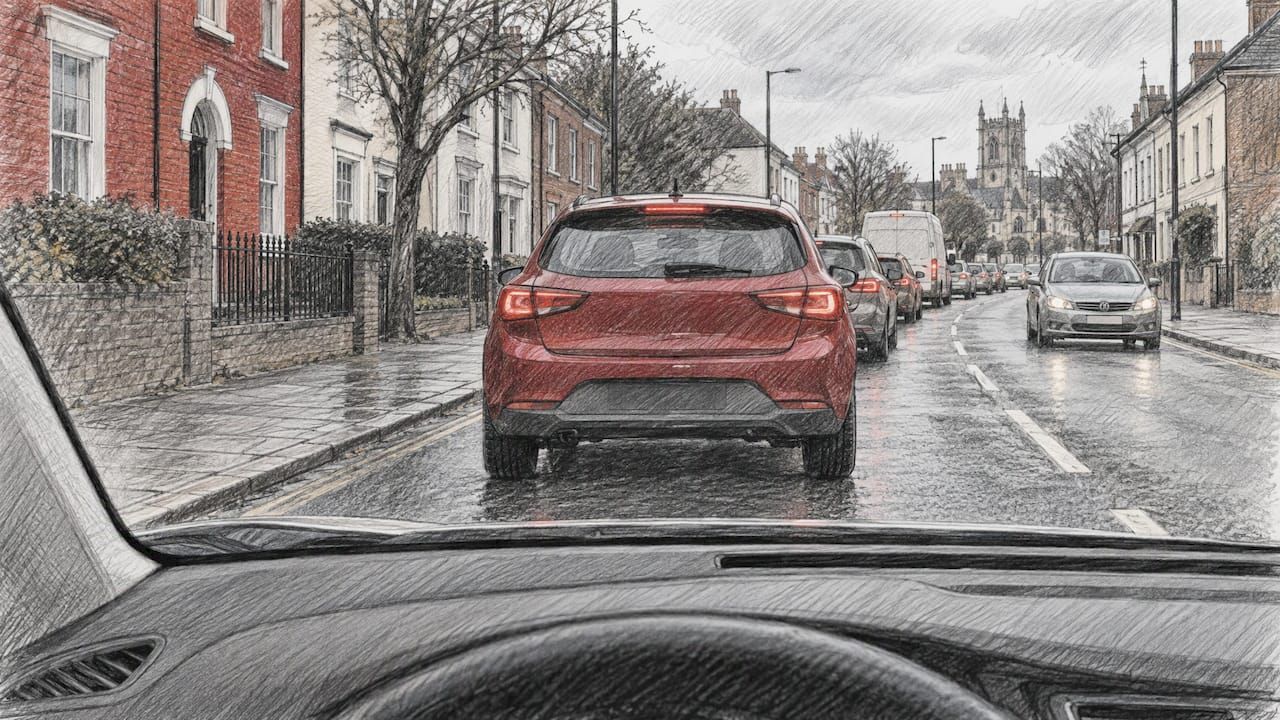
Road Safety Scotland gives the same advice for queues, adding that you should switch your engine off in long stationary queues and watch for motorbikes filtering between lanes.
A safe driving space is also part of the DVSA standard: create it and maintain it, check your blind spots, and position the car so others can see you. When someone cuts in front of you, the answer is to ease off and rebuild the gap, not to close it.
Vulnerable road users: pedestrians, cyclists, motorcyclists and horse riders
Cities have more people on foot and on two wheels. The Highway Code names pedestrians, cyclists, motorcyclists and horse riders as the most vulnerable road users, warns that a vehicle at 40 mph will probably kill any pedestrian it hits, and tells drivers to go carefully and slowly in crowded shopping streets, residential areas, and past bus stops and parked vehicles.
The hierarchy of road users
The Highway Code was updated, and the version dated 10 April 2025 still applies. It sets out a hierarchy of road users in which those who can do the most harm carry the most responsibility. In plain terms:
- You must give way to pedestrians on a zebra crossing, and to pedestrians and cyclists on a parallel crossing.
- When turning into or out of a junction, you should give way to pedestrians crossing or waiting to cross.
- Do not cut across cyclists, horse riders or horse-drawn vehicles when turning at a junction or changing lane.
A worked example: you are turning left at a junction and a cyclist is going straight ahead on your left. Check your mirror and left blind spot, slow down, and let the cyclist pass before you turn rather than swinging across their path. It costs you three seconds.
What hides at junctions
eDriving's guide points out what makes junctions risky: pedestrians, especially children, can be hidden behind parked vehicles; cyclists can arrive faster than expected and often travel faster than cars in heavy traffic; motorcycles are harder to spot and may be approaching very fast. Its advice is never to assume another vehicle will give way. Look twice at junctions, and wait until you are sure.
Near schools the risk rises. Road Safety Scotland notes that children may run out between slow-moving vehicles and that pupils walk in groups near schools, so be ready to stop.
Roundabouts and multi-lane junctions
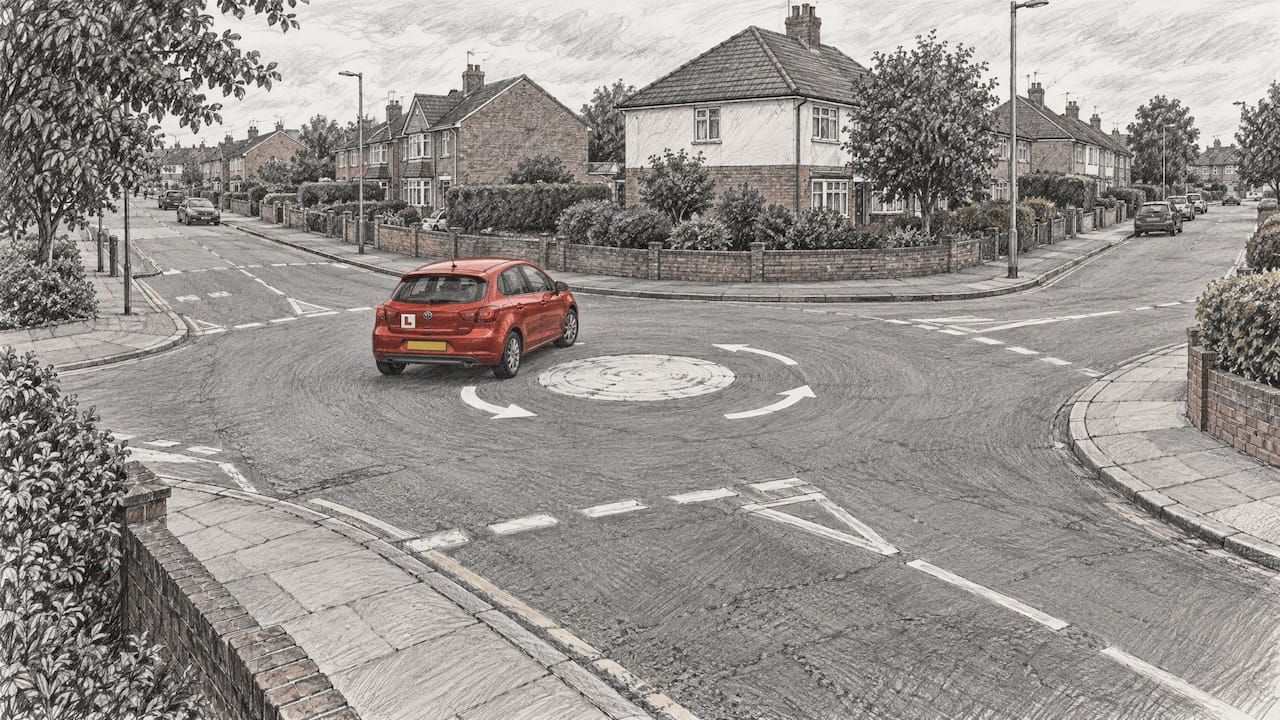
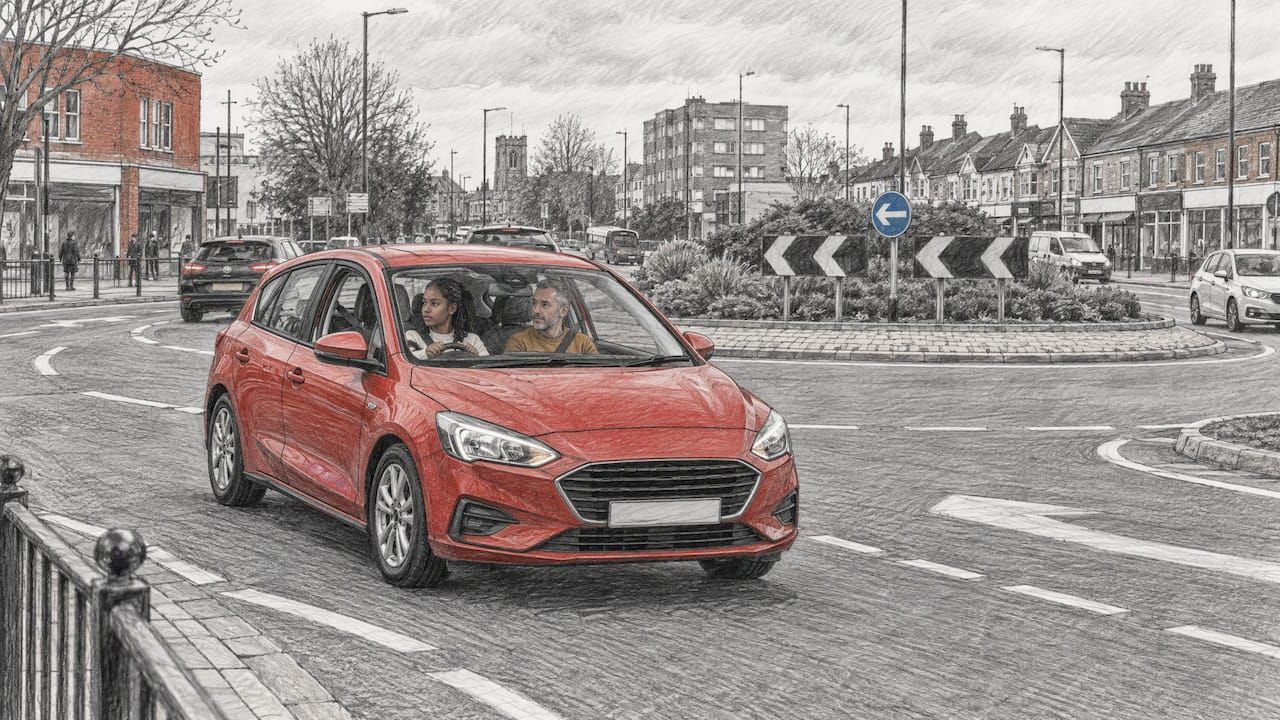
Roundabouts cause more learner anxiety than almost anything else in town. The Highway Code's rule 184, in its section on using the road, gives the method: use Mirrors, Signal, Manoeuvre at every stage, decide your exit as early as you can, get into the correct lane and adjust your speed and position to the traffic.
Rule 186 adds the cyclist point: give them priority on the roundabout, give them plenty of room, do not overtake them within their lane, and do not cut across cyclists, horse riders or horse-drawn vehicles in the left-hand lane who are continuing around.
A simple routine for a busy roundabout:
- Read the signs and road markings on approach to pick your lane.
- Mirror, signal, then slow down in good time.
- Look right and judge the gap, but keep checking the car ahead, which may stop suddenly.
- Move off only when it is clear, and signal your exit.
If you miss your exit, carry on round and take it next time. Going round again costs seconds. Swerving across lanes can cost a collision.
Staying calm when other drivers are not
You will meet impatient drivers: tailgaters, horn-sounders, people who cut in. The DVSA standard asks you to manage your own physical and emotional state so that it does not raise your risk. That is a skill, and it can be practised.
- Let the tailgater pass when it is safe, instead of speeding up or braking to make a point.
- Treat a missed turning as nothing. Take the next one, or use a safe place to re-plan.
- Breathe out slowly before a difficult junction. Tension makes you grip the wheel and stare, and staring is the opposite of scanning.
If another driver becomes aggressive, Road Safety Scotland's guidance is to avoid eye contact, keep doors locked and windows up, leave space around your vehicle and get away quickly without speeding or driving dangerously. If someone approaches the car and you cannot safely drive off, flash your lights and sound the horn. This is sensible advice anywhere in the UK.
Winter in the city
Shorter days, wet roads and low sun all reduce what you can see, which makes your scanning more important. Keeping your glass and paintwork clean and protected also helps visibility and keeps the car in good order, and this winter car protection guide covers the practical steps for UK conditions.
Parking, one-way streets and bus lanes
Three smaller city skills deserve a mention because they trip people up:
- Parking. Plan where you will park before you arrive. Circling the same streets while checking your phone is a hazard of its own. Practise reverse bay and parallel parking with your instructor until it is routine, because a busy street is a poor place to learn it.
- One-way streets. Check the lane you need early and signal in good time. Lane markings and signs often appear late, so read ahead.
- Bus lanes and cycle lanes. Check the signs for hours of operation before you enter, and watch for buses pulling out from stops.
If you want to rehearse any of these, a dedicated session works better than hoping the situation turns up on its own. Our refresher and confidence-building lessons exist for drivers who passed years ago, or recently, and still avoid town centres.
Building city confidence faster with regular lessons
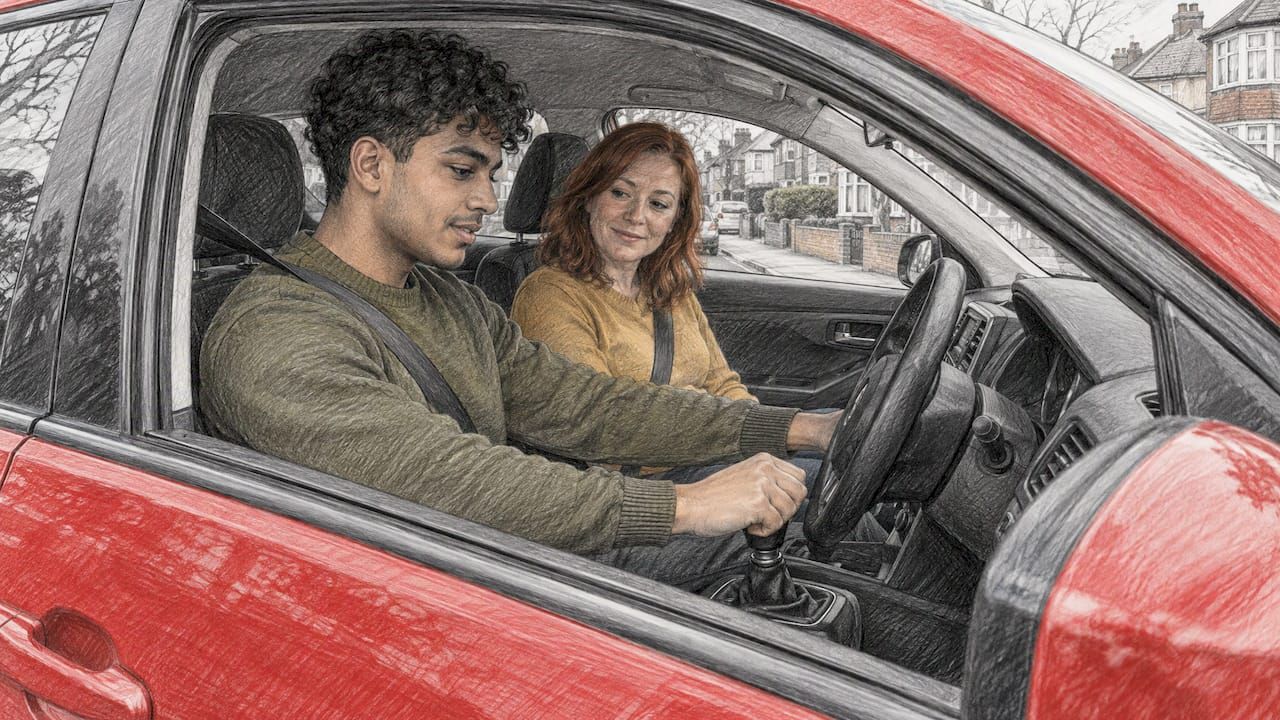
Confidence in traffic comes from repetition. The more often you meet a busy junction with a calm instructor beside you, the sooner it stops feeling like an emergency. That is the thinking behind our approach: lessons tailored to the learner, relaxed instructors who are patient and supportive with nervous drivers, and modern dual-controlled cars that let your instructor step in if you need it.
For different readers, that looks like this:
- Teenagers preparing for a test: frequent, regular lessons on the type of roads your test uses.
- Busy adults: flexible lesson times, including evenings and weekends, so practice fits around work.
- Nervous drivers: a patient pace, starting with quieter roads and building to the busy ones.
- People who want a fast result: intensive courses compress the learning into a short period.
- Automatic drivers: automatic lessons let you concentrate on the road rather than the gearbox, which many find easier in stop-start traffic.
Our published rates are £37-38 per hour for manual lessons and £42 per hour for automatic lessons. You can see the details on our driving lessons page.
Block booking: what it is and why it helps
A block booking means paying for several lessons in one go instead of one at a time. For a learner who needs a steady run of practice to get comfortable in traffic, it has three practical benefits.
It lowers the cost per hour. Carwow's pricing study, published on 29 November 2022, found the UK average one-hour lesson cost £27, falling to an average of £23 per lesson when bought in a block. Over 46 lessons, it put the average saving at £184, roughly £1,242 for individual lessons against around £1,058 bought in bulk. These are national averages from 2022, and prices vary between schools and areas, so treat them as an illustration of the pattern rather than a quote.
It keeps you booked in. City confidence needs lessons close together. With a block already paid for, there is no decision to make each week, and gaps between lessons are less likely to creep in.
It makes the commitment visible. Paying for a block is a sensible way for a learner to plan a budget and a timetable together.
On the discount amount: it depends on the size of the block, so we do not quote a single figure here. Our block bookings page is where you can see how block bookings and refresher training work with us.
Your cancellation rights
When you book a block of lessons remotely, for example online or by phone, consumer law gives you rights. LexisNexis guidance explains that a consumer generally has 14 days after entering a distance service contract to cancel, and that the trader should not start the service in that period unless the consumer expressly asks. If you ask for lessons to begin straight away, the school can reasonably charge for what you have already used. Ask for the terms in writing before you pay.
Our view on learning city driving
We have taught people to drive for over 25 years, and the pattern is clear: learners who feel calm in traffic are the ones who practise in traffic, little and often, with someone who stays relaxed beside them.
That is why we built our lessons around the individual. A nervous driver and a confident teenager need different starting points, and both do better when the instructor adapts to them rather than the other way round. Our instructors are friendly, DVSA-approved and patient, and our dual-controlled cars give everyone the reassurance to try the harder roads.
We also think flexibility matters. Evenings and weekends mean busy adults can keep lessons going, and intensive courses and our Guaranteed Pass package suit people who want to reach the test quickly. Block booking rewards the learner who commits to regular practice.
If you want to teach others one day, our one-to-one instructor training has a track record of every trainee qualifying as a DVSA-approved instructor.
Dean
Ready to practise on real city roads?
If these tips make sense on paper but you want to feel them in the car, lessons with a patient DVSA-approved instructor are the quickest way to turn them into habits. We teach manual and automatic learners across Essex, Suffolk and East London, with evening and weekend times for people who work.
Want a set route to a test date? Our Guaranteed Pass course is a one-off £2,200. Prefer to pay as you go or save with a block? See our driving lessons and block bookings, or start from our home page.
FAQ
What is the safest way to approach a busy junction in a city?
Slow down early, look far ahead and close to the car, and never assume anyone will give way. Pedestrians can be hidden behind parked vehicles and cyclists often arrive faster than expected, so check twice before you pull out.
Should I avoid rush hour while I am learning?
While you are building confidence, quieter times are a sensible way to start. Practise the same roads at calmer times first, then build up to peak traffic with your instructor beside you. Rush hour then becomes a skill you have already rehearsed, not a surprise.
Who has priority at crossings and when turning?
Under the Highway Code you must give way to pedestrians on a zebra crossing, and to pedestrians and cyclists on a parallel crossing. When turning at a junction you should give way to pedestrians crossing or waiting to cross, and avoid cutting across cyclists going straight ahead.
How does block booking save money on driving lessons?
You pay for several lessons together, and schools generally charge less per hour than for single lessons. Carwow's 2022 UK study put the average at £23 per lesson in a block against £27 for a single lesson. Check the terms for your block, including how long it lasts.
Can I cancel a block of lessons I have booked?
For contracts made at a distance, you generally have 14 days to cancel. If you asked for lessons to start within that period, the school can charge for those already given. Confirm the terms before paying.
Sources
- Learning to drive a car syllabus, Unit 4 (GOV.UK)
- National standard for driving cars and light vans, Role 4 (GOV.UK)
- The Highway Code, using the road, rules 159 to 203 (GOV.UK)
- The Official Highway Code with annexes
- The Highway Code, UK edition
- Best Practice Guide: Town/City Driving (eDriving)
- Safe driving (Road Safety Scotland)
- How much are driving lessons? (Carwow)
- Cancellation rights under the Consumer Contracts Regulations (LexisNexis)
- Winter Car Protection in the UK