Slip Road Merging: How to Join a Motorway or Dual Carriageway
Slip Road Merging: How to Join a Motorway or Dual Carriageway
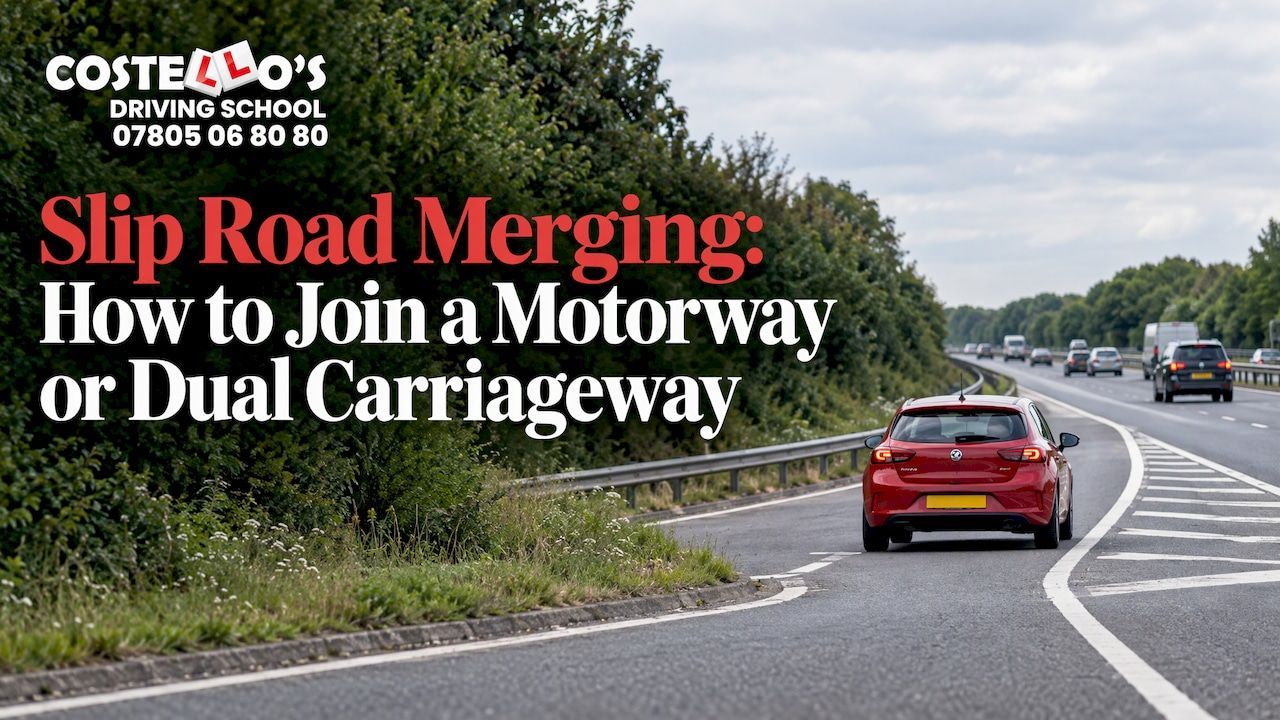
To merge from a slip road, use the whole slip road to match the speed of the traffic in the left-hand lane, find a gap, check mirrors and blind spot, signal, and slide across without forcing anyone to brake. Traffic already on the main road has priority. Most of the skill is in the preparation, and it is easy to learn with calm, repeated practice in a dual-controlled car. That is how we teach it at Costello's Driving School.
Key Takeaways
- Traffic already on the motorway or dual carriageway has priority: you fit into the flow, it does not fit around you.
- Use the slip road to build up speed so you arrive at the same pace as the left-hand lane, not at the end of the road at a crawl.
- Use the Mirrors, Signal, Manoeuvre routine (with Position, Speed, Look) and look at the gaps, not the vehicles.
- Never stop on a slip road, and never reverse on it, except in an emergency.
- Making no observations when joining a dual carriageway is a recognised driving test fault, so it is worth practising before your test.
Table of Contents
What a slip road is for
A slip road is a short link road that lets you join or leave a faster, busier road such as a motorway or dual carriageway, according to RAC Drive. Its purpose when you are joining is simple: it gives you room to speed up before you meet the traffic.
Speed limits on slip roads usually match the road you are joining, although some have lower posted limits because of tight bends or short merging lanes. Always read the signs rather than assuming. The national limit on a motorway is 70 mph, and you must not exceed any lower limit in force, for example at road works, under Rule 261 of the Highway Code.
The types you will meet
RAC Drive describes several layouts. Two matter most when merging:
- Tapered: the slip road narrows into the main carriageway. This needs confident, well-timed merging because the space runs out.
- Parallel: a longer, separate lane runs alongside the main road before it ends. You have more time to adjust speed and pick your gap.
You will also see loop slip roads at big junctions and two-lane slip roads on busy routes. Knowing which one you are on tells you how early you need to be ready.
What the Highway Code says
Rule 259 of the Highway Code covers joining the motorway. In plain terms:
- Give priority to traffic already on the motorway.
- Check the traffic and match your speed so you fit safely into the left-hand lane.
- Do not cross solid white lines or use the hard shoulder.
- If the slip road continues as an extra lane, stay in it.
- Stay in the left-hand lane long enough to adjust to the speed of traffic before you think about overtaking.
The same guidance sets two firm prohibitions. Under Rule 263 you must not reverse along any part of a motorway, including slip roads. If you miss your exit, carry on to the next one. Under Rule 271 you must not stop on a slip road except in an emergency or when told to by the authorities or signals listed in the Code.
How to merge, step by step
1. Assess early, from the start of the slip road
As soon as you can see the main carriageway, start scanning. The slip road's shape changes what you can see. RoSPA explains that a rising slip road gives you less time to judge the speed and position of vehicles in lane one, while a descending one gives an early view. On a two-lane slip road, keeping left gives you more time to assess traffic.
What goes wrong: drivers look only at the car directly beside them and miss the gap two or three vehicles back.
2. Build your speed along the slip road
Use the full length. Safe Driving for Life advises accelerating until your speed matches that of the traffic. RoSPA says the aim is to minimise the difference between your speed and lane one's so you can move sideways into a gap.
What goes wrong: joining at 40 mph into traffic doing 70 forces other drivers to brake. Equally, a nervous driver who crawls to the end of the slip road has no speed and no choice of gap.
3. Run Mirrors, Signal, Manoeuvre
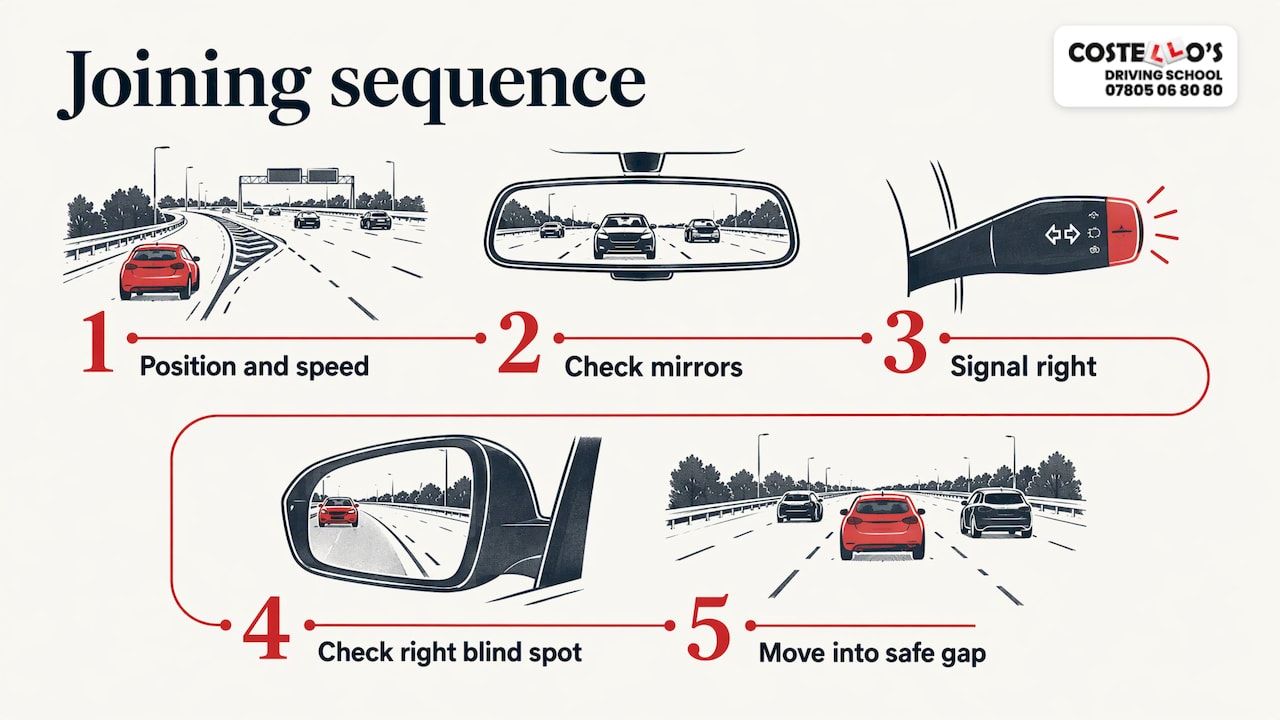
Safe Driving for Life recommends the Mirrors, Signal, Manoeuvre routine, with Position, Speed, Look (MSM/PSL). Check your mirrors, signal, check your right-hand blind spot, then move across. RoSPA adds that at busy times, signalling right can invite co-operation from drivers already on the motorway, and it is always good practice to alert them of your intention.
4. Focus on the gaps
RoSPA's advice is to focus on the gaps, not the vehicles. Looking at a car makes you drift towards it. Look at the space you want to occupy and steer into that.
5. Merge once, then settle
Move into the left-hand lane in one smooth movement, cancel your signal, and stay there to get used to the speed. Do not swing straight across to lane two. Merging points are where congestion tends to build, so drifting over at once is risky.
Joining a dual carriageway
The principle is identical. Match the speed of the traffic already there, use the slip road to do it, and give way. The differences are practical: dual carriageway speed limits can be 70 mph or lower, there may be junctions and roundabouts close by, and slower vehicles such as tractors can be in the left lane. Read the limit signs and the road as you approach.
If the slip road is short, busy or slow
Short slip road. Accelerate decisively from the first moment you can see a gap forming, and decide early. Do not leave all your decisions to the last few metres. Never cross the solid white lines to get into lane one early.
Heavy traffic. If the main road is queuing, you may need to slow to its speed. Safe Driving for Life says to avoid stopping at the end of the slip road unless you are queuing to join slow-moving traffic.
No gap at all. Never force your way in. eDriving's lane-changing guide says to avoid stopping or slowing right down where possible, but to stop if necessary until you see a safe gap. Rule 271 allows stopping only in an emergency, so the aim is always to be moving and ready. If you really cannot merge, keep to the end of the slip road and wait for a gap, and never reverse.
Gap appears and closes. Stay flexible. Ease off slightly to slot behind a vehicle rather than accelerating hard into a space that is disappearing.
Slip road merging and the driving test
The DVSA lists making no observations when joining a dual carriageway from a slip road as an example of the "Junctions: observations" fault, which is among the top reasons for failing the test. Entering without observation, or without giving way to traffic on the main carriageway, counts. The same DVSA page notes that ineffective observation was a factor in 47% of all collisions in 2023.
For test candidates, the lesson is clear: look visibly, check mirrors and blind spot, and let the examiner see you choose your gap.
Common mistakes
| Mistake | Why it matters | Fix |
|---|---|---|
| Joining too slowly | Other drivers must brake or swerve | Build speed along the full slip road |
| Staring at one car | You drift towards it | Look at the gap |
| Skipping the blind spot | Missing a vehicle alongside | Mirrors, signal, then a quick look over your shoulder |
| Stopping at the end | Dangerous with no speed to rejoin | Plan your gap early and keep moving |
| Cutting across solid white lines | Against Rule 259 | Stay on the slip road until it ends |
How to get confident
Motorway and dual carriageway driving worries many learners, and that is normal. Confidence comes from doing it in small steps: a quiet dual carriageway first, then a busier one, then the motorway, with an instructor beside you and dual controls under their feet. Practise at different times of day so you see light and heavy traffic.
Whether you are a teenager heading for your test, an adult fitting lessons around work, or a driver who passed years ago and lost your nerve, the aim is the same: arrive at the merge with the right speed, a plan and a calm head.
Our perspective
Slip roads are where a lot of drivers realise that passing a test and feeling ready are different things. Our instructors are DVSA-approved and specialise in patient teaching for nervous learners, and our modern dual-controlled cars mean you can try a merge knowing someone has your back.
We build the skill in stages. First, how to read the road ahead and judge speed. Then the routine, again and again, until it is automatic. Our manual and automatic lessons run into evenings and weekends, so practice can fit your week, and refresher lessons are there for people who passed a while ago and want their confidence back.
The most common thing we want learners to take away: speed up, look for the gap, commit. Hesitation is what makes merging hard.
Dean
Lessons that cover it
We teach slip roads and dual carriageways across Essex, Suffolk and East London. Manual lessons are listed at £37-38 per hour and automatic at £42 per hour on our driving lessons page. If you are closer to test day, our Guaranteed Pass course is a one-off £2,200, and refresher lessons suit qualified drivers who want to feel sure again.
If you would like to start, you can book through our website.
FAQ
Who has priority on a slip road?
Traffic already on the motorway or dual carriageway has priority. Rule 259 of the Highway Code tells you to give priority to it and fit into the flow safely. Adjust your speed and gap rather than expecting others to move.
Can you stop on a slip road if you can't merge?
You must not stop on a slip road except in an emergency or when directed by the authorities or signals listed in Rule 271. In practice, plan your gap early, and stop only where queuing traffic makes it unavoidable, as Safe Driving for Life describes. Never reverse.
What speed should I be doing when I merge?
Aim to match the speed of the traffic in the left-hand lane by the end of the slip road, within the limit shown. The limit is usually that of the road you are joining, but lower posted limits can apply, according to RAC Drive.
Should I indicate when joining a motorway?
Yes. Signal before you move across. RoSPA says that at busy times, indicating right can invite co-operation from drivers already on the motorway.
Can I use the hard shoulder or cross the white lines to get ahead?
No. Rule 259 says you must not cross solid white lines or use the hard shoulder when joining. Stay on the slip road until the markings let you move across.
Sources