Romford Roundabouts: Tips for Learner Drivers
Romford Roundabouts: Tips for Learner Drivers
To handle Romford's roundabouts, decide your exit early, choose your lane from the signs and markings before you reach the give-way line, give way to traffic from the right, and keep the same lane all the way round. That routine is the same on a small suburban roundabout and at Gallows Corner. The only thing that changes is how much reading of the road you have to do. Below we cover the routine, the Romford layouts that catch learners out, and how to practise them. If you want an instructor beside you for the real thing, our driving lessons in Romford are built around exactly this kind of local practice.
Key Takeaways
- Use Mirrors, Signal, Manoeuvre on every approach, and pick your exit and lane early, as Highway Code Rules 184 to 186 set out.
- You give priority to traffic from the right unless signs, markings or traffic lights say otherwise.
- On multi-lane roundabouts, painted arrows and overhead signs override the usual "left for left, right for right" habit, so read them first.
- Gallows Corner has been reworked with changed lanes, so practise it with an instructor before relying on an old mental picture of it.
- A hesitant stop on an empty roundabout and a late lane change are the faults that most often cost learners marks.
Table of Contents
The routine that works at every roundabout
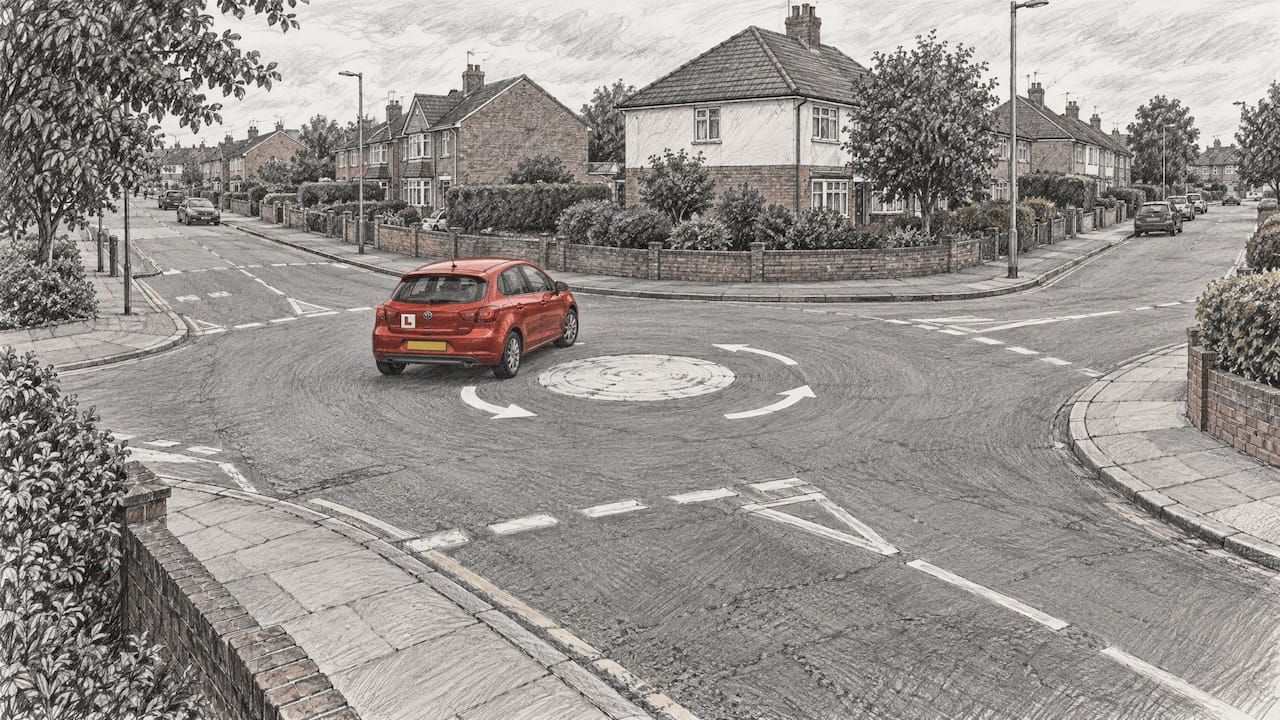
A roundabout is a sequence of decisions made in the right order. Learners who struggle usually make the right decisions too late. The order is the same every time.
1. Read the roundabout early
Look for the roundabout sign and any lane markings as you approach. The sooner you know which exit you want and which lane it needs, the less you have to do in the last few metres. Drive in a way that lets you stop at the give-way line if you need to. The nidirect roundabout guidance warns that approaching too fast can make drivers already on the roundabout brake or swerve, and can catch a following driver out.
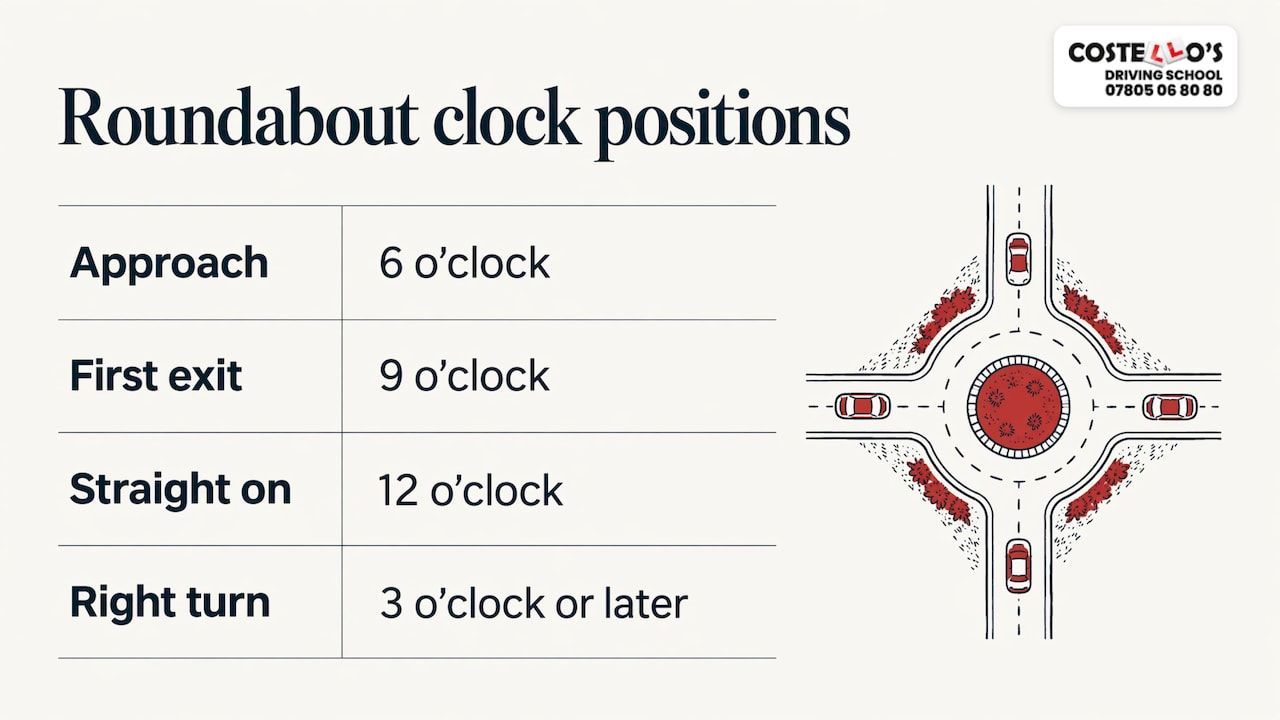
It helps to think of the roundabout as a clock face. In the UK all traffic moves clockwise, and you always approach from the six o'clock position. Your exit is then easy to name: first exit is around nine o'clock, straight on is twelve, and a right turn is three o'clock or later.
2. Mirrors, Signal, Manoeuvre
The Highway Code asks you to use Mirrors, Signal, Manoeuvre at all stages. In practice that means a mirror check, a signal if one is needed, then position and speed, then a look to the right before you go. Our instructors teach this as a habit that repeats on every approach, so it does not fall apart when the road is busy.
3. Choose your lane and signal to match
The Highway Code gives these defaults when there are no other markings:
| Where you are going | Signal on approach | Lane on approach | Signal while on the roundabout |
|---|---|---|---|
| First exit (turning left) | Left | Left | Keep left signal on |
| Straight on (intermediate exit) | None normally | Left lane, unless markings say otherwise | Signal left after passing the exit before yours |
| Right turn or full circle | Right | Right | Signal left after passing the exit before yours |
The key words are "unless signs or markings say otherwise". On many larger roundabouts, arrows on the road decide your lane, and they can send straight-on traffic into either lane.
4. Give way, then go when it is safe
Rule 185 says you must give priority to traffic approaching from your right, unless signs, road markings or traffic lights direct otherwise. Even where markings let you enter without giving way, you should still look right before joining.
On a driving test, the opposite error counts too. The RAC's roundabout guide notes that missing a clear, safe chance to join can be marked as a driver fault, and a short delay when there was plenty of time may be a serious fault. If the roundabout is clear, go. Treating the give-way line as a compulsory stop is a habit worth losing early.
5. Stay in lane, then check and signal to leave
Once you are on the roundabout, hold your lane. Changing lanes mid-roundabout is how many learners pick up a fault. Before you leave, check your mirrors, signal left and move to your exit. Cancel the signal once you are out.
The Highway Code also tells you to give cyclists plenty of room and not to overtake them within their lane on a roundabout. Cyclists often take the whole lane on purpose, so stay behind them and be patient. Our guide to leaving 1.5m for cyclists covers overtaking in more detail.
Romford layouts that catch learners out
Romford sits where the A12, the A127 and busy town-centre roads meet, so learners meet very different roundabouts within a short drive. The one most people mean when they talk about difficult roundabouts is Gallows Corner.
Gallows Corner
Gallows Corner connects the A12 Eastern Avenue, the A127 Southend Arterial Road and Main Road. The Havering Daily lists it first among the borough's most dangerous junctions, describes it as the borough's largest roundabout with five exits, and reports TfL safety work including layout changes and extended reduced speed limits on the approaches.
That work has changed what you will meet on the ground. According to the Romford Recorder, after the reopening:
- the A12 eastbound (Colchester Road) lane is separated from the other three lanes by an island, with a new sign explaining it;
- Main Road now has two lanes on the approach rather than three;
- the flyover speed limit remains 30mph;
- the widened flyover base has taken one lane on the way into the A127 from the roundabout.
What this means for you: do not drive Gallows Corner from memory. Read the signs and the arrows on the day, commit to your lane before the give-way line, and do not switch lanes half way round. If you are not sure which lane you are in, stay where you are and follow it. Taking a wrong exit and finding another way back is far better than cutting across another driver. The RAC notes that on a test you will not fail simply for choosing the wrong lane: the examiner looks at how you react, through your mirrors, checks, speed and signals.
If Gallows Corner feels like too much on day one, that is normal. Build up to it. Start on quiet roundabouts, move to two-lane ones, then bring in the bigger junctions once your routine is automatic.
Open and closed roundabouts
Not every Romford roundabout shows you the same amount. The RAC explains that "closed" roundabouts give you no view of oncoming traffic until the last moment, while "open" ones let you judge the situation in advance. That visibility affects your approach speed. On a closed roundabout, slow earlier and be ready to stop. On an open one, use the view to judge gaps, but still look right before you commit.
Mini-roundabouts, multi-lane and signal-controlled
The DVSA's Ready to Pass? guidance says test candidates must be able to handle standard, mini, multiple or satellite, and traffic-light-controlled roundabouts. They must also know the Mirrors, Signal, Manoeuvre and Position, Speed, Look routines, correct positioning and lane choice, who has priority, and how to leave. Around Romford you will meet all of these within a short drive, which is why practising on a varied local route helps more than repeating one easy roundabout.
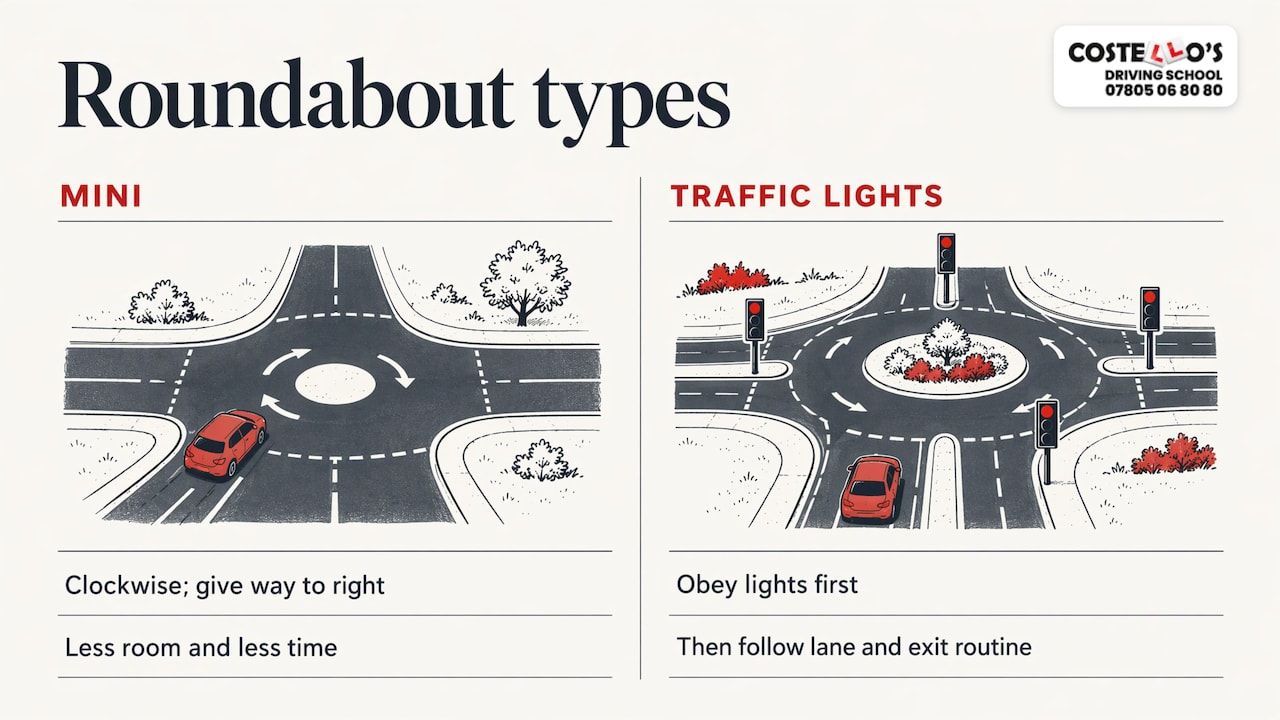
On a mini-roundabout, the same priority rule applies. You still go clockwise and give way to the right, but there is less room and less time. On traffic-light-controlled roundabouts, obey the lights first, then apply the lane and exit routine.
The mistakes that cost learners marks
The DVSA's top reasons for failing the driving test, updated 14 August 2025, include several roundabout faults:
- entering when a vehicle is approaching from the right;
- not using mirrors when exiting a multi-lane roundabout;
- positioning in the left-hand lane when turning right;
- choosing the wrong lane despite clear signage;
- driving straight across a roundabout that has no lane markings, instead of following the circle.
Here is how to fix each one.
- Entering into traffic from the right. Slow on the approach so you have time to look right, judge the gap and decide. Do not look only at the car in front.
- Skipping the mirror before leaving. Make the mirror check the first move of your exit, before the signal and before the steering.
- Wrong lane for a right turn. If you are turning right or going full circle, you normally need the right-hand lane on approach, unless markings say different.
- Ignoring signage. Read the sign 200 to 300 metres out, where one is provided, and let the arrows over-rule habit.
- Straight-lining. With no lane markings, follow the shape of the roundabout rather than cutting across the middle.
Two more worth knowing. Hesitating when the roundabout is clear can be marked as undue hesitation. And a signal left too early, or left on after you exit, confuses other drivers. Cancel it as soon as you are out.
For a deeper look at test faults and drills, see our guide to beating the four roundabout test faults.
How to practise roundabouts around Romford
Reading about roundabouts helps. Driving them repeatedly, with feedback, is what builds the habit. A sensible build-up looks like this:
- Quiet roundabouts first. Practise the mirror, signal and position routine until you do not have to think about it.
- Add exits. Take the first exit, then straight on, then a right turn, on the same roundabout, so you feel the difference in lane and signal.
- Move to two-lane roundabouts. Practise reading arrows and choosing a lane early.
- Try busy times. Gaps are tighter in rush hour, so your observation and decision-making improve quickly.
- Link them into a route. On test, roundabouts come mid-route, between other tasks, so practise them that way. Our guide to Romford driving test routes explains the road types that matter, and the Hornchurch test route guide does the same for the neighbouring area.
If you take a wrong turn on a roundabout during the independent driving part, it will not fail you by itself. Our page on the independent driving part explains why.
When you are driving with family or friends between lessons, a plan helps. Our Romford practice plan shows how to combine two lessons with 30 to 45 minutes of extra driving each week.
If roundabouts make you nervous
Many nervous drivers say roundabouts are what they dread most, because they feel fast and unpredictable. Three things help:
- Slow early. A calm approach gives you more time to look, and the whole sequence feels less rushed.
- Break the roundabout into pieces. Approach, give way, circulate, exit. Think only about the stage you are in.
- Repeat the same one. Driving one roundabout five times in a row teaches more than five different ones once.
Our instructors work with nervous learners and we offer refresher and confidence-building lessons. Starting with a quiet roundabout and building up is exactly how we plan them.
Our view on Romford roundabouts
Most learners think a roundabout is a speed problem. We see it as a planning problem. If you know your exit and your lane before the give-way line, the rest is a calm, repeatable routine.
That is why we teach roundabouts in layers, on real local roads, in dual-controlled cars, with friendly DVSA-approved instructors who explain each decision as you make it. Learners who build the routine on quiet roundabouts turn up at the big junctions already knowing what to do, and that confidence is what carries over to the test.
With more than 25 years of teaching experience across Essex, Suffolk and East London, we believe the best way to learn a roundabout is steadily, with the same instructor, until the routine is yours.
Dean
Learn Romford's roundabouts with Costello's
We teach manual and automatic lessons around Romford, with flexible times including evenings and weekends. Manual lessons are £37 to £38 an hour and automatic lessons are £42 an hour, as published on our site. If you want to learn faster, we also run intensive courses and a Guaranteed Pass course at £2,200 one-off. See our lesson options and prices or look at the Romford lessons page to book.

If you already hold a licence and have lost your nerve, our refresher training is a good way back onto the road. See the block booking and refresher options.
FAQ
Do you drive clockwise or anticlockwise around a roundabout in the UK?
Clockwise. You approach from the six o'clock position on the clock face, give way to traffic coming from your right, and leave in the direction you want. Nidirect's guidance describes all movement on roundabouts as clockwise.
What should I do if I am in the wrong lane on a roundabout?
Stay in your lane and follow where it takes you, then find a safe way back. Do not swerve across other traffic. The RAC says you will not fail a test just for choosing the wrong lane: the examiner looks at how you react, using your mirrors, checks, speed and signals.
When do I signal on a roundabout?
Signal left on approach for the first exit and signal right for a right turn or full circle. For straight on you normally do not signal on approach. For right-hand and straight-on exits, signal left after passing the exit before yours. This follows the Highway Code.
Is Gallows Corner too hard for a learner?
It is busy and has been reworked, but it is manageable once your routine is solid. Build up from quiet roundabouts, read the signs and arrows on the day, and practise it with an instructor first.
Sources
- The Highway Code: Using the road (159 to 203)
- Appendix: roundabouts (nidirect)
- Top 10 reasons for failing the driving test in Great Britain (DVSA)
- Junctions, roundabouts and crossings (Ready to Pass?)
- Which are Havering's most dangerous junctions? (The Havering Daily)
- Gallows Corner open with lanes and speed limit changed (Romford Recorder)
- Roundabouts guide for drivers (RAC Drive)
Recommended