Gearbox Types Explained: Manual, Automatic, CVT and DCT
Gearbox Types Explained: Manual, Automatic, CVT and DCT
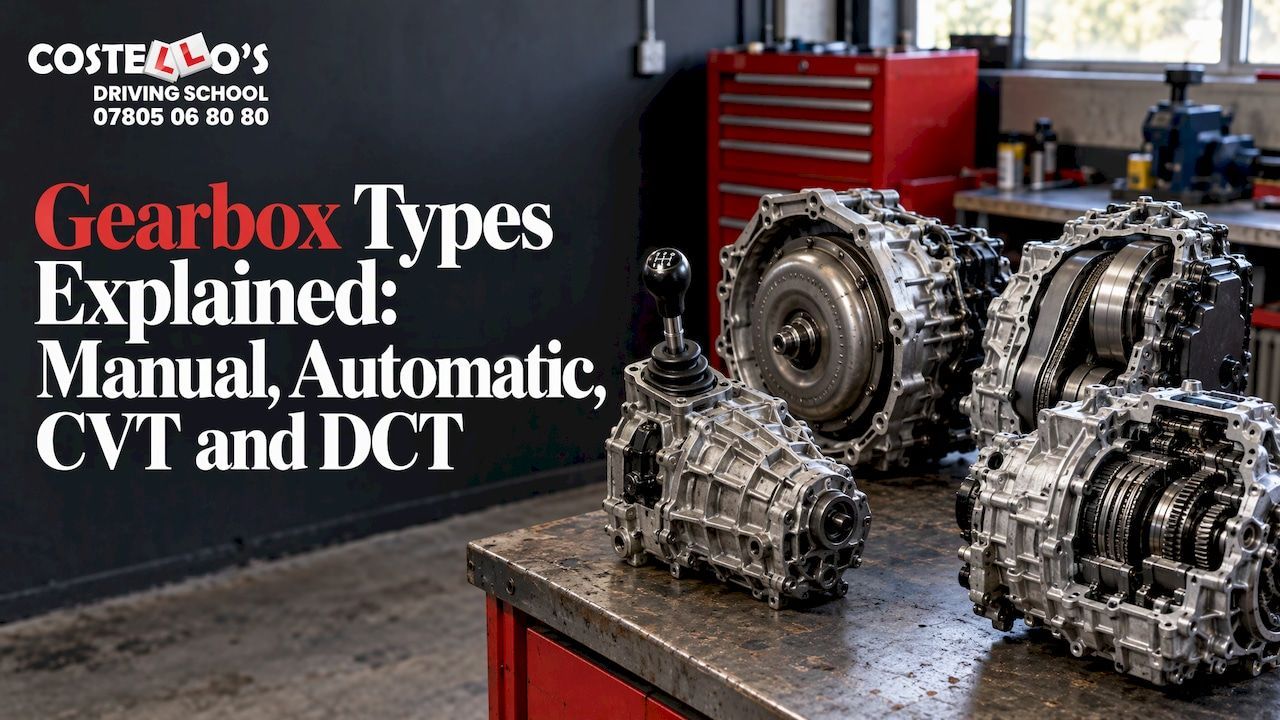
Most cars on UK roads use one of five gearbox types: manual, torque-converter automatic, CVT, dual-clutch (DCT) and automated manual. For a learner, the choice really comes down to two decisions: do you want to work the clutch and gears yourself, or let the car do it? And if you go automatic, how does that particular gearbox behave on the road? We teach both manual and automatic lessons across Essex and Suffolk, so this guide explains each type in plain words and shows how it feels from the driver's seat.
Key Takeaways
- A manual gearbox gives you a clutch pedal and a gear lever. Every automatic type does the gear changes for you, but each one does it differently.
- The four automatic types are torque converter, CVT, dual-clutch and automated manual. Torque converter and dual-clutch are the ones you will meet most often in newer cars.
- On test day the type of automatic matters less than you might think: you select D, steer, and manage the brake and accelerator. Learning on an automatic lets you put your attention on road skills.
- A leg injury does not automatically rule out driving. You must tell DVLA if a broken limb will stop you driving for more than three months.
- Whichever you choose, the right instructor and the right car matter more than the gearbox name on the badge.
Table of Contents
- What a gearbox actually does
- The manual gearbox
- The torque-converter automatic
- The CVT automatic
- The dual-clutch gearbox (DCT)
- The automated manual
- Quick comparison
- Manual or automatic for learning?
- Hill starts in an automatic
- Driving an automatic with a leg injury
- Our view on choosing a gearbox
- Book your lessons with us
- FAQ
- Sources
What a gearbox actually does
A car engine works best within a narrow band of speeds, yet the wheels need to turn slowly when you pull away and quickly on a motorway. The gearbox sits between the two and swaps ratios so the engine can stay in its comfortable range. Low gears give you pulling power for moving off and climbing hills. High gears let the engine relax at cruising speed.
The difference between gearbox types is simply who chooses the ratio and how the power is connected while the ratio changes. In a manual, you do both with your left foot and your left hand. In an automatic, the car does it, using one of four different mechanisms.
The manual gearbox
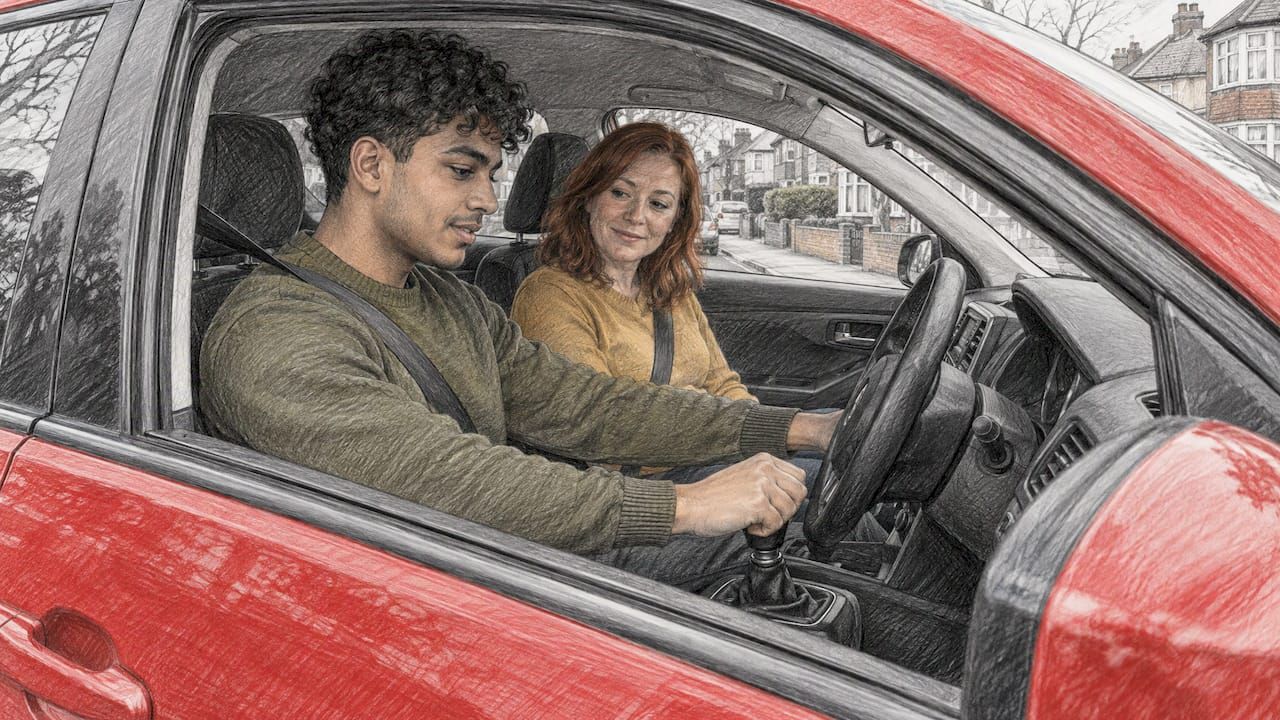
A manual has a clutch pedal, a gear lever and, in most cars, five or six forward gears plus reverse. Pressing the clutch disconnects the engine from the wheels so you can move the lever into the next gear, then you release the pedal smoothly to reconnect them.
The skill is in the clutch. Finding the "bite point", the spot where the engine starts to drive the wheels, is what stops you stalling when you pull away. Hill starts need the clutch, accelerator and handbrake working together. It is a skill that clicks for most learners with practice, and most people who learn on a manual car gain the freedom to drive either type afterwards.
If you own a manual long term, the clutch is a wear part. A manual transmission and clutch repair specialist can explain how clutches wear and what servicing involves, which helps when you buy your first car.
Our manual lessons are £37–£38 per hour, taught in modern dual-controlled cars, so your instructor can step in with a second set of pedals while you build the feel for the clutch.
The torque-converter automatic
This is the classic automatic. The Car Expert explains that it has been around since the 1950s and replaces the clutch with a sealed case of fluid: the engine pushes fluid around an impeller, and that moves energy to the output shaft. Most modern cars with this type offer between six and ten gears.
From the driver's seat it is the simplest car to drive. There are only two pedals, brake and accelerator. You select D for drive, release the brake and the car moves off gently by itself. Changes happen automatically as you speed up and slow down, usually smoothly. It is a long-proven design, found in many new cars, and a common choice for learners.
The CVT automatic
A CVT (continuously variable transmission) has no fixed gears at all. Instead of stepping between set ratios, it slides smoothly through an endless range of them. The Car Expert notes that this is particularly helpful in hybrid cars, where the transmission has to balance a petrol engine and an electric motor.
To drive one, you do exactly what you do in any automatic: select D and go. According to CarGurus UK, the difference is the feel. There is no stepped gearchange, so acceleration is very smooth, and the gearbox holds the engine at its most efficient rev point. That means the revs stay steady while your speed climbs, which can sound unusual if you are used to the rise and fall of a normal gearbox. Most modern CVTs are quiet enough inside the cabin that you will barely notice.
CVT vs torque converter: which feels different?
If you are comparing the two, think about feel rather than controls, because the controls are identical.
- Torque converter: conventional gears with a fluid link instead of a clutch. You can feel the car moving through its gears, even if gently.
- CVT: one continuous swell of acceleration with no gearchange sensation, and a steady engine note.
Neither needs any extra skill from you. Both are "select D and drive" cars, so a learner can move from one to the other in minutes.
The dual-clutch gearbox (DCT)
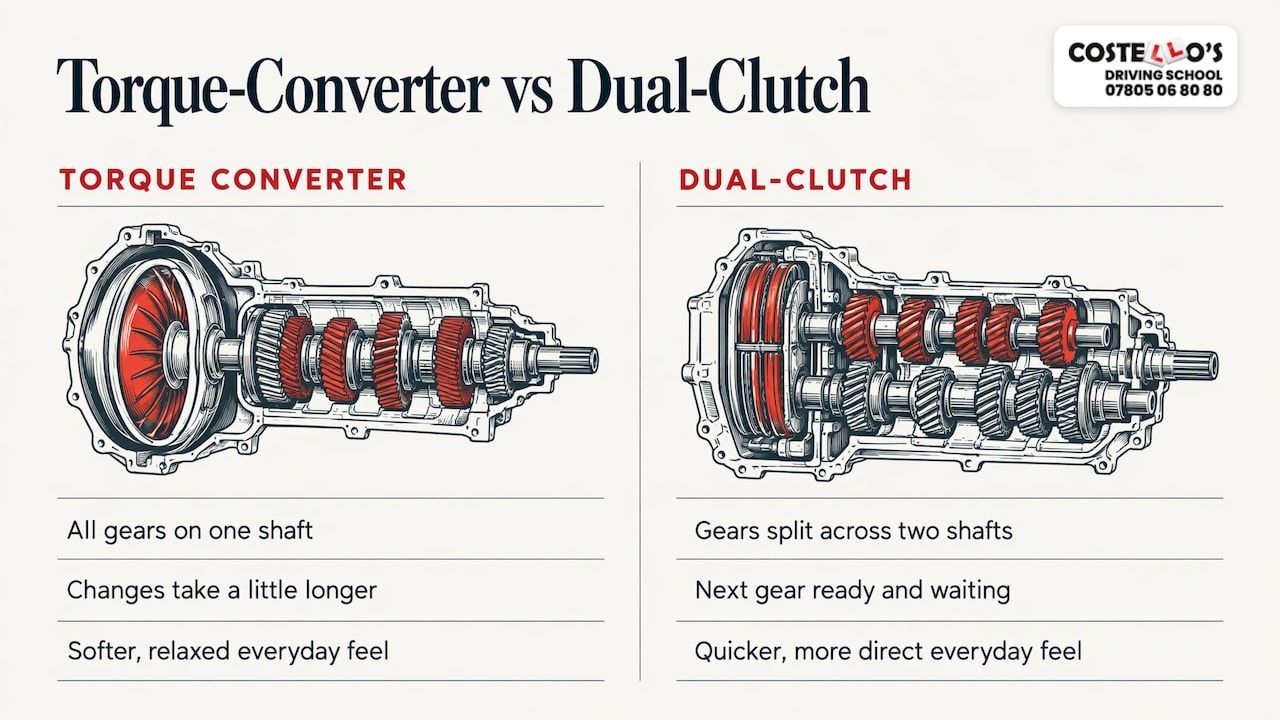
A dual-clutch gearbox has two clutch systems working on two shafts, one for the odd-numbered gears and one for the even-numbered gears. Carwow explains that electronics and hydraulics control the clutches, so the car can shift faster. The Car Expert adds that because it can pre-select the next gear before the change happens, shifts are considerably faster than in other automatic types, and in performance cars they are almost imperceptible. The same article says DCTs are fast becoming the most common automatic in petrol and diesel cars.
You may see it under different names: DSG at Volkswagen, SEAT and Skoda, S tronic at Audi and PDK at Porsche. They are the same idea under different badges.
You still drive it as an automatic, with no clutch pedal. The only difference from the driver's seat is that the changes are brisk and precise.
Dual clutch vs torque converter
In a conventional torque-converter automatic, all the gears sit on a single shaft, and changes usually take a little longer. A dual-clutch has the gears split across two shafts, so the next gear is ready and waiting. In everyday traffic, the result is that a dual-clutch feels quicker and more direct, while a torque converter feels softer and more relaxed. Which you prefer is largely personal taste.
The automated manual
An automated manual (sometimes called a robotised manual) is a manual gearbox with computer-controlled actuators doing the clutch and gear changes. As the name suggests, there is no clutch pedal and no gear lever to move, though you will still see a selector for drive and reverse. It is found mainly in small, low-cost cars. It is the least common of the four automatic types in newer models, and gear changes can feel more deliberate than in the others.
Quick comparison
| Type | Clutch pedal? | How it changes gear | How it feels |
|---|---|---|---|
| Manual | Yes | You, with clutch and lever | Full control, needs clutch skill |
| Torque converter | No | Fluid coupling and set gears | Smooth and relaxed |
| CVT | No | Endless ratios, no steps | Very smooth, steady engine note |
| Dual clutch (DCT) | No | Two clutches, pre-selected gears | Fast and precise |
| Automated manual | No | Computer works a manual gearbox | Simple, shifts can feel deliberate |
Manual or automatic for learning?
The honest answer is that it depends on you.
Teenagers preparing for their test often find an automatic lets them concentrate on the road, mirrors, junctions and hazards rather than the clutch. Many choose manual because it gives them a licence that covers both types of car.
Busy adults who want to pass in the fewest hours often find automatics attractive, because without a clutch to master there is one skill fewer to learn.
Nervous drivers tend to appreciate the calmer cockpit of an automatic: no stalling, no clutch control while you are still learning to judge space and traffic.
Some costs are worth knowing before you decide. Our automatic lessons are £42 per hour against £37–£38 for manual. If you plan to buy a car afterwards, Auto Express says to expect to pay around £1,000 more for an automatic than a manual of the same model when buying new, depending on the brand. Weigh that against how much more confidently you could be driving from week one.
A licence earned in an automatic covers automatic cars, and a licence earned in a manual covers both. If you expect to drive a variety of vehicles, such as a family member's car or a work van, tell us at your first lesson and we will help you decide.
Hill starts in an automatic
Hill starts are far less stressful in an automatic, because you do not have to balance a clutch against the accelerator. The routine is simple:
- Stop with your foot firmly on the footbrake, with D selected (or the handbrake on, if the instructor shows you that method).
- Check your mirrors and surroundings.
- Release the brake or handbrake as you gently press the accelerator.
- Pull away smoothly as the car takes up drive.
Many modern automatics have a hill-hold feature that keeps the brakes applied for a moment as you move your foot across, though it varies by car, so your instructor will show you what yours does. A good habit is to hold the car on the brake rather than using the accelerator to balance it against the slope. Over time that is kinder to the gearbox.
Driving an automatic with a leg injury
An automatic needs no clutch pedal, so it can be a practical option if your left leg is affected. Whether you can drive at all depends on your condition, and that is a medical and licensing question, not a gearbox one.
The rules are set out by GOV.UK: you must tell DVLA if a broken limb means you will be unable to drive for more than three months, and failing to report a condition that affects your driving can bring a fine of up to £1,000. DVLA's November 2025 fitness-to-drive guide confirms that drivers have a legal duty to notify DVLA of any injury or illness likely to affect safe driving, with exceptions for short-term conditions unlikely to last beyond three months, and that the final licensing decision rests with DVLA. It also says that ignoring medical advice to stop driving may affect your motor insurance.
If you are recovering, ask your doctor whether you are fit to drive and check with DVLA where needed. Once you have the all-clear, tell us what you need. We offer Driveability lessons and can match you with a patient instructor and a dual-controlled car.
Our view on choosing a gearbox
We have taught learners across Essex and Suffolk for over 25 years, and the question we hear most is "which should I learn in?" Our answer starts with you, not the car.
If you are nervous behind the wheel, an automatic takes a big job off your plate. You can spend your first hours learning to read the road, not fighting a clutch. Our instructors specialise in nervous learners, and a relaxed car makes a relaxed lesson.
If you are keen to keep every option open, a manual lesson gives you the clutch skill and the wider licence that comes with it. Our modern dual-controlled cars let your instructor help at any moment while you learn.
Whichever you choose, we plan lessons around your own pace, with evenings and weekends available for busy people. And if your plan is to pass quickly, we also run intensive courses and a Guaranteed Pass course.
Dean
Book your lessons with us
We teach manual lessons at £37–£38 per hour and automatic lessons at £42 per hour, with friendly DVSA-approved instructors, flexible times including weekends and modern dual-controlled cars. If you want a fixed route to your test, our Guaranteed Pass course is £2,200 as a one-off. You can see everything on our driving lessons page, or start from our homepage.
We also run refresher and confidence-building lessons, and one-to-one DVSA-approved driving instructor training for anyone who wants to turn their driving into a career.
FAQ
What are the main types of gearbox in a car?
There are five: manual, torque-converter automatic, CVT, dual-clutch and automated manual. The last four are all types of automatic, because you do not use a clutch pedal. They differ in how they change ratio, which shows up in how smooth or quick the car feels.
Is a CVT better than a torque converter?
Neither is better for every driver. A CVT feels extremely smooth with no gearchange sensation, while a torque converter feels more conventional and is a long-proven design. To drive, you do the same thing in both: select D and use the brake and accelerator.
Is a dual-clutch the same as an automatic?
Yes, in that you drive it without a clutch pedal. Inside, it uses two clutches to pre-select the next gear, so changes are faster than in a standard torque-converter automatic. It may be badged DSG, S tronic or PDK depending on the maker.
Can I learn to drive an automatic with a leg injury?
Often an automatic can help, but it depends on your condition. Tell DVLA if a broken limb will stop you driving for more than three months, and ask your doctor about fitness to drive. When you are cleared, we can plan lessons around your needs.
Should nervous drivers choose an automatic?
Many do. With no clutch to control, you can focus on road awareness and junctions. Our instructors are experienced with nervous learners, and you can switch to manual later if you wish.
Sources