Change driving instructor: your practical UK guide for 2026
Change driving instructor: your practical UK guide for 2026
Yes, change your driving instructor if they are damaging your confidence, teaching unsafely, or blocking your progress towards a test. If those problems are not present, diagnose the real issue first: a bad instructor and a lack of practice look similar from the driver's seat but need very different fixes.
Before you act, know this: from 12 May 2026, only you can book, change or cancel your driving test, not your instructor or school. That single change reshapes how switching should happen if you already have a test date booked.
Two things to do this week:
- Start vetting a replacement instructor before you say a word to your current one.
- Check your test booking status and your current instructor's cancellation terms so you know exactly what you stand to lose or keep.
Key Points:
- Only you can change or cancel your driving test from May 2026, making early coordination with a new instructor crucial if your test is upcoming.
- If you experience three or more red flags, such as unsafe behavior or poor communication, switching instructors becomes strongly advisable.
- Prioritize booking a paid assessment lesson with a new instructor before committing to a full block to evaluate their teaching style and progress tracking.
- Keep all communication, receipts, and T&Cs in writing before requesting refunds or making changes, and verify who will provide the test car near your exam date.
- The most effective time to switch is at the first sign of persistent issues, rather than waiting until frustration accumulates, as early change reduces wasted lessons and costs.
Table of Contents
- Red flags: the concrete signs it's time to leave
- Timing and test administration: what GOV.UK's 2026 changes mean for switching
- How to find and vet a replacement instructor
- How to tell your instructor, protect your money, and manage bookings
- If you're in Essex, Suffolk or East London: what a Costello's assessment lesson looks like
- Key Takeaways
- Why most switching advice gets the timing backwards
- Sources
- FAQ
Red flags: the concrete signs it's time to leave
Some instructor habits are annoying. Others are genuinely dangerous, and the difference matters when you're deciding whether to switch driving instructor or just have an awkward conversation.
Watch for these seven patterns:
- Shouting, sarcasm, or belittling comments when you make a mistake, rather than calm correction.
- Distracted while you're driving , Incredibly dangerous for you and other road users.
- Persistent lateness or cancelled lessons with no rescheduling effort.
- No structured lesson plan — every session repeats the same manoeuvre with no sense of building towards test standard.
- Vague feedback like "just drive more carefully" instead of specific, correctable notes.
- Reluctance to book your test once you're clearly ready, often with excuses about availability.
- Hidden fees for cancellations, mock tests, or "extra" administration not mentioned when you signed up.
One flag on its own is usually worth a direct conversation rather than an exit. Nine common red flags are enough to build a useful rule of thumb: three or more together, or a single serious safety issue, means you switch. Don't wait for it to get worse.
Timing and test administration: what GOV.UK's 2026 changes mean for switching
The booking rules that took effect in May 2026 change how switching works in practice, not just who you complain to.
Under the updated GOV.UK rules, you can make a limited number of changes to an existing test booking, and if you move the date, you can only move your test to one of the nearest few test centres. Cancel with at least 10 full working days' notice and you get a full refund; leave it later and you risk losing your fee entirely.
That changes the calculus depending on where you are in your learning:
- No test booked yet: switch whenever you're ready. There's no administrative risk at all.
- Test booked, weeks away: switch freely, but confirm early whether your new instructor's car is available for that date, since switching close to a test can force you into using your own car if the old instructor withdraws theirs.
- Test booked, days away: unless the issue is genuinely unsafe, most learners are better off keeping the lesson going with the current instructor until after the test, then switching for any retest or further practice.
If safety is the concern, none of this timing advice overrides that. Leave immediately and sort the logistics afterwards.
How to find and vet a replacement instructor
Finding someone new is straightforward. Vetting them properly is where most learners cut corners, and it's the step that actually determines whether switching helps.

Start with the DVSA's official find-an-instructor service, which lists every DVSA-approved instructor in your postcode. Cross-check any name against reviews and, where possible, ask for a reference from a recent pupil.
When you make first contact, ask:
- How do you track a pupil's progress across lessons?
- What happens if I need to cancel, and what's your refund policy?
- Do you provide the car for the practical test, and is it included in the lesson price?
- Do you run mock tests, and how close to test-ready would you say a typical pupil needs to be before booking one?
- What does a typical lesson structure look like week to week?
How an instructor answers the progress-tracking question tells you more than anything else on this list. A professional instructor will describe a system, not a shrug.
Once you've shortlisted someone, book a single paid assessment lesson rather than committing to a block. A good instructor uses that hour to work out exactly where your skills sit and what's missing, rather than assuming you're starting from nothing. Costello's Driving School structures its own driving lessons around this same principle: assess first, then plan. If cost is a factor in choosing, it's worth comparing against typical driving lesson prices across the UK before you commit to a new block booking.
How to tell your instructor, protect your money, and manage bookings
Ending things cleanly protects both your refund and your peace of mind. How you handle it depends on why you're leaving.
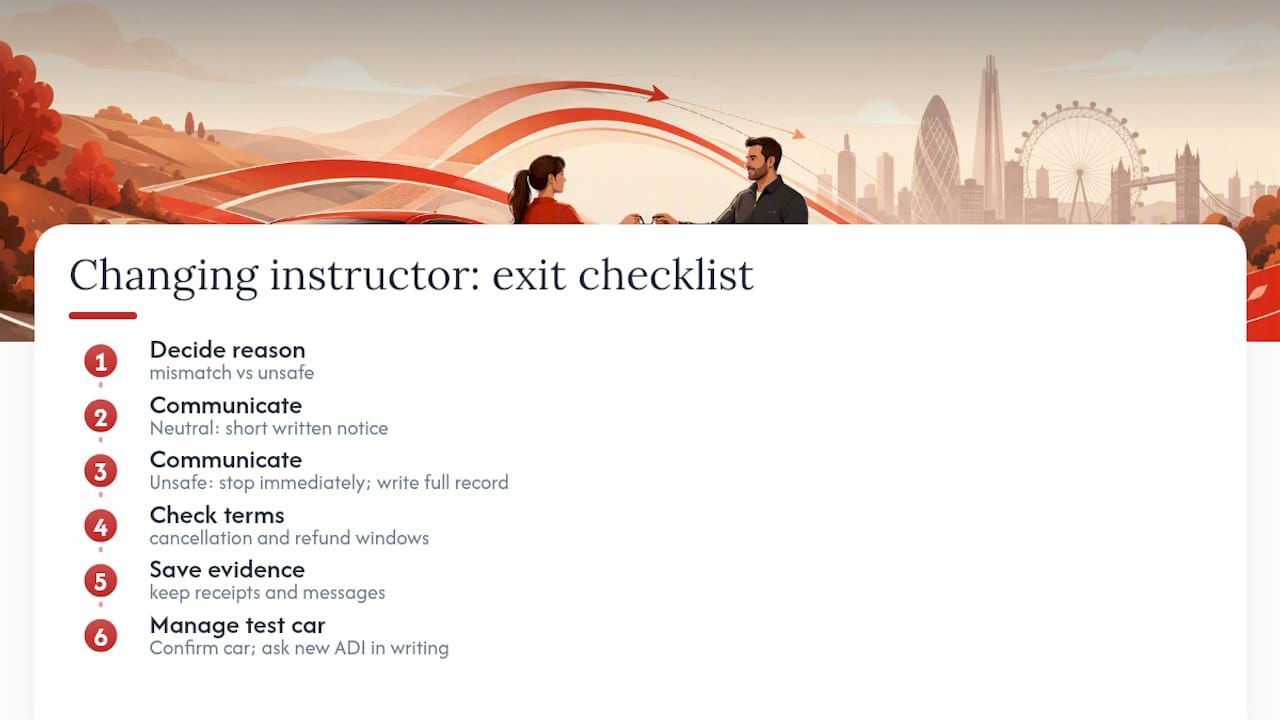
If the issue is a mismatch in teaching style, pace, or personality, and nothing unsafe has happened, it's usually fine to finish out any pre-paid lessons while you line up a replacement. If it's unsafe or exploitative, stop immediately and don't attend another lesson to "be polite" about it.
For a neutral exit, keep it short and in writing:
For a serious or unsafe situation, put everything in writing and keep a copy: what happened, when, and what you're requesting. If you booked through a school rather than an independent ADI, contact the school's administration directly rather than confronting the instructor yourself.
Before sending anything, check the instructor or school's terms and conditions for their cancellation and refund window, and save every receipt and message as evidence if a dispute arises.
If you have a test booked, confirm in writing whether your outgoing instructor will still provide the car for that date, or whether you'll need to arrange your own vehicle or transfer the booking to your new instructor's car.
Pro Tip: Ask your new instructor, in writing, whether they can provide a car for your existing test date before you finalise anything with your old one. Losing car cover a week before a test is one of the most common and avoidable mistakes learners make when switching.
If you're in Essex or Suffolk: what a Costello's assessment lesson looks like
Costello's Driving School has run lessons across Essex and Suffolk for over 25 years, with DVSA-approved instructors and modern dual-controlled cars for both manual and automatic training.
A typical assessment lesson runs 45 to 60 minutes and covers:
- Core manoeuvres, observation habits, and hazard awareness at your current level.
- Confidence under pressure at junctions, roundabouts, and higher-speed roads.
- A short verbal or written summary of what's solid and what needs work, so you leave with a plan rather than just an impression.
From there, you can move into standard lessons, an intensive course, or a Guaranteed Pass package depending on how close you are to test-ready. Refund terms and scheduling flexibility, including weekend lessons, are set out clearly before you book, so there are no surprises if your circumstances change again.
Key Takeaways
Switching driving instructor works best when it targets a specific, identifiable problem rather than a vague feeling that things aren't going well.
| Point | Details |
|---|---|
| Use the three-flag rule | One red flag warrants a conversation; three or more, or any safety issue, warrants switching. |
| Only you manage test bookings | From May 2026, GOV.UK rules mean the learner alone can change or cancel a driving test. |
| Book an assessment lesson first | Pay for one lesson with a new instructor before committing to a full block. |
| Protect your refund in writing | Keep messages, receipts, and T&Cs on file before requesting any refund. |
| Confirm car cover near a test date | Check who provides the test car before finalising a switch close to your booking. |
Why most switching advice gets the timing backwards
Most guidance on this treats switching as a last resort, something you only do after months of frustration. That's backwards. The learners who switch earliest, as soon as a pattern of poor feedback or unstructured lessons becomes clear, tend to lose the least time and money. Waiting doesn't make the decision safer; it just adds more wasted lessons to the pile.
The bigger error, though, is assuming a new instructor automatically fixes things. A change of instructor cannot fix inconsistent practice between lessons or test-day nerves, and pretending it can just delays the real work. What the 2026 booking rules actually do is remove the instructor from the admin loop entirely, which is a genuine improvement: you're no longer at the mercy of someone else's diary for your own test date.
If you take one thing from this, prioritise the assessment lesson over the emotional exit conversation. Sort out where you actually stand first. The goodbye message can wait an hour.
— The Costello's Team
Sources
FAQ
Is it okay to switch driving instructors?
Yes. Switching is a normal, sensible decision when your current instructor is holding back your progress, and it carries no penalty with the DVSA or GOV.UK.
How do I update my ADI details?
Instructors update their ADI registration details through GOV.UK's ADI online services, and trainees moving to a new school must apply for a new trainee licence and return their old one to DVSA once the new licence arrives.
How do you tell your driving instructor you want to change?
Keep it short, polite, and in writing: thank them for the lessons so far, confirm you're moving on, and ask about any remaining balance or refund. For serious or unsafe situations, put the specific concern in writing and keep a copy for your records.
Is there demand for driving instructors in the UK?
Demand for qualified instructors remains strong across most of the UK, which is part of why vetting matters. There are enough instructors that you can afford to be selective rather than settling for the first available slot.
Recommended