Manual vs automatic: which one should you actually learn?
Manual vs automatic: which one should you actually learn?
Choose automatic if you want to pass sooner and expect to drive automatics or EVs day to day; choose manual if you need licence flexibility and access to cheaper used cars later. Automatic licences legally restrict you to automatic vehicles, and with the 2030 shift towards electric cars gathering pace, that restriction matters less than it used to. The sections below cover pass rates, costs, and licence rules in detail.
KEY POINTS:
- Pass rates for automatic tests increased to 44.6% in 2025/26, while manual test pass rates remain around 48.4%, influenced by who chooses each type.
- Even though learning is specific to every individual learners generally need fewer lessons in automatics, around 20 to 30 hours, compared to 30 to 45 hours for manuals, partly due to the absence of clutch control.
- Choosing automatic suits city driving, electric vehicles, or physical conditions, but results in an automatic-only licence, which may restrict vehicle options after 2030.
- Learning manual offers full license flexibility, cheaper used cars, and easier international car rental, but involves mastering clutch control and a steeper learning curve.
- Switching from automatic to manual later requires retaking lessons and passing a new test, as automatic licences are restricted to automatics only.
Table of Contents
- Manual vs automatic: what an automatic actually involves
- Manual vs automatic: what learning a manual really means
- What do UK pass rates actually tell you?
- How many lessons will you need, and what does it cost?
- Licence rules and the 2030 shift towards electric cars
- Manual or automatic: a decision checklist for your situation
- How Costello's Driving School approaches manual and automatic tuition
- The myths that muddy the manual vs automatic debate
- Market perspective: why EVs and policy are quietly rewriting the rules
- Book your manual or automatic lessons with Costello's Driving School
- Sources
- FAQ
Manual vs automatic: what an automatic actually involves
An automatic car does the gear changing for you. There's no clutch pedal, no biting point to find, and no risk of stalling at a junction because you're too slow off the mark. You steer, accelerate, and brake; the car's gearbox handles the rest. For a lot of learners, this removes the single biggest source of early frustration in driving lessons.

That simplicity has knock-on effects for how quickly you're ready for test day. Instructors typically get automatic learners test-ready faster because there's no clutch control to drill, and less time spent in car parks practising hill starts.
Where automatic makes sense:
- You mainly drive in stop-start city traffic, where constant clutch work in a manual gets tiring fast
- You've already decided your next car will be an EV, since virtually all electric cars are automatic
- You have a physical condition that makes clutch operation difficult
- You want the fastest realistic route to a full licence
The trade-offs are real, though. Automatic lessons sometimes cost more per hour because fewer instructors teach them, and instructor availability can be patchy outside larger towns. Passing your test in an automatic also locks you into an automatic-only licence. If you ever want a cheap, older used car, the manual market is still far bigger and generally cheaper.
Manual vs automatic: what learning a manual really means
Learning manual means mastering clutch control, which is finding the exact point where the clutch engages the engine without stalling or lurching, then coordinating that with the accelerator and gear lever every time you change speed. It's a skill, not an intuition, and it takes most learners several lessons to click.
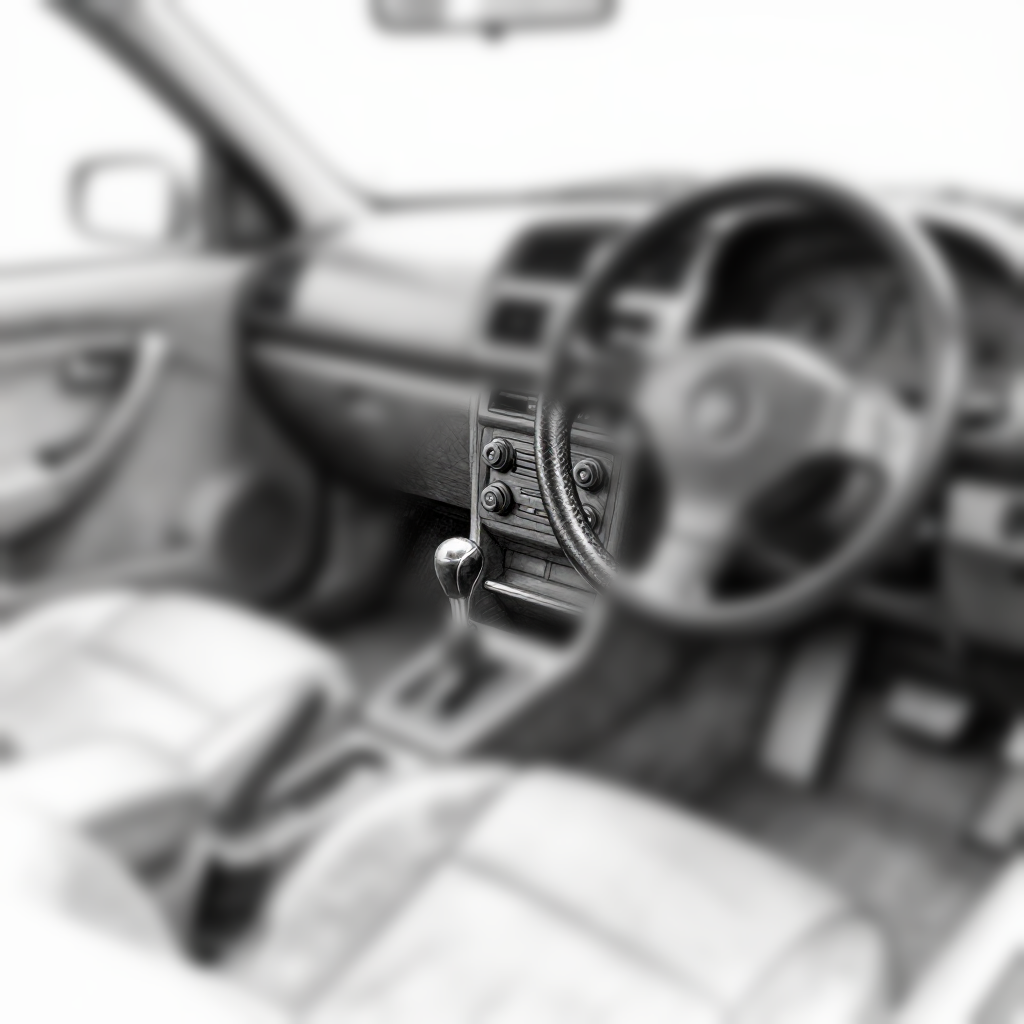
The reward for that early struggle is flexibility. A full manual licence lets you drive both manual and automatic cars, no restrictions, no upgrade test needed later.
Manual's genuine advantages:
- Your licence covers every car on the road, manual or automatic
- The used-car market is stacked with cheaper manual options, particularly for older, budget vehicles
- Some jobs, particularly driving-related trades and certain delivery or logistics roles, still expect a manual licence
- Hiring a car abroad, especially in Europe, is far easier and cheaper in manual, since automatics often cost more to rent
But there's no getting around the learning curve. Stalling, jerky hill starts, and that particular embarrassment of rolling backwards at a junction are part of the process. New-car manual options are also shrinking year on year as manufacturers lean into EVs, so the "cheaper manual" advantage applies mostly to the used market, not new showroom stock.
What do UK pass rates actually tell you?
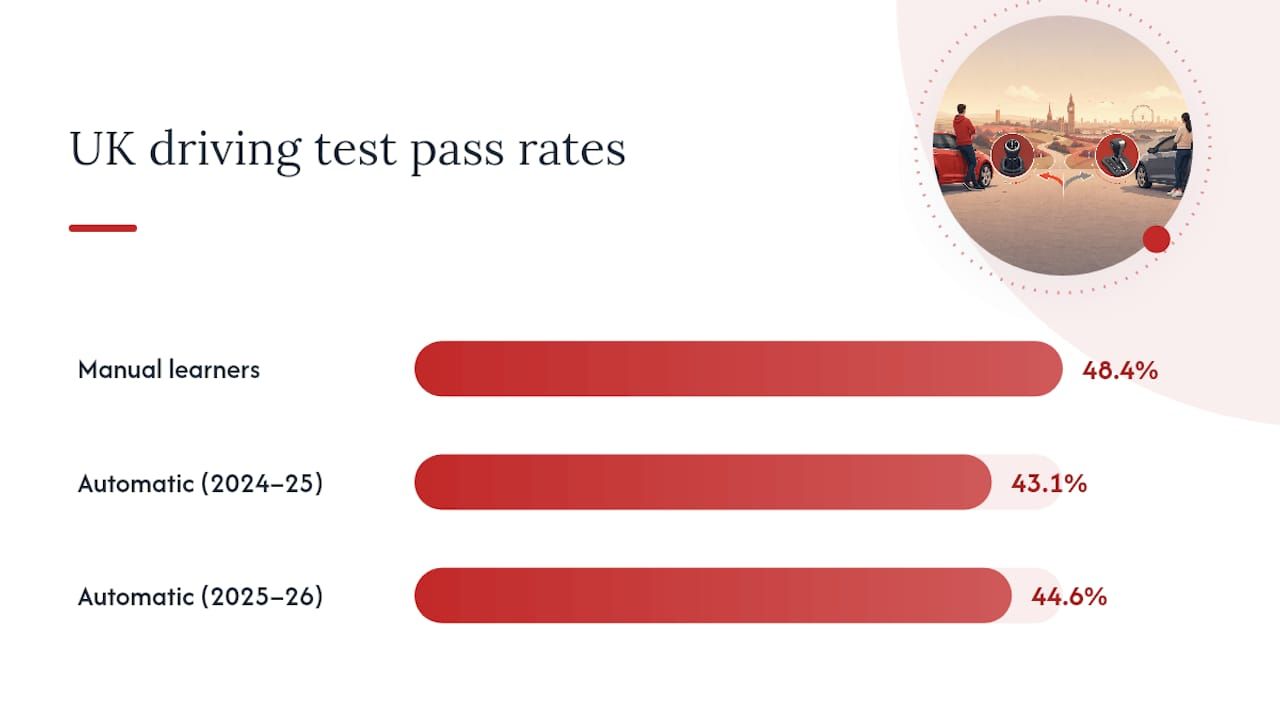
The pass-rate gap, explained: Manual candidates: 48.4% pass rate. Automatic candidates: 43.1% pass rate (DVSA-aggregated data, 2024–25). The gap likely reflects who takes automatic tests, not which gearbox is harder to master.
The AA's analysis shows the automatic pass rate has since risen to 44.6% in 2025/26, alongside a sharp rise in the number of people testing in automatic overall.
Cohort effects explain a good chunk of the gap. Automatic learners are, on average, newer to structured driving tuition and sometimes rushing towards a licence for practical reasons, work deadlines, a sudden need for independence, rather than steady long-term preparation. Don't read the raw percentages as "manual is objectively easier." Read them as a snapshot of who's testing in each category, and focus instead on your own readiness with a qualified instructor.
How many lessons will you need, and what does it cost?
Lessons are very much an individual factor uniqe to each and every learner driver, but the patterns are consistent enough to budget around.
- Automatic learners typically need fewer total hours, often somewhere in the region of 20 to 30 lessons, because there's no clutch control to practise and refine.
- Manual learners usually need more, commonly 30 to 45 hours depending on prior experience, since clutch coordination and gear selection take repetition to embed.
- Test fees are the same regardless of gearbox: £62 for a weekday practical test booked through DVSA, on top of your lesson costs.
- Switching later from automatic to manual means starting again from a licence perspective. You'll need full manual tuition and a fresh practical test, effectively paying for lessons twice if you change your mind after passing in automatic.
Insurance and resale value also feed into the real cost. Automatic insurance quotes are sometimes higher, partly because automatic cars themselves often carry a higher purchase price, and manual cars generally hold value better on the used market simply because more buyers can drive them.
Licence rules and the 2030 shift towards electric cars
The legal position is straightforward and worth understanding before you book a single lesson. Pass your test in a manual car, and your licence, Category B, covers both manual and automatic vehicles. Pass in an automatic, and your licence carries a restriction limiting you to automatic-only driving.
That restriction used to feel like a bigger deal than it does now, because of where the car market is heading.
- The government has confirmed new pure petrol and diesel car sales will end from 2030, with hybrids permitted under transitional rules to 2035
- Used petrol and diesel cars, manual included, remain completely legal to buy, sell, and drive after that date
- Almost every electric car sold is automatic, so manufacturers are steadily dropping manual variants from new model ranges
- Fleet operators and company car schemes are already skewing automatic as EV uptake grows
- Hiring a car abroad still tends to favour manual for cost, so an automatic-only licence can catch you out on holiday
If your future driving is mostly new cars and EVs, the automatic restriction may never bother you. If you might need a manual for work, travel, or a specific older vehicle, that restriction is worth avoiding from day one.
Manual or automatic: a decision checklist for your situation
Work through these criteria in order. Each one should narrow the choice further.
- What will your next car realistically be? If it's an EV or a newer automatic, learning automatic saves time and money.
- Where do you drive most? Heavy urban traffic favours automatic; mixed rural and motorway driving works fine in either.
- Does your job, or a future one, need a manual licence? Some driving-related roles and international postings still specify it.
- What's your budget for lessons? If cash is tight, manual's higher hour count is offset by cheaper hourly rates in most areas.
- Can you actually find a local automatic instructor? Check availability before committing, since automatic tuition is less widely available in some areas.
Choose manual if you want maximum licence flexibility, cheaper used cars, or a job that requires it. Choose automatic if you want the fastest practical route to a licence and you're confident your future cars will be automatic anyway.
If you're still unsure, book a single trial driving lesson in each transmission type before committing to a course.
How Costello's Driving School approaches manual and automatic tuition
Dean has spent years watching learners wrestle with clutch control, and the pattern is consistent: it's rarely intelligence or coordination that holds people back, it's nerves around stalling in traffic. Costello's Driving School has taught both manual and automatic learners across Essex, Suffolk, and East London for over 25 years, using DVSA-approved instructors and modern dual-controlled vehicles.
- Clutch control gets broken into small, low-pressure drills in quiet car parks before any road driving begins
- Instructors flag automatic as an option when a learner's progress stalls repeatedly on clutch work, not as a default first choice
- Intensive course learners typically compress the usual lesson count into a shorter calendar window without skipping fundamentals
Pro Tip: Practise clutch control with the handbrake on and the engine running, in a driveway or empty car park, before your first lesson. Feeling the biting point without the pressure of moving traffic cuts weeks off the learning curve for most nervous beginners.
One recent learner switched from manual to automatic after eight lessons of persistent stalling anxiety, and passed within three weeks of the change, proof that the "right" choice sometimes only becomes obvious once you're actually behind the wheel.

The myths that muddy the manual vs automatic debate
A few claims circulate so often that people repeat them as fact, and most don't hold up.
"Automatic is always easier to pass." The DVSA figures say otherwise, manual pass rates sit higher, though that's mostly down to who tests in each category rather than raw difficulty.
"Automatics are only for older or nervous drivers." That stereotype is fading fast. Younger buyers choosing EVs are pushing automatic test numbers up sharply, not out of nervousness but because that's simply what the car does.
"You can switch back to manual whenever you like." Not without consequence. An automatic-only licence means a full new practical test and fresh manual tuition if you change your mind later, not a quick top-up lesson.
"Manual cars are dying out completely." Not true for the used market. New manual choice is shrinking as EVs dominate showrooms, but millions of manual cars remain on UK roads and will stay legal to buy and drive well beyond 2030.
"Insurance is always cheaper on manual." It depends on the car more than the gearbox. A cheap automatic runabout can insure lower than a powerful manual hot hatch.
Market perspective: why EVs and policy are quietly rewriting the rules
Manufacturers aren't dropping manual gearboxes because of any driving-test debate. They're dropping them because EVs don't need them, and EVs are where new-car investment is going. Learners choosing now still have a genuine choice; learners in five years may find new manual cars genuinely hard to buy. If you're weighing this up today, factor in what you'll likely drive in 2030, not just what's cheapest to learn on this year.
— The Costello's Team
Book your manual or automatic lessons with Costello's Driving School
Costello's Driving School gives you a genuine choice most local instructors can't. Over 25 years teaching across Essex and Suffolk, Costello's runs full manual and automatic lesson programmes side by side, so you're never stuck with whichever instructor happens to have a free slot.
You can start with a single lesson to see which gearbox suits you, move onto block booking discounts to bring costs down, or go straight for an intensive course if your test date is looming. Nervous learners and complete beginners are a specific focus here, with patient, DVSA-approved instructors and modern dual-controlled cars in both transmission types. If passing by a set date matters more than anything else, the Guaranteed Pass course is built exactly for that. Covering Colchester, Ipswich, Chelmsford, Braintree, and the wider East London area, book a lesson today and find out which gearbox actually fits how you drive.
Sources
FAQ
Should I get an automatic or manual car in the UK?
Get automatic if you mainly drive in traffic or plan to buy an EV; get manual if you want the cheapest used-car options and full flexibility to drive either type later.
Is the UK mostly manual or automatic?
The UK remains predominantly manual, but automatic uptake is rising fast, with automatic tests climbing from around 4% of all car tests in 2007/08 to 29.4% in 2025/26.
Should I learn manual or automatic in 2026?
Learn manual if you want a licence with no restrictions and cheaper used cars; learn automatic if speed to a full licence matters most and you're confident your future cars will be automatic, including most EVs.
Why do Brits prefer manual cars?
Manual has historically been cheaper to buy, insure, and learn in, and it gives unrestricted licence flexibility, though that preference is shifting as EV adoption and the 2030 new-car rules push more buyers towards automatic.
Can I switch from an automatic licence to a manual one later?
Yes, but it means taking full manual lessons and passing another complete practical test, not a quick add-on course, since an automatic pass restricts your licence to automatic vehicles only.
Recommended