Driving lesson prices UK: your 2026 budget guide
Driving lesson prices UK: your 2026 budget guide
Expect to pay somewhere between £28 and £45 an hour for driving lessons in the UK, with most learners settling around £35. Run that against the DVSA's guidance of roughly 45 hours of professional tuition, and a first-time pass typically costs a few thousand pounds once you add licence, theory and test fees. The RAC pegs a fair hourly price at £35 to £50 depending on where you live, and Costello's Driving School sees the same pattern across Essex, Suffolk and East London: prices vary by postcode more than most learners expect.
- National hourly range: £28 to £45+ per hour
- Typical total for a first-time pass: £1,500 (lessons only) to £2,500 (with fees and extras)
- Outside London: budget from £1,700 as a sensible starting point
- London and the South East: budget closer to £2,200 to £2,500
Key Takeaways
Realistic UK budgeting for driving lessons means combining the DVSA's 45 hour guidance with your own region's hourly rate, not relying on a single national average.
| Point | Details |
|---|---|
| Hourly rate range | Expect £28 to £45+ per hour depending on region, with London at the top end. |
| Total cost estimate | Budget £1,700 to £2,500 for a first-time pass including fees and extras. |
| Fixed DVSA fees | Provisional licence £34, theory test £23, practical test £62 to £75. |
| Biggest saving lever | Block bookings and consistent weekly scheduling cut costs more than haggling on rate. |
| Local option | Costello's Driving School offers manual, automatic, intensive and Guaranteed Pass options across Essex, Suffolk and East London. |
Table of Contents
- How much are driving lesson prices UK-wide, per hour?
- How many lessons will you actually need?
- What do the provisional licence and test fees actually cost?
- Why do driving lesson prices differ so much by region?
- Are block bookings and intensive courses worth it?
- How can you cut the total cost without cutting corners?
- What actually drives the price you're quoted?
- Why the "average" figure misleads more learners than it helps
- Ready to book lessons in Essex, Suffolk or East London?
- Sources
- FAQ
How much are driving lesson prices UK-wide, per hour?
Manual lessons average £30 to £38 an hour across most of the UK, according to 2026 industry summaries. Automatic lessons often run a little higher, sometimes by £2 to £5 an hour, because automatic-only instructors and cars are less common outside major towns. That said, some learners need fewer hours in an automatic, which can level out the total cost even if the hourly rate looks steeper on paper.
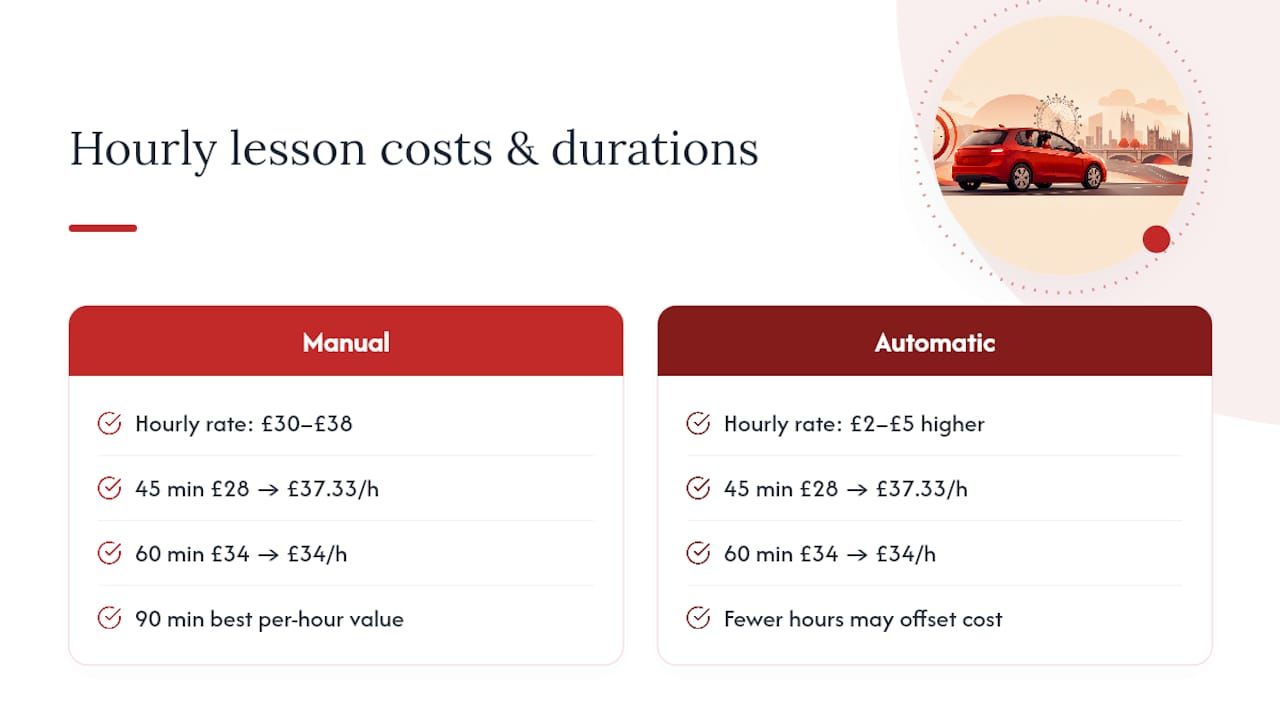
Lesson length matters just as much as the headline rate. A 45 minute slot advertised at £28 works out more expensive per hour than a 60 minute lesson at £34, so always convert quoted prices to a true hourly figure before comparing instructors. Ninety minute lessons are common for intensive learners and tend to offer the best per-hour value, since instructors lose less time to driving between pickups.
A genuinely good price is one that matches your region's midpoint and clearly states what's included. GOV.UK confirms instructors set their own prices with no legal minimum, so a suspiciously cheap rate often means a shorter lesson, an older car, or no fuel allowance built in.
Pro Tip: Ask whether the quoted rate includes use of the instructor's car for your practical test. Some schools charge £30 to £60 extra for test-day car hire if it isn't already bundled in.
How many lessons will you actually need?
The DVSA's own estimate is 45 hours of professional tuition plus 22 hours of private practice with a family member or friend, though this is an average, not a target — some learners pass comfortably on 25 hours, others need 60 or more. GOV.UK is explicit that there's no minimum number of lessons required. Treat 45 hours as a planning figure rather than a fixed rule.
Here's how that translates into money at three realistic hourly rates:
On top of tuition, budget for:
- Provisional licence: just over thirty pounds online
- Theory test: around twenty-three pounds
- Practical test: in the low sixties on weekdays, mid seventies for evenings or weekends
- Learner driver insurance for private practice, if you're not covered on a family policy
- Fuel or a contribution towards it, if your instructor doesn't include this
- Car hire for the test day, if your instructor doesn't provide their vehicle automatically
Add those fixed costs to a £1,575 tuition subtotal and you land close to the £1,700 lower end of the total-cost range quoted by industry guides.
What do the provisional licence and test fees actually cost?
The fees here are fixed and set by GOV.UK, so there's no negotiating them: a first provisional licence costs just over £30 online or slightly more if by post, the theory test costs in the low twenties, and the practical test costs in the low sixties on weekdays or mid seventies in the evening and at weekends. You can book your theory test directly through GOV.UK once you've passed the hazard perception revision stage.
The bigger financial risk isn't the fee itself. It's what happens if you fail and need to rebook. Each retake means paying the test fee again, plus however many extra lessons your instructor recommends beforehand, often another £150 to £300 depending on how much work is needed. Test centre waiting lists in busier areas can stretch to several weeks, which pushes learners into extra "keep-warm" lessons just to stay test-ready.
Sourced figure: The DVSA's guidance of 45 hours of professional tuition plus 22 hours of private practice remains the most widely cited benchmark for budgeting total lesson costs in the UK.
Why do driving lesson prices differ so much by region?
Instructor overheads, local demand and fuel costs all push regional prices in different directions, and the gap between the cheapest and most expensive parts of the UK can run to several hundred pounds across a full course.
- London and the South East: £38 to £48+ per hour, driven by higher instructor costs and car running expenses
- Midlands: £30 to £38 per hour, broadly close to the national midpoint
- North West and North East: £28 to £34 per hour, among the lowest rates in the UK
- Wales: £29 to £36 per hour, with rural areas often cheaper than city centres
- Scotland: £30 to £38 per hour, with Edinburgh and Glasgow sitting above rural averages
- Northern Ireland: £28 to £35 per hour, generally at the lower end nationally
- Essex, Suffolk and East London: typically £32 to £42 per hour, varying by proximity to London
Regional test centre waiting lists add a hidden cost too. Areas with longer waits often mean learners take extra refresher lessons to avoid skill fade before their delayed test date, and travelling to a less busy test centre further away brings its own fuel and time cost.
Are block bookings and intensive courses worth it?
Block bookings, typically 10 hours or more paid upfront, usually shave a small amount off the per-hour rate compared with paying lesson by lesson, and they're one of the most reliable ways to reduce your total spend without compromising on instructor quality. Intensive courses compress the same tuition into a shorter timeframe, often one to two weeks, and suit learners with a fixed deadline, such as before starting university or a new job requiring a licence.
Guaranteed Pass packages bundle a set number of hours with a promise of further free or discounted lessons if you don't pass first time. Before booking one, check:
- Exactly how many hours are included and what happens once they're used up
- Whether the "guarantee" only applies if you follow a strict lesson schedule
- What the instructor's actual first-time pass rate looks like, not just marketing claims
- Whether test fees and retake fees are included or charged separately
Costello's Driving School structures its own intensive courses and Guaranteed Pass options around exactly these questions, so learners know the terms before committing.
How can you cut the total cost without cutting corners?
Booking a block of lessons is the single most accessible saving most learners overlook, according to the RAC, and it's worth asking every instructor you contact whether they offer one.
- Book a 10 or 20 hour block rather than paying week by week
- Ask about off-peak discounts for daytime, midweek lessons
- Combine professional tuition with private practice once you're insured to drive a family car
- Stick to a regular weekly schedule rather than spacing lessons out unevenly
- Compare independent ADIs against larger schools, since independents sometimes have lower overheads
Private practice genuinely reduces the number of paid hours you need, provided you're covered by learner driver insurance or a named-driver policy on the family car.
Pro Tip: Book lessons close together, ideally weekly rather than fortnightly. Long gaps between lessons cause skill fade, and many instructors spend the first 15 to 20 minutes of a delayed lesson simply recapping, time you're still paying for.
What actually drives the price you're quoted?
An instructor's ADI qualification, years of experience and vehicle age all feed into the rate you're offered, and it's rarely random. A newly qualified ADI with an older car will typically charge less than an experienced instructor running a newer dual-controlled vehicle with a strong local pass rate.
Before comparing quotes, check that you're comparing like for like:
- Lesson length (45, 60 or 90 minutes)
- Whether the instructor's car is included for your test, or charged separately
- Cancellation policy and notice period required
- Whether the instructor publishes an honest pass rate, not just a headline claim
- Fuel and mileage inclusion, particularly for lessons that involve motorway or dual carriageway driving
Methodology and assumptions
Figures here draw on DVSA cost guidance, RAC pricing benchmarks, and 2026 industry summaries. Worked examples assume 40 to 45 hours of tuition at £30 to £45 per hour, plus standard DVSA fees. To adapt this for your own postcode, check current instructor rates in your specific town, confirm whether test fees have changed on GOV.UK, and adjust hours up or down based on your own driving experience.
Why the "average" figure misleads more learners than it helps
Most guides quote a single national average and leave it there, but that number hides more than it reveals. A £35 hourly rate means something completely different in Colchester than it does in central London, and quoting one figure to both learners does neither of them any favours.
The bigger blind spot, though, is treating the DVSA's 45 hour estimate as a target to hit rather than a rough midpoint. Learners who space lessons too far apart often need more than 45 hours simply because they keep relearning the same skills, which quietly inflates the total cost far more than the hourly rate ever does. Consistency saves more money than haggling over £2 an hour ever will.
If there's one thing worth prioritising above all else, it's matching lesson frequency to your own pace of learning rather than fixating purely on finding the cheapest quote. A slightly pricier instructor who gets you through in 40 hours will almost always cost less overall than a cheaper one who needs 55.
Ready to book lessons in Essex or Ipswich?
Costello's Driving School is the practical next step once you've worked out your budget: manual and automatic lessons, intensive courses, and Guaranteed Pass packages are all available with DVSA-approved instructors across Essex including Chelmsford, Colchester, Ipswich and Hornchurch.
Every quote you get should tell you the lesson length, whether the car's included on test day, and what happens if you need extra hours, so compare like for like before you commit. If you'd rather skip the spreadsheet altogether, browse driving lessons with Costello's to see current manual and automatic pricing, or check the Guaranteed Pass course if a fixed outcome matters more to you than a fixed price. Local pages are also available for Chelmsford, Colchester and Ipswich if you'd like to check availability nearest you.
Sources
FAQ
How much do 10 driving lessons cost in the UK?
At the national average of £30 to £35 an hour, 10 lessons typically cost £300 to £350, though prices are higher in London and the South East.
How do I claim 40 hours of free driving lessons?
There's no general UK scheme offering free driving lessons; some employers, colleges or specific council schemes occasionally offer subsidised lessons, so check locally rather than assuming a national entitlement exists.
Is 20 lessons enough to pass?
It can be for confident learners with some private practice, but the DVSA's average is 45 hours of professional tuition, so 20 lessons alone is below what most learners need without significant additional practice.
Can I learn to drive in three months in the UK?
Yes, many learners pass within three months by combining weekly lessons with private practice, or faster still with an intensive course that compresses tuition into one or two weeks.
Recommended