Refresher Lessons: Start With a 2 Hour Assessment for UK Drivers
Refresher Lessons: Start With a 2 Hour Assessment for UK Drivers
For most UK drivers returning after a break, a short refresher is worth it. Your full licence stays valid no matter how long you've been off the road, but confidence and reaction times fade faster than legal status does. A two-hour assessment lesson typically shows within minutes whether you need just a few sessions, and it's far cheaper than finding out the hard way on a roundabout. Check your insurer's terms before driving solo again.
Key Points
- Drivers returning after more than a year off typically need three to six lessons, while those with shorter gaps usually require only one to three sessions.
- An initial assessment lesson helps identify specific skill gaps, guiding targeted practice on motorway driving, parking, or hazard perception.
- Refresher lessons cost between £37 and £38 per hour for manual cars and £42 for automatics, with discounts available for packages or block bookings.
- Choosing an instructor with DVSA approval, local knowledge, and clear structuring improves the effectiveness and safety of the refresher course.
- Disclosing long absences or recent health changes to insurers can sometimes lead to better premiums if you complete certified refresher training.
Table of Contents
- Who actually needs refresher lessons?
- What happens in a refresher lesson?
- How many lessons and what will it cost?
- How to choose the right instructor for a refresher course
- Getting ready for your first lesson back
- Insurance and the legal basics for returning drivers
- Why Costello's Driving School backs refresher lessons
- Book a refresher lesson with Costello's Driving School
- Sources
- FAQ
Who actually needs refresher lessons?
The gap between your last drive and today is the single best predictor of how much help you need. It's not exact science, but instructors use a rough scale that holds up well in practice.
- Under a year off the road: 1 to 3 lessons usually restore full confidence, often just clutch control, mirror checks and general road positioning.
- 1 to 5 years away: expect 3 to 6 lessons, since traffic patterns, junction layouts and even road signs may have changed.
- 5 years or more: budget for a structured package rather than a one-off session, because both physical skills and hazard awareness need rebuilding together.
Time away isn't the only trigger. Drivers recovering from a crash or a near miss often need refresher lessons regardless of how recently they last drove. So do naturally anxious drivers who passed their test years ago but have avoided motorways or busy town centres ever since. Switching vehicle type matters too. Someone who learned in a manual and now drives an automatic, or an EV with regenerative braking, will find the first hour behind the wheel feels unfamiliar even if their overall driving is fine.
Age and health changes belong on this list as well. New medication, a change in eyesight, or reduced mobility can all shift how a driver handles a car, and a qualified instructor can flag issues a self assessment would miss. Finally, insurance is worth factoring into the decision itself. If a long gap or a recent health change means your premium has risen or your policy has extra conditions attached, a documented refresher course can sometimes work in your favour when you're negotiating cover.
What happens in a refresher lesson?
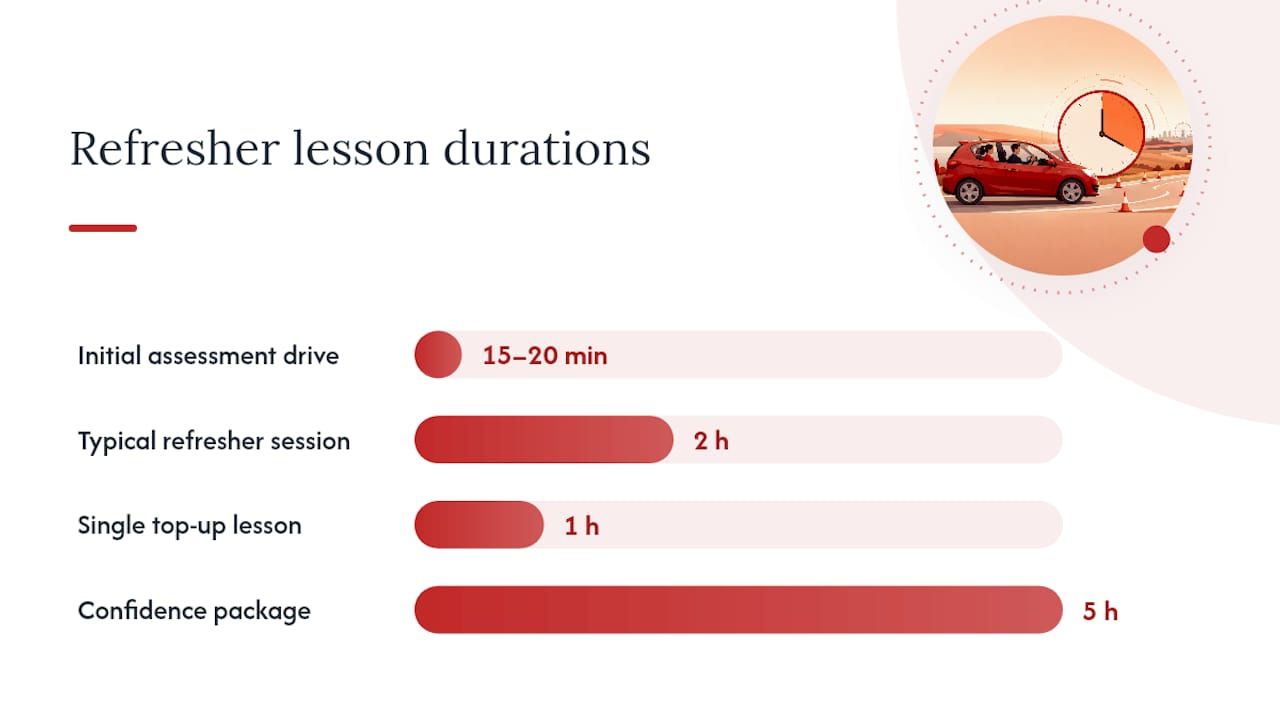
Refresher lessons aren't a repeat of your original driving course. Nobody's teaching you the biting point again unless you genuinely need it. Instead, most sessions begin with a short assessment drive, usually 15 to 20 minutes, where the instructor watches how you handle junctions, speed changes and general observation before deciding where to spend the rest of the lesson.
From there, time gets targeted at whatever needs it most:
- Motorway driving: joining slip roads, lane discipline, and maintaining speed in fast moving traffic.
- Parking and manoeuvres: parallel parking, bay parking and reversing around corners, often the first skills to rust.
- Roundabouts and complex junctions: especially multi-lane roundabouts, which have multiplied in many UK towns since some drivers last took a test.
- Hazard perception: reading developing situations early rather than reacting late.
- Adapting to newer vehicles: clutch behaviour, regenerative braking in EVs, and touchscreen controls that didn't exist on older models.
Formats vary. IAM RoadSmart's Driving Skills Refresher runs as a two-hour session built around personalised feedback and a certificate at the end, while gov.uk's Pass Plus scheme structures its guidance around short, practical modules with written feedback rather than a pass or fail outcome. Other providers offer single hour top-up lessons or five hour confidence packages spread across a fortnight.
Pro Tip: Ask your instructor to pace the lesson around confidence, not correctness. A refresher isn't a test, so there's no reason to feel rushed through manoeuvres before you're ready to move on.
How many lessons and what will it cost?
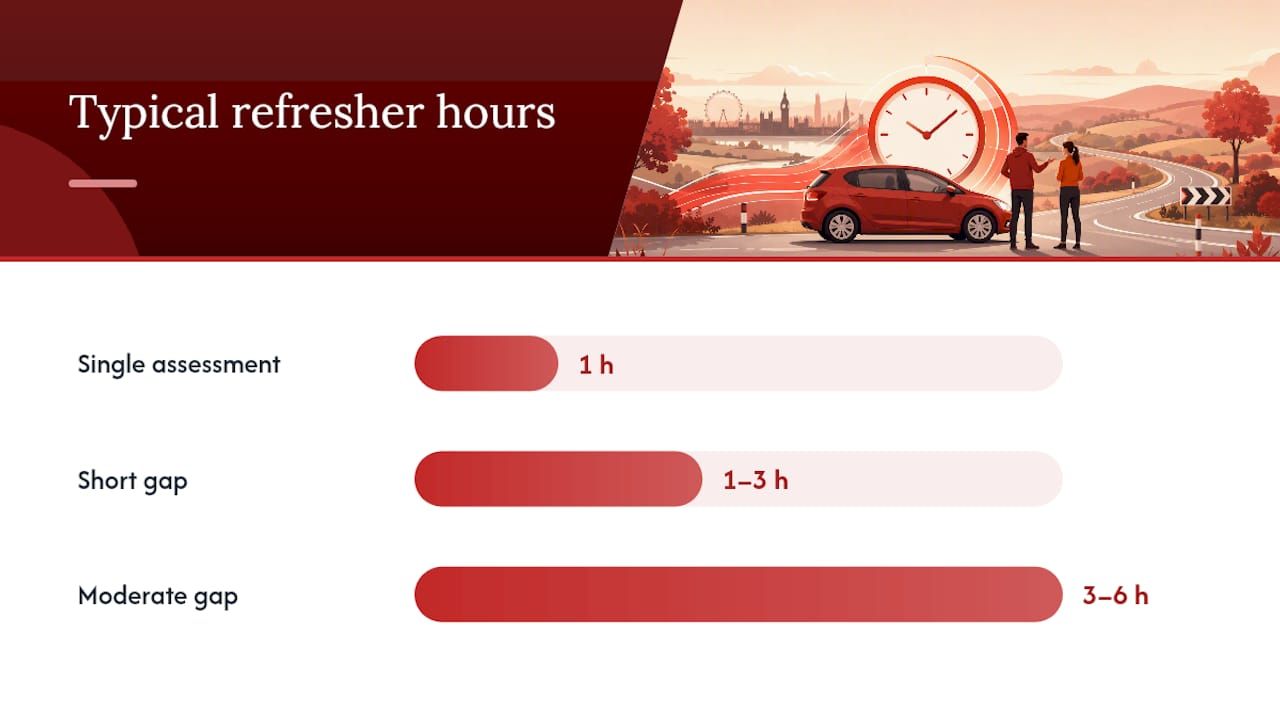
Most returning drivers need far fewer hours than a learner starting from scratch, and pricing tends to reflect that. A local driving guide covering the Luton area for example, reports typical ranges of 1 to 3 lessons for shorter gaps and 3 to 6 for moderate ones, which lines up with what instructors across Essex and Suffolk generally see too.
Manual lessons with Costello's Driving School run at £37 to £38 per hour, with automatic lessons priced at £42 per hour. Beyond single sessions, pricing tends to fall into a few shapes:
- Single assessment lesson: the cheapest way to find out exactly what you need before committing further.
- Short packages: a handful of hours bundled together, often at a slight discount over paying per lesson.
- Block bookings: better value per hour for drivers who know upfront they'll need five or six sessions.
Prices shift regionally, and city centre lessons in places with heavier traffic can run higher than quieter market towns. A reasonable refresher package should include clear feedback after each session and flexibility to add or drop hours if your assessment turns out to be off. Be wary of anyone quoting a fixed high number of hours before they've even watched you drive. Starting with a single assessment lesson is the most cost-efficient route, since it tells you precisely where the gaps are rather than guessing.
How to choose the right instructor for a refresher course
Not every instructor is equally suited to refresher work. Someone who spends most of their week coaching 17-year-olds through their first three point turn may not have the same feel for rebuilding a 45-year-old's motorway confidence after a decade away from the wheel.
- Confirm ADI status. Every instructor should be DVSA-approved, and it's fair to ask how much refresher specific experience they have alongside standard learner tuition.
- Check the vehicle matches your needs. A dual-controlled car is standard, but make sure it's the right transmission, manual, automatic or EV, since practising in an unfamiliar car adds an extra layer of difficulty you don't need.
- Ask how the lesson is structured. A good instructor will explain their assessment process upfront and tell you what kind of feedback you'll get, written, verbal, or both.
- Watch for red flags. Pressure to buy a large block of lessons before any assessment, vague pricing, or reluctance to explain their approach are all reasons to look elsewhere.
- Ask about local knowledge. An instructor who knows your area's tricky junctions and school run traffic patterns will target practice more effectively than one working from a generic script.
Pro Tip: When you call to book, ask what happens if the first lesson shows you need fewer hours than expected. A trustworthy school will happily adjust the plan rather than lock you into a package you don't need.
Getting ready for your first lesson back
Before your lesson, check three things: your photocard licence hasn't expired, your eyesight still meets the DVSA standard, and your own car's insurance is sorted if you plan to practise between sessions. If you've been off the road for years, it's worth telling your insurer about the gap, since some policies have questions about regular use that a long absence can affect.
On the day, expect the same rhythm most refresher courses follow:
- A short initial assessment to identify your actual skill gaps.
- Phased practice, starting with quieter roads before building up to trickier conditions.
- Instructor feedback at the end of each session, often followed by a simple plan for what to work on next.
- Short, regular top-up drives between lessons if you have access to a car, since little and often beats one long session.
Don't attempt a busy motorway alone the first time you're back behind the wheel. Save that for a lesson with an instructor who can talk you through lane positioning in real time.
Insurance and the legal basics for returning drivers
Your full UK driving licence doesn't expire through inactivity, so there's no legal requirement to retake any test or "requalify" after time away. Refresher lessons exist to rebuild currency and confidence, not to satisfy a licensing rule.
Insurance is a separate matter. If your policy asks about regular use or annual mileage, a long gap since you last drove is worth disclosing, and it's sensible to ask your insurer directly whether refresher training affects your premium. Some insurers view documented refresher lessons as a sign of a responsible, low-risk driver, which occasionally translates into a better quote or fewer conditions attached. Keep any certificate or written confirmation from your lessons and mention it when you're shopping around for cover. It costs nothing to ask, and it can only help your case.
Why Costello's Driving School backs refresher lessons
Over 25 years of teaching learners and returning drivers across Essex and Suffolk has shown one thing clearly: confidence returns faster than most people expect, but only when the practice is structured. We've watched drivers arrive convinced they'd forgotten everything, then relax within a single session once they realise the fundamentals never actually left them.
Every instructor at Costello's Driving School is DVSA-approved, and our modern dual-controlled vehicles mean returning drivers practise in cars that behave predictably, which matters when you're already feeling rusty. Our approach starts the same way for every refresher client: an honest assessment drive, a plan built around whatever that assessment reveals, and direct feedback after every lesson rather than vague reassurance.
Most people who come to us for refresher training fall into a few groups: parents returning after years of school runs by bus, drivers who've relocated to busier roads, and people shaken by a minor incident who just need to rebuild trust in their own judgement. The realistic outcome for most is a handful of lessons, not a lengthy course.
— Dean
Book a refresher lesson with Costello's Driving School
Costello's Driving School gives returning drivers a direct route back to confidence, without the guesswork of trying to work out what you've forgotten on your own. We offer refresher training alongside standard manual and automatic lessons, and our block booking options suit drivers who'd rather commit to a short course once they know what they need.
If you're unsure how many hours to book, start with a single assessment lesson and let your instructor guide the plan from there. Weekend and evening slots are available for anyone juggling work or family commitments around lessons. Manual lessons run at £37 to £38 per hour and automatic at £42 per hour, with friendly, DVSA-approved instructors covering Essex, Suffolk and East London. Get in touch to book your first refresher session and find out exactly where your driving stands today.
Sources
For official guidance on refresher-style tuition, see gov.uk's Pass Plus scheme and the DVSA, which sets UK instructor standards. IAM RoadSmart's Driving Skills Refresher outlines a widely used two-hour format, and DriveGate's refresher guide offers practical UK lesson-count and pricing context.
FAQ
Do I need refresher driving lessons?
You don't legally need them, since a full UK licence stays valid regardless of how long you've been off the road. Most people benefit from refresher lessons if they've had a gap of a year or more, felt shaken after an incident, or feel uneasy about motorways and busy junctions.
When should I do a refresher course?
Book one as soon as you notice hesitation creeping into everyday driving decisions, rather than waiting until a specific trip forces the issue. Drivers returning after 1 to 5 years away typically need 3 to 6 lessons, so earlier planning gives more flexibility around timing and cost.
How many lessons does a refresher course take?
It depends heavily on how long you've been away from driving. Shorter gaps under a year often need just 1 to 3 lessons, while gaps of 5 years or more usually call for a structured package rather than a single session.
Is it worth becoming a driving instructor in the UK?
That's a separate decision from taking refresher lessons, but it's worth knowing Costello's Driving School also runs DVSA-approved instructor training for people considering a career change. Anyone weighing it up should look closely at DVSA qualification requirements before committing time and money to the process.
What does a refresher lesson with Costello's Driving School cost?
Refresher training pricing isn't published separately, but standard lessons run at £37 to £38 per hour for manual and £42 per hour for automatic. Block booking options are available for anyone who prefers to commit to a short course once their assessment lesson confirms how many hours they'll need.
Recommended