Avoid winter skids: winter driving lessons for UK learners
Avoid winter skids: winter driving lessons for UK learners
Yes. Supervised winter driving lessons are worth booking for learners and refresher drivers because they turn a genuinely dangerous set of conditions into a controlled teaching opportunity, coached step by step rather than faced alone for the first time after passing. The main payoff is confidence: knowing how a car behaves when grip drops away, and how to respond without panic. If a test gets cancelled by weather, the DVSA reschedules it free of charge, so there's little to lose by learning through winter rather than avoiding it.
Key Points:
- Winter driving lessons help learners gain confidence by practicing car control and road reading on icy or snowy surfaces, reducing panic in real conditions.
- Lessons focus on smooth inputs, higher gears at lower speeds, and staged progression from quiet roads to busier, more challenging routes.
- Proper vehicle preparation and arriving early for lessons are crucial, with specific emphasis on clearing ice, checking tires, and packing essential winter gear.
- Ice can double or even tenfold the stopping distance, making cautious braking, increased following gaps, and avoidance of sudden maneuvers essential for safety.
- Flexible scheduling, instructor experience with winter conditions, and clear cancellation policies are key factors when choosing a winter driving course.
Table of Contents
- What winter driving lessons teach you
- What actually happens in a winter driving lesson
- Getting yourself and the car ready for a winter lesson
- The stopping-distance fact every learner needs to know
- Choosing the right winter lesson or package
- How long does a winter driving lesson actually take?
- Cancellation and refund policies for winter lessons
- Building confidence step by step
- What winter driving lessons typically cost
- Booking, rescheduling, and what happens if your test gets cancelled
- Why I recommend staged winter teaching every time
- Book winter driving lessons with confidence
- Sources
- FAQ
What winter driving lessons teach you
A winter lesson isn't a different curriculum bolted onto normal driving tuition. It's the same skills, practised more deliberately, with far less margin for error.
Instructors slow everything down. Every input, whether that's braking, accelerating, or turning the wheel, gets softened, because sudden movements are what cause a car to lose grip in the first place. You'll also spend time in higher gears at lower speeds than feels natural, since this reduces the chance of wheelspin on compacted snow or black ice.
A significant part of a winter lesson is learning to read the road rather than just drive it. That means:
- Noticing when tyre noise drops away, often the first sign you've hit an icy patch
- Feeling for a lighter, vaguer response through the steering
- Using dipped headlights and fog lights appropriately, rather than leaving full beam on or forgetting lights altogether in daytime murk
- Keeping demisters and wipers working continuously rather than clearing the windscreen once and hoping
Lessons build progressively. You'll start with these techniques on quiet, low-traffic roads before an instructor lets you apply them somewhere busier, and only once your inputs are smooth and consistent. Guidance from Ready to Pass backs this staged approach, noting that experience across different weather conditions is a core part of becoming a genuinely safe driver, not an optional extra.
What actually happens in a winter driving lesson
A typical winter session doesn't start with driving at all. It starts with the car.
Your instructor will check the vehicle is properly cleared and demisted before you move, then run through low-speed handling exercises on a quiet stretch of road. Only once you're comfortable with gentle inputs does the lesson progress to varied surfaces, junctions, and roads with a bit more traffic.
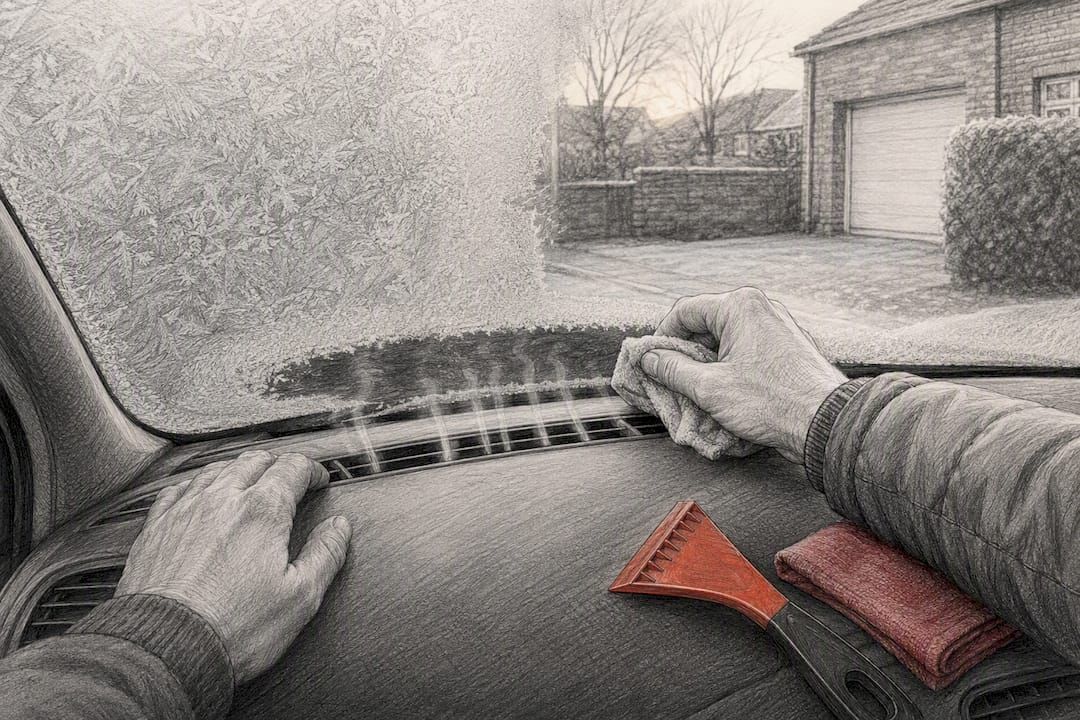
Safety decisions sit with the instructor, not the learner, and that matters more in winter than at any other time of year. If conditions deteriorate mid-lesson, ice forming faster than forecast, fog rolling in, a competent instructor will simply reroute or cut the session short rather than push on. That's a judgement call built on experience, not a script.
A few practical things worth expecting:
- Some lesson time goes on preparation: clearing the windscreen, letting the engine warm, waiting for demisters to clear condensation properly
- Instructors build this into the plan rather than eating into your driving time unannounced
- Dual controlled vehicles mean an instructor can intervene instantly if a manoeuvre goes wrong on a slippery surface, which is a real safety net for nervous learners
Pro Tip: Ask whether your instructor holds current DVSA-approved status and how much winter-specific coaching they actually do each year. Not every instructor teaches through the colder months with the same intensity, and the difference shows in how calmly they talk you through a skid or a patch of black ice.
Some driving schools run modern dual-controlled cars with DVSA-approved instructors and offer flexible scheduling, including weekend lessons and intensive courses, so winter tuition can fit around exam terms, shift patterns, or a tight test date.
Getting yourself and the car ready for a winter lesson
Turning up unprepared wastes lesson time that should be spent driving, not scraping ice off a windscreen while the meter runs; for practical advice, see road salt protection for cars.
- Pack the right kit. An ice scraper, a bottle of de-icer, a torch, warm gloves, and boots with decent grip all earn their place in your bag. A phone charger and a bit of food or a warm drink matter too if you're travelling any distance for the lesson.
- Check the car before you leave home. Tyre tread and pressures matter more in winter than any other season, since worn tyres lose grip fastest on cold, wet tarmac. Confirm lights and number plates are clean and visible, fuel is topped up, and demisters actually clear the glass rather than just fogging it further.
- Clear the whole car, not just the windscreen. Snow left on the roof or bonnet can slide down and block your view under braking, or fly off and hit another vehicle.
- Arrive with time to spare. Give yourself ten to fifteen minutes to clear and warm the car before the lesson officially starts, so you're not cutting into instructor time doing basic prep.
- Do your own pre-drive checks. Seat position, mirrors, and familiarity with the controls take seconds and save your instructor from having to talk you through the basics before the real lesson begins.
The stopping-distance fact every learner needs to know
Stopping distances on ice can run to up to ten times greater than on a dry road. That single figure explains almost everything about how winter driving instruction differs from normal lessons.
The Highway Code's guidance on adverse weather is built around two ideas: leave far more space than feels necessary, and touch every control gently. Specific expectations include:
- Keeping windows, mirrors, and lights completely clear before setting off, not just a porthole scraped in the windscreen
- Recognising when conditions are genuinely too dangerous to drive, and delaying the journey rather than pushing on
- Increasing the gap to the vehicle in front well beyond what feels instinctive
- Avoiding sharp braking, sharp acceleration, or sudden steering at any point on a slippery surface
If a driving test gets cancelled because of bad weather, the DVSA reschedules it at no extra charge, though there's no compensation for other costs tied to that day, so it's worth checking any lesson-provider policy on rebooking around a cancelled test too.
Choosing the right winter lesson or package
Not every learner needs the same thing. Someone six months from their test with steady progress wants something different from a nervous refresher driver who hasn't touched a car since last February.
Start by deciding the format:
- A single refresher lesson to rebuild confidence before winter properly sets in
- A short run of winter-focused lessons layered into your normal course
- An intensive course that folds winter practice into a compressed test-preparation schedule
Then interrogate the provider before booking anything:
- Is the instructor DVSA-approved, and do they specifically teach winter conditions rather than just standard lessons?
- Are the vehicles dual-controlled, giving an instructor the ability to intervene instantly?
- What's the actual policy if a lesson needs rescheduling because of ice, snow, or fog?
- Are block bookings or weekend slots available if your schedule is tight?
Be wary of any instructor pushing you onto busy, gritted A-roads before you can handle a quiet estate road smoothly, or one who's vague about cancellation policy when you ask directly. Costello's Driving School offers Guaranteed Pass packages alongside standard and intensive lessons, which suits learners who want a structured route through winter conditions with a clear endpoint.
How long does a winter driving lesson actually take?
Standard lesson length doesn't change in winter, most run for an hour or two, but how that time gets used does. Expect the first ten to fifteen minutes of any winter session to disappear into vehicle prep: clearing glass, waiting for the demister, letting the engine settle before moving off in cold conditions.
A well-run lesson accounts for this rather than treating it as lost time. Instructors typically use those early minutes for a proper walk-round check and a briefing on what the road conditions are likely to be that day, so nothing is actually wasted.
For learners working towards a test, an intensive course that runs several hours a day over a week or two can absorb winter conditions more comfortably than scattered single lessons, simply because there's more total time to build up staged exposure. A block of hour-long lessons spread over several weeks works just as well for someone with no fixed deadline, since the gap between sessions gives skills time to settle. Either way, don't expect a shorter lesson just because it's cold outside. If anything, winter sessions reward a slightly longer booking, since the early preparation phase eats into pure driving time on a standard one-hour slot more noticeably than on a two-hour one.
Cancellation and refund policies for winter lessons
Weather-related cancellations are common enough in winter that any reputable provider will have a clear policy, and it's worth asking about before you book rather than after a lesson falls through.
Most driving schools reserve the right to cancel or reschedule a lesson if an instructor judges the roads unsafe, black ice, unploughed snow, dense fog, and that decision typically sits with the instructor rather than the learner, since they're the one qualified to assess risk on the day. A genuinely weather-cancelled lesson should be rescheduled without penalty, not treated as a missed booking that forfeits the fee.
The same principle applies to the practical test itself. If the DVSA cancels a test because of bad weather, it's rebooked free of charge, though there's no refund for anything else tied to that day, extra lessons booked around it, travel, or time off work. That's worth factoring into how tightly you schedule a test date against a run of winter lessons: build in a little slack rather than booking your last lesson the morning of the test.
Before committing to a course or block booking, ask specifically what happens if multiple lessons get disrupted by a cold spell. A flexible provider will simply shift the schedule rather than losing you lessons you've already paid for.
Building confidence step by step
Confidence in winter conditions doesn't arrive in one lesson. It builds through repetition, staged carefully so each new challenge sits just beyond what you can already do comfortably.
The starting point is always a quiet road, somewhere with little traffic and no complicated junctions, where you can get a feel for how the car responds when grip is reduced. Only once braking and steering inputs are consistently smooth does an instructor introduce busier roads, roundabouts, or faster-moving traffic. Rushing that sequence is the single biggest mistake in winter tuition. A learner pushed onto a gritted dual carriageway before they can handle a residential street in the wet is being set up to freeze at the wheel, not to learn.
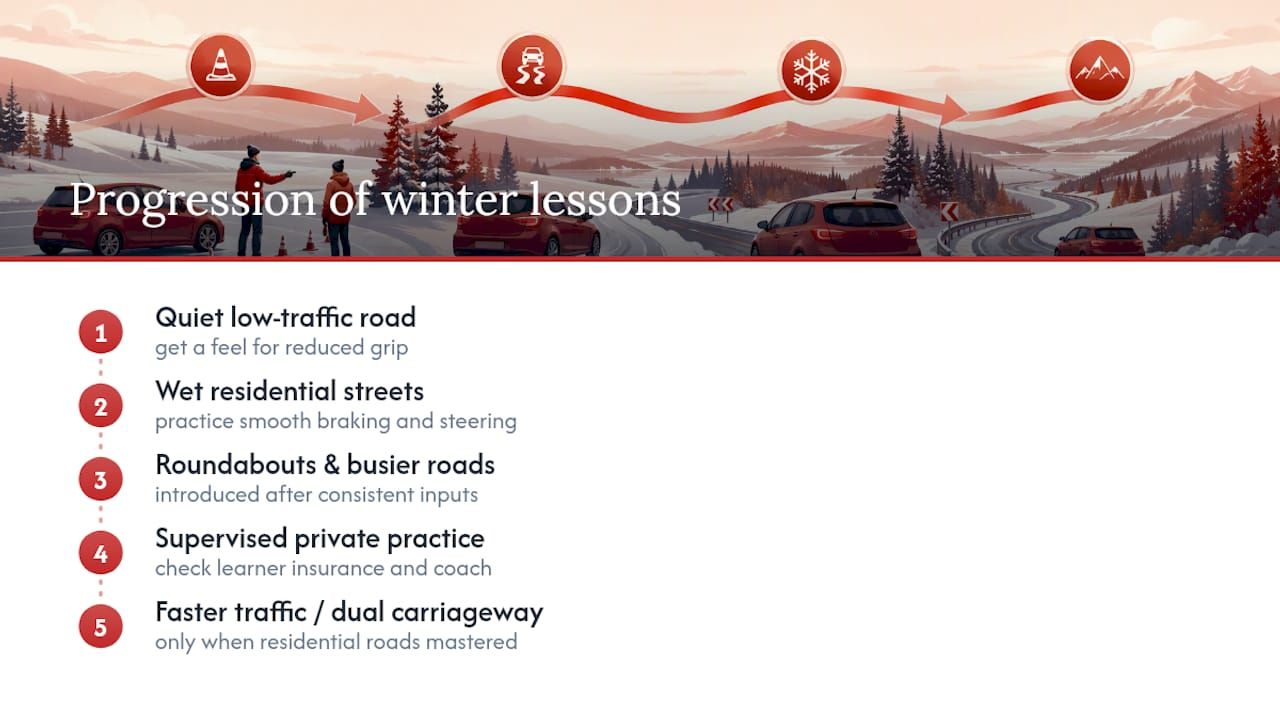
Supervised private practice between lessons helps too, provided the supervising driver is genuinely comfortable coaching someone through poor conditions rather than just sitting in the passenger seat. If you're considering extra practice outside your booked lessons, it's worth checking the insurance requirements for learner drivers first, since cover terms can vary depending on whose car you're using.
Small wins matter here. Successfully controlling a minor skid at low speed on a closed, quiet road teaches more than a dozen lessons of avoiding the subject entirely.
What winter driving lessons typically cost
Winter lessons aren't usually priced differently from standard lessons; the hourly or per-session rate tends to stay the same, since the skill level being taught doesn't fundamentally change, only the conditions do.
Where cost varies is in format. A single one-off lesson costs more per hour than lessons bought as a block, and most schools offer a discount for booking several sessions upfront rather than paying week by week. Intensive courses that compress a full programme, including winter-specific practice, into a matter of days or a couple of weeks are priced as a package rather than per hour, and that total tends to reflect the number of hours booked plus the test itself where it's bundled in.
Guaranteed Pass packages sit at a different price point again, since they typically include a structured number of lessons plus a commitment around retests if the first attempt doesn't succeed. That structure suits learners who want cost certainty over a winter period when lessons are more likely to need rescheduling.
Whatever the format, ask directly what's included: is the test fee separate, does the price cover a fixed number of hours or a fixed outcome, and what happens financially if bad weather forces a reschedule. A transparent answer to that last question is one of the clearest signs of a well-run school.
Booking, rescheduling, and what happens if your test gets cancelled
Booking a winter lesson works the same way as booking any other lesson: pick a slot, confirm the instructor and vehicle, and turn up prepared. The difference is flexibility matters more between November and March than at any other point in the year.
Look for a provider offering weekend slots as well as weekday ones, since winter daylight is short and after-work lessons in the dark carry their own challenges for a brand-new learner. Ask, too, how far in advance you need to reschedule if a lesson clashes with something else, and whether last-minute weather cancellations, initiated by the instructor rather than you, count against any cancellation notice period.
The DVSA's own policy is the model worth knowing before you sit your test. If your test is cancelled because conditions are too dangerous, it's rebooked at no extra charge, and DVSA guidance makes clear there's no compensation owed for the disruption itself. A well-run driving school mirrors that fairness in how it treats weather-cancelled lessons, rescheduling rather than penalising you for something outside your control.
Some driving schools offer flexible scheduling, including weekend lessons and intensive booking options, which gives some room to manoeuvre if a cold snap disrupts a run of planned sessions.
Why I recommend staged winter teaching every time
Staged exposure on quiet roads builds real capability faster than avoiding winter practice altogether. I'd argue the opposite approach, telling a nervous learner to simply "wait until spring", does them no favours: it just delays the first encounter with ice or fog until they're driving alone, with no instructor and no dual controls to fall back on.
Practising with an instructor now means that first skid, that first patch of black ice, happens under supervision rather than on a solo commute six months after passing. DVSA-linked guidance on winter driving backs this: supervised practice in adverse conditions consistently outperforms unprepared exposure once someone's driving independently. Most learners I've watched go through this process arrive dreading winter lessons and leave asking why they didn't start sooner.
— Dean
Book winter driving lessons with confidence
Choosing a driving school that provides an instructor familiar with your driving, in a dual-controlled car set up for this kind of coaching, with the flexibility to reschedule around a cold snap rather than losing a lesson entirely, can offer advantages over one-off or last-minute winter bookings.
You can book manual or automatic lessons, weekend slots, or an intensive course that folds winter practice into a compressed timetable ahead of a test date. If you'd rather have cost and outcome settled upfront, the Guaranteed Pass course bundles structured lessons with a clear plan for retests. Check availability and book your first lesson through the driving lessons page, and get winter conditions covered before you're facing them without an instructor beside you.
Sources
For the rules behind the advice in this article, the Highway Code's guidance on adverse weather and DVSA's test cancellation policy are worth reading directly. RoSPA's winter driving guidance covers broader vehicle preparation and journey planning.
- Gov
FAQ
Do I need extra lessons specifically for winter?
Not necessarily a separate course, but adding winter-focused sessions or a refresher lesson before the coldest months gives you supervised practice with skills like gentle braking and reading low-grip surfaces.
What happens if my lesson or test is cancelled for bad weather?
A weather-cancelled driving test is rescheduled free of charge by the DVSA; most driving schools apply a similar no-penalty policy to lessons cancelled by an instructor for safety reasons.
Can I practise privately in winter as a learner?
Yes, provided your supervising driver meets legal requirements and you've checked your learner insurance cover, though private practice works best alongside, not instead of, instructor-led lessons.
What should I bring to a winter driving lesson?
Pack an ice scraper, de-icer, warm clothing, sturdy boots, and a charged phone, and arrive early enough to help clear the car before the lesson starts.
How many winter lessons do I actually need?
There's no fixed number; it depends on your existing confidence and how much winter driving you're likely to face, though most learners benefit from at least a handful of sessions to practise staged exposure to slippery and low-visibility roads.
Recommended