Pass the UK automatic driving test: DVSA checklist, instructor drills
Pass the UK automatic driving test: DVSA checklist, instructor drills
Yes, you can take your practical driving test in an automatic car, and doing so gives you a full category B licence with an automatic-only restriction, known as code 78. The test itself follows the same DVSA format as the manual version: eyesight check, vehicle safety questions, general driving, independent driving, and a reversing manoeuvre, lasting roughly between 35 and 40 minutes. You'll need a theory test pass before booking, and practical test fees apply, typically between £62 and £75 depending on timing and day.
Key Points:
- Automatic driving test assessments focus on the same skills as manual tests, including observation, junction handling, and safety awareness.
- A full category B licence is granted after passing, but with restriction code 78 limiting drivers to automatic and semi-automatic vehicles.
- Upgrading to manual later requires only a practical test with six to ten hours of tuition, without retaking the theory test.
- Bookings must be made after passing the theory test and vehicle requirements include display of L plates and valid insurance.
- The test duration typically lasts 38 to 40 minutes, with specific attention needed for independent driving and reversing manoeuvres.
Table of Contents
- What the automatic driving test actually assesses
- What code 78 means and how to upgrade to manual later
- Booking, fees and vehicle checks for the automatic test
- What actually happens on test day, step by step
- Preparing to pass: an instructor's plan and practical drills
- When the automatic test is genuinely the smarter choice
- Ready to book your automatic driving test?
- Sources
- FAQ
What the automatic driving test actually assesses
The examiner marking your automatic driving test uk candidacy is looking at exactly the same skills as they would for a manual candidate, just without any clutch or gear-change judgement to worry about. That distinction shapes how instructors prepare learners, but it doesn't change what gets marked.
The test opens with an eyesight check. You'll need to read a number plate from 20 metres; fail this and the test stops immediately, before you've even started the engine. Bring your glasses or contact lenses if you use them for driving.
Next come two vehicle safety questions, the "show me, tell me" section. One question is asked before you move off (a "tell me" question, such as explaining how you'd check your brakes work), and the other while driving (a "show me" question, like operating the heated rear windscreen). Getting comfortable with the full question bank in advance removes one of the easiest sources of nerves on the day.
From there, the examiner assesses:
- General driving ability across normal roads, judging observation, speed for conditions, road positioning, and how you handle junctions and roundabouts.
- Independent driving , usually about 20 minutes, where you follow either sat-nav directions or a series of traffic signs with minimal input from the examiner.
- A reversing manoeuvre , chosen from the DVSA's standard set, such as parallel parking, bay parking, or pulling up on the right and reversing back.
The independent driving section trips up more automatic candidates than any other part, mostly because learners over-rely on the examiner for reassurance rather than trusting their own route-reading.
What code 78 means and how to upgrade to manual later
Passing your test in an automatic gets you a full category B licence, but with restriction code 78 printed on it, meaning you can only legally drive automatic vehicles. That includes fully automatic gearboxes, most electric vehicles, and many semi-automatic or pre-selector systems, as confirmed in DVSA examiner guidance on vehicle types. If you're eyeing an EV as your long-term car, code 78 is unlikely to ever hold you back.
Driving a manual car on a code 78 licence is a genuine legal problem, not a technicality. It counts as driving otherwise than in accordance with your licence, and it can invalidate your insurance entirely if something goes wrong.
Upgrading later is straightforward but not instant:
- You do not need to retake your theory test; the upgrade only requires a fresh practical test in a manual car.
- Most learners who upgrade need somewhere in the region of six to ten hours of focused manual tuition, though this varies with how much clutch experience you've had before.
- You book the upgrade practical test the same way as any other practical test, though some booking situations for upgrades are handled by phone rather than online.
Pro Tip: If there's any chance you'll need to drive a manual hire car abroad, for work, or as a family runaround in the next few years, factor those six to ten upgrade hours into your decision now rather than after you've already passed automatic-only.
Weigh this against your actual life: commuting in an automatic company car, running errands in a family EV, or learning to drive with less stress all point towards automatic. Needing to drive a works van, hire cars on holiday, or an older relative's manual runabout points the other way.
Booking, fees and vehicle checks for the automatic test
Booking follows a fixed sequence, and skipping a step is the most common reason learners get delayed.
- Pass your theory test first. You cannot book a practical test without a valid theory pass, and the theory test itself costs £23.
- Book online through GOV.UK for a standard test; phone booking is generally reserved for exceptional cases, including some licence upgrade bookings.
- Pay the practical test fee , which sits between £62 and £75 depending on the day and time slot you choose, weekday daytime slots sit at the lower end, evenings and weekends cost more.
- Confirm your vehicle meets requirements : it must display L plates front and rear, carry valid insurance that covers use for a driving test, and be roadworthy with no warning lights showing.
- Decide whose car you're using. Most learners test in their instructor's dual-controlled automatic, which the examiner already knows is compliant; using your own car means confirming insurance and mechanical condition the day before, not the morning of.
What actually happens on test day, step by step
Knowing the running order takes a surprising amount of pressure off. Here's roughly how it unfolds.
You arrive around 10 minutes early with your provisional licence and theory test pass certificate reference. The examiner checks your ID against DVSA's system before anything else happens.
Once inside the vehicle, the eyesight check comes first, followed by one "tell me" safety question before you move off. The second, "show me", question comes once you're driving. The examiner then guides you through general driving on a mix of road types for a good portion of the test, watching for the same faults every time: missed mirror checks, hesitation at junctions, poor positioning, and speed that doesn't match the road.
Independent driving follows, about 20 minutes of either sat-nav navigation or sign-following, according to GOV.UK's guidance on the test structure. Getting briefly off-route here isn't a fault in itself; what matters is how safely you correct.
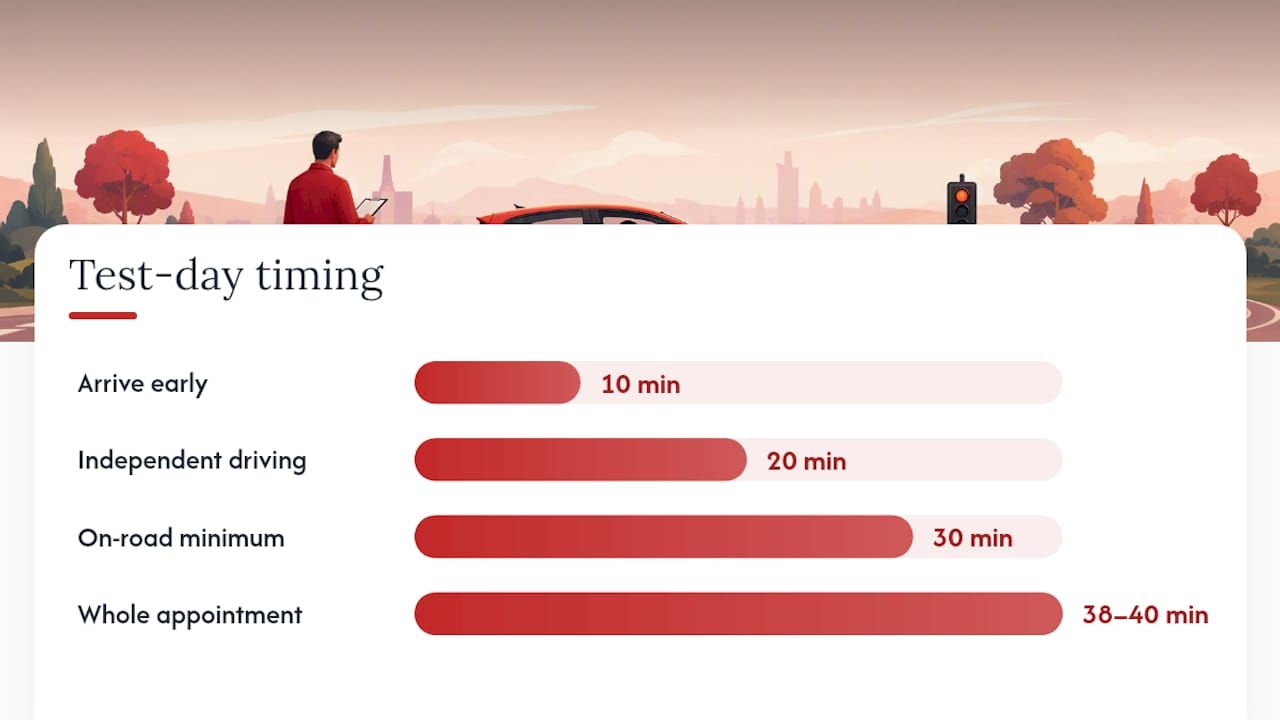
Your reversing manoeuvre happens at some point during the drive, and the overall time on the road runs to a minimum of 30 minutes for category B, with the whole appointment lasting closer to 38 to 40 minutes once you include vehicle checks and paperwork.
Faults fall into three categories:
- Minor faults (previously "driving faults"): up to 15 are allowed before you fail.
- Serious or dangerous faults : even one means an automatic fail.
- The result is logged on a digital test report and delivered verbally at the end, with the DVLA notified automatically once you've passed.
Preparing to pass: an instructor's plan and practical drills
A structured lesson plan beats ad hoc practice every time, and this is where instructor experience earns its keep. At Costello's Driving School, automatic learners typically work through a plan built around four pillars: junction and observation drills early on, sat-nav route practice once basic control is solid, reversing manoeuvre repetition until it's automatic rather than memorised, and at least one full mock test under exam conditions before the real thing.
Removing clutch control from the equation genuinely does speed up early progress for a lot of learners; instructors regularly see nervous drivers reach test-ready standard faster in an automatic simply because there's one less thing to think about at every junction. That doesn't mean automatic is "easier" in some overall sense, it just redistributes where the learning effort goes, towards observation, positioning and decision-making rather than mechanical coordination.
A typical automatic learner benefits from:
- Focused sessions on sat-nav independent driving, since this is where candidates lose the most confidence.
- Repeated practice of whichever reversing manoeuvre suits their local test centre's typical routes.
- At least one exam-style mock test, run to the real timing and marking criteria, close to the test date.
- A realistic look at how many lessons their pace of progress actually needs, rather than a fixed number decided in advance.
Pro Tip: Book your mock test for the same time of day as your real one wherever possible. Traffic patterns, light levels and even your own energy levels differ between an 8am slot and a 4pm one.
Guaranteed Pass packages are built around this same principle: tailored pacing with DVSA-approved instructors in modern dual-control automatics, rather than a rigid number of hours applied to every learner regardless of how they're actually progressing. For learners with additional needs, including those learning with ADHD, shorter and more frequent sessions with a consistent instructor tend to outperform longer, less frequent ones, mainly because consistency of feedback matters more than sheer hours logged.
When the automatic test is genuinely the smarter choice
More learners are choosing automatic than at any point I've watched this industry cover, and it isn't just about avoiding stall anxiety. With EVs becoming a bigger share of new cars sold, an automatic-only licence now covers most of what a lot of people will actually drive for the next decade. If your work involves vans, you might hire cars abroad, or your household runs an older manual car, manual still makes more sense. Otherwise, pick automatic, pass sooner, and upgrade later if your circumstances change.
— Dean
Ready to book your automatic driving test?
Compared with going it alone or piecing together lessons from different instructors, learners can benefit from one consistent instructor, a modern dual-control automatic, and a lesson plan built around your actual pace rather than a generic course length. That matters most for nervous learners and anyone juggling work or family commitments around lesson times.
Automatic lessons, exam-style mock tests, and a Guaranteed Pass course are designed specifically to get you test-ready without wasted hours. A mock test session runs to the real DVSA timing and marking standard, so you walk into the actual test having already felt the pressure once. If you're ready to start, book your first automatic driving lesson with a DVSA-approved instructor near you and get a realistic date for your test in front of you.
FAQ
What are the new driving test rules for 2026?
There's no wholesale change to the practical test format; the core structure of eyesight check, safety questions, general driving, independent driving, and a manoeuvre remains as set out on GOV.UK. Always check GOV.UK directly before your test date, since booking systems and waiting times shift more often than the test content itself.
Can I get an automatic-only driving licence in the UK?
Yes. Passing your practical test in an automatic vehicle results in a category B licence carrying restriction code 78, which limits you to automatic and semi-automatic vehicles, including most EVs.
Is it hard to pass an automatic driving test?
The automatic test uses the same pass standard and fault criteria as the manual test, so it isn't inherently harder or easier, though many learners find it less stressful without clutch control to manage. Structured practice, particularly on independent driving and reversing manoeuvres, matters more than which transmission you choose.
How much is an automatic driving test in the UK?
The practical test fee is £62 to £75 depending on the day and time slot, on top of the £23 theory test fee you'll need to have already passed. The transmission type doesn't affect the fee itself.
Recommended