60% of UK road deaths: rural driving tips instructors teach
60% of UK road deaths: rural driving tips instructors teach
On country roads, the single most important rule is to drive at a speed that lets you stop within the distance you can see. Highway Code Rule 154 spells this out directly, and it matters more than most drivers realise: rural roads accounted for 60% of all UK road fatalities in 2025 despite carrying only 45% of traffic. Slow for bends before you reach them, and give cyclists, horse riders and pedestrians far more room than you would on a wide urban road.
Key Points:
- Drivers must always choose a speed that allows them to stop within their visible stopping distance, especially on roads with frequent blind bends and dips.
- Overtaking should only occur when the road ahead is clearly visible and a safe, unobstructed stretch is confirmed long before the maneuver.
- Giving vulnerable road users like horses, cyclists, and pedestrians plenty of space is crucial, especially on narrow rural lanes with no footpaths or cycle lanes.
- When approaching bends, slow down and brake in a straight line before turning, using road features as cues for safe speeds and overtaking decisions.
- Repetition and structured practice with experienced instructors are essential for building confidence in handling narrow lanes, blind bends, and rural passing places safely.
Table of Contents
- Essential rural driving tips at a glance
- Speed, stopping distances and reading the road
- Bends, overtaking and lane discipline
- Single-track roads and passing places etiquette
- Giving space to cyclists, horse riders, pedestrians and livestock
- Night driving and adjusting for bad weather
- Pre-journey vehicle checks for country roads
- Passing tractors and other slow farm vehicles
- Building rural-road confidence through structured practice
- A note on mindset and practice
- How Costello's Driving School builds rural confidence into every lesson
- Sources
- FAQ
Essential rural driving tips at a glance
Before you head out on unfamiliar lanes, run through this checklist. It won't cover every scenario, but it catches the mistakes that cause most rural incidents.
- Treat the speed limit as a ceiling, never a target. A 60mph limit on a single carriageway lane with hedges either side is rarely a safe speed to actually drive at.
- Scan constantly for gateways, driveways, and gaps in hedgerows where a tractor or dog walker might emerge without warning.
- Keep to a road position that gives you the earliest possible view through the next bend, without drifting over the centre line.
- Identify passing places well before you need them, not at the moment you meet an oncoming vehicle.
- Only overtake when you can see the road is clear far enough ahead to complete the manoeuvre and return to your side safely.
- Slow to walking pace for horses and give livestock a wide, patient berth rather than trying to push past.
- Adjust for weather immediately. Wet leaves, standing water, and low winter sun change the game on lanes that have no drainage or lighting.
Pro Tip: If someone's tailgating you on a narrow lane, don't speed up to please them. Find the next safe passing place, indicate, and let them through. One instructor trick worth remembering: a following driver's impatience is their problem to manage, not yours to solve by taking a risk.
Speed, stopping distances and reading the road
"Stop within the distance you can see" sounds simple, but it demands constant judgement. Every hedge, dip, or blind crest hides how far you can actually see, and that visible distance should dictate your speed, not the posted limit.
Practical cues help here. A high hedge line usually means a bend is sharper than it looks. A dip in the road often hides a junction or a parked vehicle just beyond it. Village name signs are a legal cue to slow down, but treat them as a reminder to start braking early, not a line to brake at.
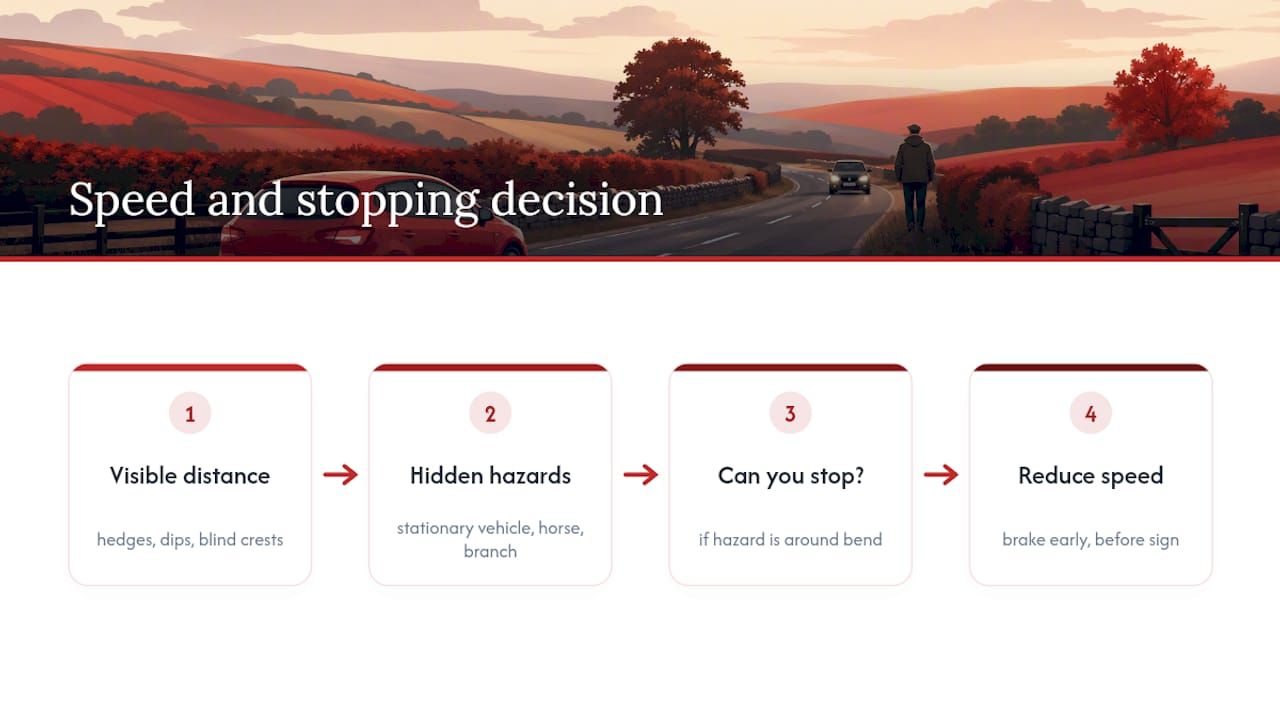
As you approach any bend, ask yourself if you could stop safely if there's a stationary vehicle, a horse, or a fallen branch just around it. If you cannot, you should reduce your speed.
Bends, overtaking and lane discipline
A blind or partially hidden bend deserves a specific technique, not just a slower speed. Brake in a straight line before you turn in, position yourself towards the outside of your lane on the approach (without crossing the centre line), and look for the exit point of the bend as your earliest clue to what's coming.
Overtaking on rural single carriageways is where good judgement really counts. IAM RoadSmart's guidance on country road driving stresses that hazard anticipation matters more than raw reaction speed, and overtaking is the clearest test of that mindset.
- Only pull out if you can see a clear, unobstructed stretch of road well beyond the vehicle you're passing.
- Build in a margin for error. If a tractor could turn into a hidden gateway mid overtake, wait.
- Never commit to an overtake because someone behind you is pushing. Patience costs seconds; a head-on collision costs far more.
- Use dips and brows as an automatic no-overtake zone. You simply cannot see far enough beyond them.
Single-track roads and passing places etiquette
Single-track roads have no centre line and room for only one vehicle at a time, with passing places built in at intervals for vehicles to pull into. Etiquette here isn't written into law in fine detail, but a few conventions keep traffic flowing without conflict.
- Spot passing places early, on either side of the road, and slow down as soon as you see an oncoming vehicle approaching.
- If a passing place is on your left, pull in and stop. If it's on your right, wait opposite it and let the oncoming vehicle use it or pass you.
- Reverse back to the last passing place if you've gone beyond it and the road ahead is blocked, rather than expecting the other driver to do so.
- Wave the other vehicle through with a clear gesture once you've stopped, so there's no confusion about who's going first.
- Never park in a passing place, even briefly. It's the one obstruction that blocks the whole road for everyone behind you.
Giving space to cyclists, horse riders, pedestrians and livestock
Vulnerable road users are far more exposed on country lanes than on urban streets with pavements and cycle lanes. The Highway Code's guidance on road users requiring extra care sets out clear expectations, and rural roads are exactly where they get tested most often.
- Slow to a crawl when passing horses, and never sound your horn or rev your engine. Horses can spook badly at sudden noise.
- Give cyclists at least as much room as you would a small car, passing wide and slowly rather than squeezing by.
- Watch for walkers on roads with no pavement, particularly around bends where they may be forced to step into the carriageway.
- If livestock are blocking the road, stop completely and wait. Don't try to nudge through a flock of sheep or a herd of cattle.
Pro Tip: Treat every hedge-lined bend as if there's a horse rider just out of sight. It costs you nothing to slow down for a bend that turns out to be empty, but it costs everything if you get it wrong.
Night driving and adjusting for bad weather
Rural lanes have no street lighting, no cat's eyes in many stretches, and hazards that appear from nowhere in your headlights. Full beam should be your default on unlit lanes, but dip immediately for oncoming traffic and well before you crest a hill where your lights would dazzle drivers coming the other way.
- Drop your speed further in rain, ice or fog than you would on a main road, since surface water pools on uneven rural tarmac.
- Increase your following distance significantly. Grip is less predictable on lanes without proper drainage or camber.
- Download offline maps for areas with poor signal, since satnav routing can send you down unsuitable tracks in mobile blackspots.
- Tell someone your route if you're driving remote lanes after dark, particularly in winter. For more detail, see this guide to night driving on UK roads.
Pre-journey vehicle checks for country roads
A breakdown on a busy motorway is inconvenient. A breakdown on an unlit single-track lane with no verge to pull onto is genuinely dangerous. A few minutes before you set off catches most preventable problems.
- Check tyre tread and pressure. Rural roads chew through tyres faster thanks to loose stone, potholes and unswept verges.
- Test lights, including fog lights, since unlit lanes rely entirely on your own visibility.
- Confirm your brakes feel firm and responsive before you're relying on them for a sudden stop behind a tractor.
Pro Tip: If you've driven through standing water or thick mud, test your brakes gently at low speed before you need them properly, and glance at your wheel arches for lodged stones once you've stopped.
Pack a torch, a hi-vis vest, a blanket and a charged phone. Coverage drops out fast in rural dips and valleys, so don't assume you can call for help the moment something goes wrong.
Passing tractors and other slow farm vehicles
Farm machinery behaves differently to normal traffic, and that's the point to remember. A tractor might swing wide before turning into a narrow gateway, drop mud across the full width of the lane, or stop abruptly to let a farmhand through a gate.
- Hold back and give a longer following distance than you would behind a car. You need time to react if it turns or stops unexpectedly.
- Only overtake if the driver has pulled in to let you pass, or you have a genuinely long, clear stretch of road ahead.
- Watch for indicators on wide farm vehicles. What looks like a vehicle pulling left to let you by can sometimes be the start of a right turn into a field.
- If you meet mud or debris on the road, ease off rather than braking hard. Loose surface material behaves unpredictably under sudden braking.
Building rural-road confidence through structured practice
Confidence on narrow lanes rarely comes from reading rules. It comes from repetition, under supervision, in low-pressure conditions. Driving school instructors build this into lessons through staged drills that isolate one skill at a time.
- Practise approaching a known blind bend at a slow, controlled speed, gradually increasing pace only once the visibility and technique feel automatic.
- Reverse into a passing place under supervision until the manoeuvre stops feeling like a puzzle and starts feeling routine.
- Run a low-speed overtake in a genuinely safe, open stretch of road before attempting one independently.
Learners preparing for tests around Ipswich or Colchester often meet exactly these conditions on their test routes, which is exactly why the drills are worth practising properly rather than rushing through once.
A note on mindset and practice
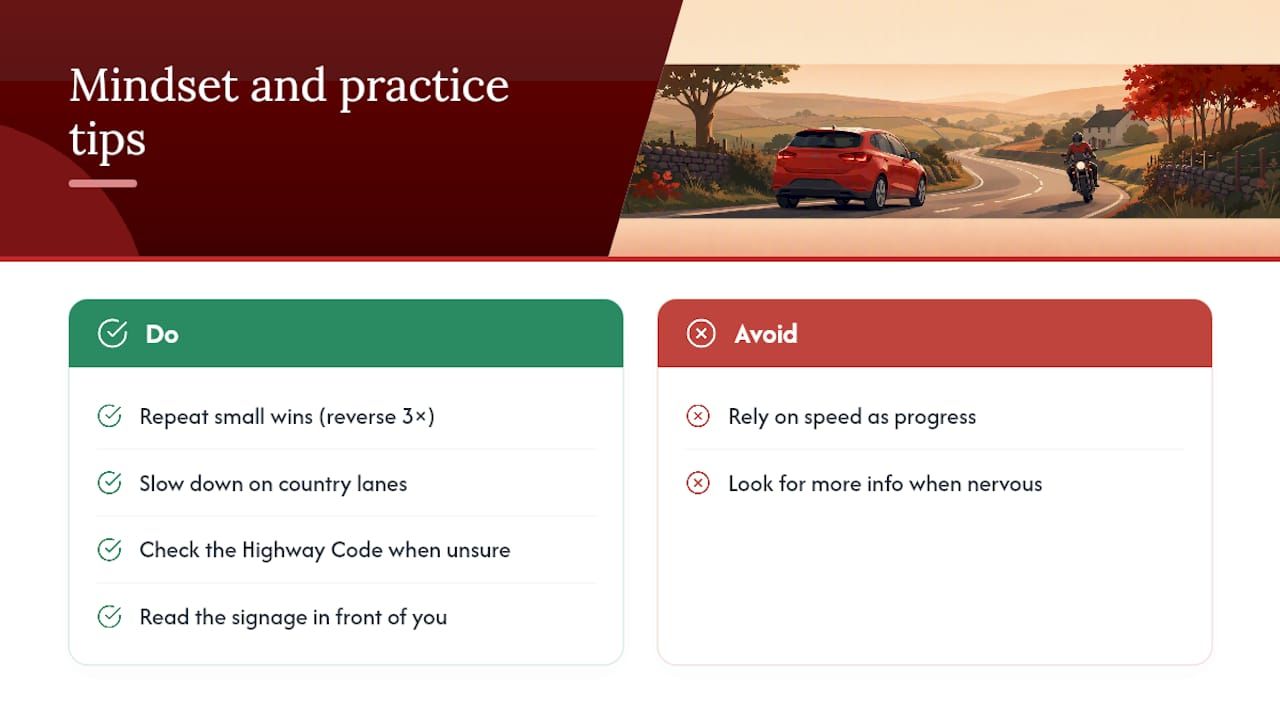
Nervous learners rarely need more information. They need smaller, repeatable wins, like reversing into a passing place three times until it stops feeling like a threat. Speed feels productive, but on a country lane it's almost always the wrong instinct.
Slow down, check the Highway Code when a rule feels unclear, and read the signage in front of you rather than what you expect it to say.
— Dean
How Costello's Driving School builds rural confidence into every lesson
Reading rules is one thing. Sitting behind the wheel on a genuinely narrow lane, with an instructor talking you through your road position in real time, is what actually changes how you drive. A driving school with decades of experience teaches learners in Essex, Suffolk and East London, and rural-route practice is built into standard lessons wherever a learner's local test routes call for it.
A rural-focused lesson typically covers blind bend approaches, controlled reversing into passing places, and low-speed overtake judgement, all with a DVSA-approved instructor talking through your decisions as you make them, not after. Nervous learners get the same patient, dual-controlled setup that's helped build Costello's reputation for high pass rates, and anyone wanting a faster route to test-ready confidence can look at the Guaranteed Pass course alongside standard weekly lessons. If you're ready to put rural driving theory into practice, book a lesson through the Costello's Driving School lessons page and get route-specific practice sorted before your test date.
Sources
FAQ
What are the most important driving tips for UK country roads?
Drive at a speed that lets you stop within the distance you can see, per Highway Code Rule 154, and always give vulnerable road users extra space on lanes with no pavement.
What is the 10% rule in UK driving?
There's no official "10% rule" in the Highway Code; it's an informal idea some drivers use for minor speed tolerance, but it has no legal standing and shouldn't guide your speed on rural lanes where sightlines matter far more than a fixed number.
How should I drive on single-track rural roads?
Slow down as soon as you see an oncoming vehicle, use passing places correctly, and reverse back to the last one if you've gone past it while the road ahead is still blocked.
Why are rural roads more dangerous than motorways?
Rural roads carried 45% of UK traffic in 2025 but accounted for 60% of road fatalities, largely due to blind bends, no lighting, and higher closing speeds between vehicles.
Can driving lessons help with rural road confidence?
Structured lessons with a DVSA-approved instructor, including staged drills like Costello's Driving School uses for blind bends and passing places, build the kind of repeatable confidence that reading guidance alone doesn't provide.
Recommended